Health & Safety
Slip and Fall Prevention for Bay Area Commercial Buildings
January 24, 2026
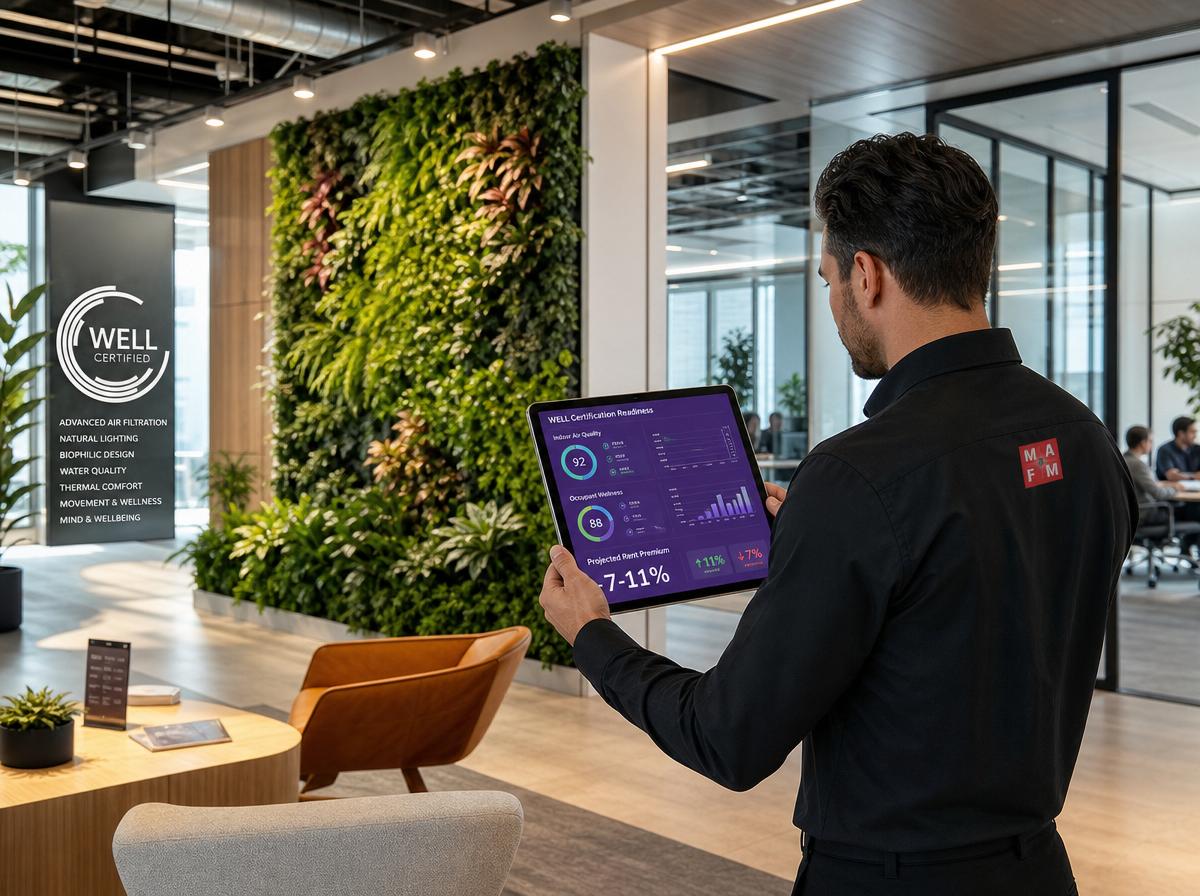
The WELL Building Standard is a health-focused rating system for buildings, and for a facility manager the part that matters most is that much of it is tested and documented in operation, not just drawn on plans. If you run a Silicon Valley office and a tenant, owner or investor asks about WELL, the practical answer is: your air, water, light, comfort and sound readings get measured on site, and your cleaning, pest and maintenance records get reviewed.
That makes WELL a facility operations question as much as a design question. This guide covers how WELL is organized, what gets verified, which operational routines it touches, and where the lighter WELL Performance Rating fits for buildings that cannot be redesigned.
WELL is a standard published by the International WELL Building Institute (IWBI) that organizes health and well-being requirements into ten concepts. According to IWBI's own comparison of WELL v1 and v2, the ten concepts are Air, Water, Nourishment, Light, Movement, Thermal Comfort, Sound, Materials, Mind and Community.
It is often described next to LEED, but the focus differs. LEED is built around environmental performance, while WELL is built around occupant health. The two overlap in places, such as indoor air quality, which is why many teams run them together.
You do not need to be a design professional to engage with it. Most facility managers meet WELL when a landlord, a tenant improvement team or a corporate real estate group asks what the building can document today.
Facility operations influence most of the ten concepts, but five carry the most day to day work. Each one is a place where a good maintenance routine either backs up the design or quietly undoes it.
Light, Thermal Comfort and Sound are performance concepts you can see in the building's own readings, which is why a facility team should treat them as ongoing work, not a one time commissioning event. For the air side in detail, see our guide to office indoor air quality.
WELL verification combines on site testing with documentation review. IWBI describes two types: onsite testing of environmental conditions, and confirmation that design, operational and policy documentation meet expectations.
Testing is done by third parties. IWBI's page says WELL Performance Testing Agents test air quality at locations throughout a space to confirm particulate matter levels fall within the allowed threshold. Its Performance Verification Guidebook (Q2 2023 edition) states that testing "should be conducted under regular project conditions."
That wording is the operational point. The building has to perform on an ordinary working day, with the HVAC running as it normally runs, not only on the day someone is watching. A facility team that has kept filters, coils, drains and controls in order already has the habits that this kind of test rewards.
Buildings can also use permanently installed sensors. The same guidebook says air and thermal comfort parameters are judged on each sensor's data meeting the feature threshold for at least 90% of regularly occupied hours, with at least one calendar month of data for an initial award. It also says air quality sensors must be recalibrated or replaced annually, which belongs on the maintenance calendar.
WELL asks for a written cleaning plan, trained staff and lower hazard products, not just a product swap. The most useful detail comes from USGBC's Detailed Look into WELL v2 Materials Features, which walks through feature X11, Cleaning Products and Protocols.
A WELL cleaning plan under X11 covers operational basics a good janitorial program already runs:
The same document says the training goes to "building management, building operators, and contracted cleaning staff, on an annual basis, and whenever protocols change." It also says the plan must specify cleaning products identified as low hazard or safer by an ISO reference or an approved third-party certification. If your crew already works from certified green products, the work is mostly written protocol and training records. Our post on green cleaning certifications in California explains what those labels cover.
Pest control is the other Materials item. The same USGBC document describes feature X10, Pest Management and Pesticide Use, as requiring an integrated pest management (IPM) strategy covering roles, pest identification, prevention measures, tolerance thresholds, and records of monitoring and applications. It calls for notifying occupants at least 24 hours before a pesticide application and for assessing the plan annually. If you already run IPM, our integrated pest management guide covers the building side.
Renewal is a standing operational duty. The Performance Verification Guidebook states: "WELL Certification is valid for three years and WELL Ratings are valid for one year, at which point projects must undergo recertification or renewal to maintain their certified or rated status."
That changes how you think about records. A building does not pass once and coast. Maintenance logs, filter service dates, water test results and cleaning training records need to stay current the whole time, because the next review looks at what happened in between.
For many existing buildings the WELL Performance Rating is the more realistic starting point. IWBI's Performance Rating page says achieving it requires 21 out of 33 measurable, performance based strategies from the WELL Building Standard. Its focus areas are indoor air quality and thermal conditions, water quality management, light measurements, acoustic performance, environmental monitoring and occupant experience.
IWBI's marketing guidelines describe the criteria as "a subset of relevant features from the WELL Building Standard adapted for facility operations and management." The rating is valid for one year, and enrollment must be renewed annually. IWBI also states that the Rating is distinct from WELL Certification, so a building holding only the Rating should not describe itself as WELL Certified.
Choosing between the two is a business decision for the owner. Ask IWBI for current fees and scope, and ask your owner what a rating or certification would be used for before anyone commits budget.
Start with a gap review of what you can already prove, then close gaps in the order of how cheap and fast they are. A sensible sequence looks like this:
The records point matters most. A team that logs work as it happens turns documentation review into collecting files. A team that does not has to rebuild a year of history from memory.
Silicon Valley adds one practical wrinkle: many buildings have several vendors for HVAC, plumbing, pest control and cleaning, so records live in different places. Naming one coordinator, internally or through a facility management partner, keeps the evidence in one folder. See our San Jose service area if that is your market.
Is WELL required by law in California?
No. WELL is a voluntary standard from a private institute, so no building has to obtain it. Legal requirements such as Cal/OSHA rules apply regardless, and WELL sits on top of them as an optional credential.
What is the difference between WELL Certification and the WELL Performance Rating?
Certification covers a wider scope and is valid for three years. The Performance Rating is a subset of operations focused strategies, valid for one year and renewed annually. IWBI notes the two are distinct designations.
Does WELL testing happen during normal operation?
Yes. IWBI's guidebook says testing should be conducted under regular project conditions, and sensor based verification looks at readings across occupied hours. A building that only performs when prepared for a visit will struggle.
Can a janitorial contractor affect WELL results?
Yes. WELL's cleaning feature requires a written plan, Safety Data Sheets on site, and annual training that includes contracted cleaning staff. Your contractor's products, procedures and training records can become part of what is reviewed.
If WELL is on your radar, the most useful first move is a records and routines review. MAFM is a facilities management company in San Jose that plans and coordinates janitorial, facility and move work, and can line up the cleaning, maintenance and vendor schedules your evidence file depends on. Specialist testing, HVAC and water work stays with qualified vendors, which we coordinate. Talk to us about facility management.
MAFM offers comprehensive facility management solutions tailored to your business needs.
Get in Touch