Facility Maintenance
Commercial HVAC Maintenance for Silicon Valley Offices
February 12, 2026
Integrated pest management for commercial buildings means keeping pests out, removing what feeds and shelters them, watching for early signs and treating only where the evidence calls for it. It is a program with a calendar and a log, not a spray on a schedule.
The US Environmental Protection Agency describes integrated pest management the same way: set action thresholds, monitor and identify pests, use prevention as the first line of control, and choose lower-risk controls first. It also says broadcast spraying of non-specific pesticides is a last resort. For an office building, that translates into a handful of habits that a facility team can run all year.
It is four routines that feed each other, owned by named people and written into the service contracts.
The EPA's "action threshold" idea matters most in a commercial setting. One ant on a windowsill and a trail of ants in a break room call for different responses. Deciding in advance what each finding triggers keeps the team from over-treating small things and ignoring signs of a real problem.
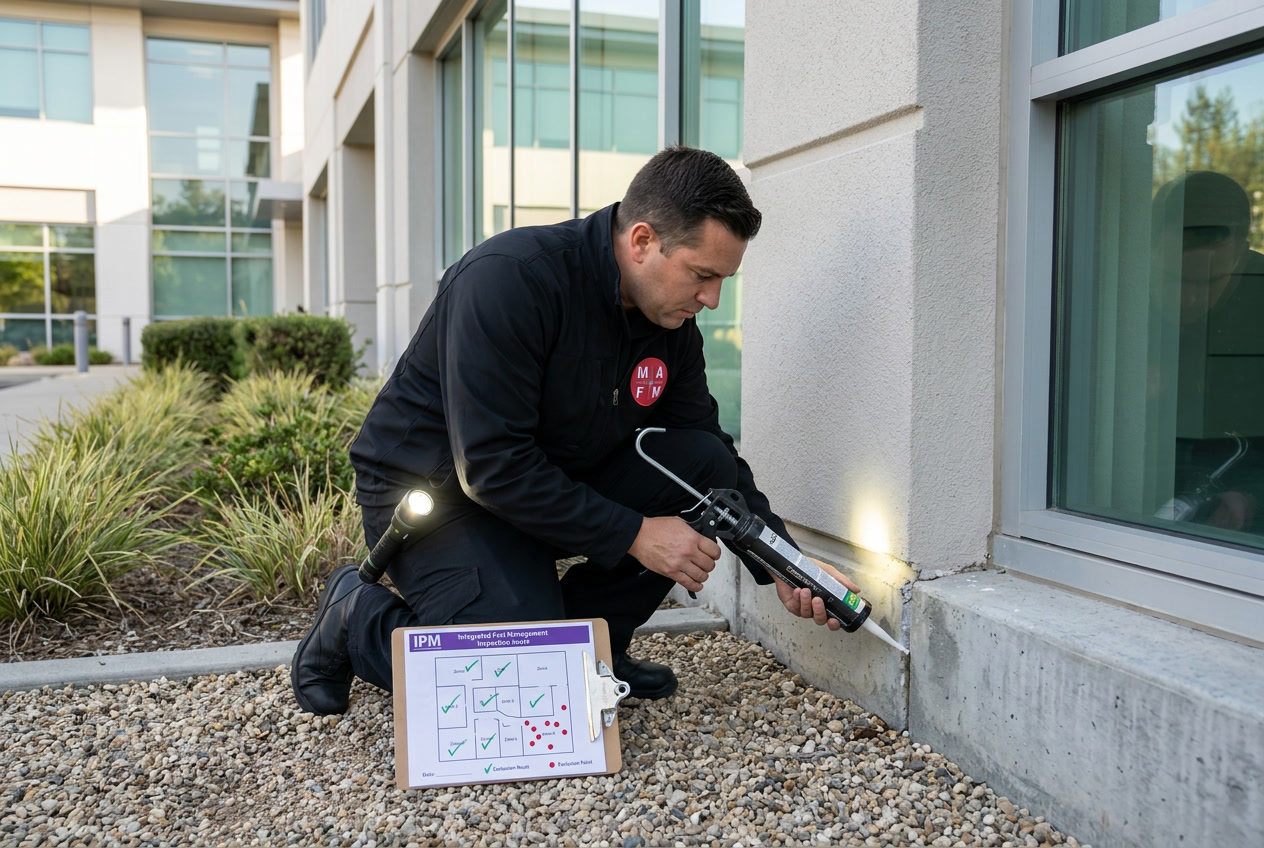
Close the openings, and use materials that pests cannot chew through. The University of California's house mouse Pest Notes (updated July 2025) say to keep mice out of buildings by eliminating all gaps and openings larger than a quarter inch. They also say to seal small cracks with wire screen or coarse steel wool that mice cannot chew through, and to seal openings around water pipes, vents and utility cables with metal or concrete. Plastic screening, rubber, vinyl, expanding foam and wood are listed as ineffective for plugging holes mice use.
That last point catches many buildings out. A bead of foam around a pipe looks finished and does not stop a mouse.
A perimeter walk with a flashlight and a punch list is the right tool. Check:
On that last item, the UC ant guidance advises keeping plants, grass and mulch several inches away from the foundation. The same guidance says to fix leaking faucets and sprinkler heads, since they attract thirsty ants.
See also our post on rodent exclusion work. Sealing work in walls and on roofs is done by qualified trades. A facility management partner builds the punch list, schedules the vendor and checks the work afterward.
Make food hard to reach, keep surfaces dry and clear out places to hide. Pests need food, water and shelter, and most commercial buildings supply all three in the same few rooms.
Break rooms, kitchenettes, vending areas, trash rooms and loading docks deserve the most attention. The UC cockroach guidance says to store food in insect-proof containers such as glass jars or re-sealable plastic containers, and the ant guidance says to use clean, sealed containers instead of plastic bags or open packaging. The cockroach page also says to seal cracks and openings where cockroaches hide or enter.
A practical sanitation routine for a commercial building includes:
This is where the cleaning contract matters. Janitorial scopes often say "break room: daily," and nothing about appliance interiors, drain areas or the floor behind the refrigerator. If those tasks are not on the list, they do not happen. Writing those detail tasks into the janitorial scope makes sanitation a scheduled duty instead of a favor.
Tenants are part of the program too. A short notice about food storage and spill cleanup, and a clear way to report a sighting, make a difference.
Check on a fixed schedule, write down what you find, and act on trends, not on single sightings. Sightings reported by occupants arrive after the fact, so a program that waits for them is always behind.
The UC cockroach guidance says sticky traps or glue boards offer the best way to detect and monitor cockroach populations, and advises checking traps daily for several days until it is clear where the most cockroaches are caught. The mouse guidance says to look for droppings, fresh gnaw marks and tracks, which show where mice are active.
A simple monitoring plan has:
The log is what makes this a program. Counts that rise in the same place every month tell you where to look for the cause, such as a door that does not seal or a drain that stays wet.
Treat when monitoring shows a real and specific problem, and choose targeted methods first. The EPA says to select lower-risk options first, with more targeted pesticide use only if those fail.
For ants and cockroaches, that usually means baits. The UC ant guidance calls baits the only type of insecticide recommended in most situations, and says that when properly used they are more effective and safer than sprays. It also says spraying around the foundation will not provide permanent control. For cockroaches, UC advises applying gel bait in small dabs in cracks and crevices where the insects will find it. Identification comes first: the same guidance notes that winged ants are often mistaken for termites, and the right approach depends on the pest.
Rodents come with legal limits in California. Under the Department of Pesticide Regulation's notices, the use of chlorophacinone and warfarin has been prohibited since January 1, 2025 for prohibited uses, including most industrial and institutional uses. The department's notice on second-generation anticoagulant rodenticides says most uses of those products have been prohibited since January 1, 2021. Exemptions exist for particular users and sites, so your pest control company should be able to tell you which rules apply to your building.
The practical consequence is that exclusion and trapping carry more of the load in California. The UC mouse guidance says to use enough traps to make the trapping period short and decisive, and, if baits are used at all, to place them in tamper-proof bait stations out of reach of children, pets and wildlife.
Pick a licensed company that will work inside your program, and make reporting a contract requirement. Pest control in California is licensed. The Structural Pest Control Board has a "Verify a Company or Licensee" lookup on its website. Use it before you sign.
Write these expectations into the contract:
Reports should be specific enough to guide action. "Routine service completed" tells you nothing.
Licensed pest control professionals apply pesticides and do technical pest work. MAFM does not perform pest control. As a facility management company, we plan and coordinate around it: we keep the pest log and punch lists current, schedule the vendor and give them access, align the cleaning scope with the sanitation plan and follow up on repairs that close entry points.
That coordination is often where programs succeed or fail. A vendor can report a gap under a dock door, but nothing changes unless someone owns the repair and checks it afterward. If you run a building in the South Bay, see how we work on our San Jose page.
What is integrated pest management? It is a way of controlling pests that puts prevention first. The EPA describes four steps: set action thresholds, monitor and identify pests, prevent problems, and use lower-risk controls before more targeted pesticides. Broadcast spraying is treated as a last resort.
How small does a gap have to be to keep mice out? The University of California says to eliminate all gaps and openings larger than a quarter inch. It also says to seal with materials mice cannot chew through, such as wire screen, coarse steel wool, metal or concrete, because foam, plastic, rubber and wood are ineffective.
Can a commercial building in California use rodenticides? Often not. Since 2021, most uses of second-generation anticoagulant rodenticides have been prohibited, and since January 1, 2025 most uses of chlorophacinone and warfarin have been as well, including most industrial and institutional settings. Exemptions are limited, so ask your licensed provider which rules apply.
How often should pest monitors be checked? There is no single schedule that fits every building. UC guidance suggests checking cockroach traps daily for several days to find the problem area, and a routine program checks monitors at every service visit, more often in food areas and docks. What matters is that the checks are on a calendar and recorded.
If pests keep coming back to the same rooms, the cause is usually a gap, a leak or a cleaning task that is not on the list. MAFM can walk the building with you, write the punch list and coordinate the licensed vendors and cleaning crew that carry it out. Talk to us about facility management.
MAFM offers comprehensive facility management solutions tailored to your business needs.
Get in Touch