Facility Maintenance
Commercial HVAC Maintenance for Silicon Valley Offices
February 12, 2026
If you've been following this week's series on late-summer pest prevention, you already know the biology: as temperatures drop in September and October, rodents shift from foraging outdoors to seeking warm, dry harborage, and commercial buildings are exactly what they're looking for. What hasn't been covered yet is the specific, hands-on work required to keep them out, and why the next six weeks are the only realistic window to do it properly.
Exclusion work (sealing gaps, repairing damaged penetrations, and hardening vulnerable points in the building envelope) is fundamentally different from the bait stations and glue boards most facility teams associate with pest control. It's construction-adjacent work: masonry patching, sheet metal fabrication, door sweep replacement, and utility penetration sealing. It requires walking the building's exterior with a flashlight and a notepad, not just servicing interior stations. And in the South Bay's mix of 1980s-era R&D campuses, converted warehouses, and newer mass-timber office buildings, the vulnerable points differ enough that a generic checklist won't cut it.
We've walked hundreds of commercial exteriors across Santa Clara and San Mateo counties, and the pattern is consistent: buildings that get exclusion work done by mid-September see 60-70% fewer interior rodent sightings between November and January compared to buildings that wait until they see the first dropping in a break room. This post covers how to run that audit, what materials actually hold up, and how to document the work so it protects you contractually as well as physically.
Most commercial pest control contracts renew or get reviewed on a calendar basis, often January or the fiscal year start, which has nothing to do with rodent biology. Norway rats and roof rats in the Bay Area begin actively seeking indoor harborage as outdoor temperatures dip below the mid-50s at night, which in Santa Clara County typically starts in late September and accelerates through October. By the time facility teams notice droppings or hear scratching in a drop ceiling, the animals are already established, breeding, and far more expensive to remove than to have excluded.
The six-week window from mid-August to the end of September is when three things line up: weather is still dry enough for exterior masonry and sealant work to cure properly, landscaping crews haven't yet done fall pruning that temporarily displaces rodent populations toward buildings, and pest activity is still low enough that you're doing prevention rather than remediation. Wait until October and you're not sealing an empty building anymore: you may be sealing rodents inside, which creates a worse problem than the one you started with.
This is also the point in the calendar when many Silicon Valley properties are dealing with drought-tolerant landscaping conversions, xeriscaping, and creek-adjacent maintenance: all of which disturb ground cover and push rodent populations toward the nearest structure. If your landscaping contractor is doing any fall bed cleanup or Coyote Creek/Guadalupe River corridor maintenance in September, coordinate your exclusion timeline to happen before or during that work, not after.
An effective exclusion audit is a slow, methodical walk of the entire exterior perimeter, and it takes longer than most facility teams budget for: plan on 3-4 hours for a 50,000 to 100,000 square foot single building, longer for campus configurations with multiple structures and connecting walkways. The auditor should be checking for openings a quarter-inch or larger, since that's the threshold a house mouse can squeeze through; roof rats and Norway rats need closer to a half-inch, but you seal to the smaller pest to cover both.
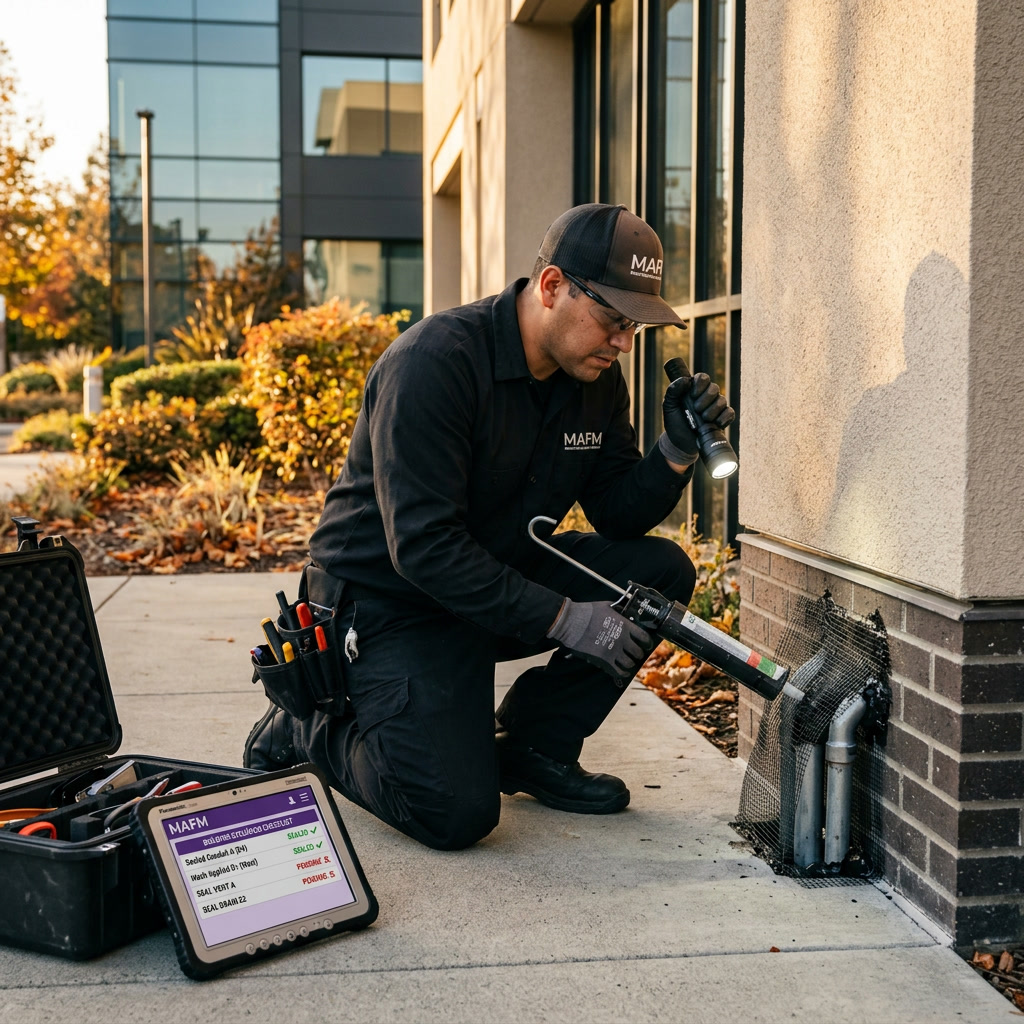
Focus areas that consistently turn up problems: utility penetrations where conduit, gas lines, or data cabling enter the building (especially retrofitted fiber runs added after the original construction), the gap under loading dock doors and dock levelers, roof-to-wall transitions and parapet flashing, HVAC curb penetrations, and expansion joints in tilt-up concrete construction, a common building type across Sunnyvale, Santa Clara, and Milpitas business parks. Weep holes in brick veneer, while necessary for moisture management, are a frequent overlooked entry point and require rodent-resistant weep vents rather than sealing shut.
Document every finding with a photo, a location reference tied to the building's grid or room numbering system, and a gap measurement. This isn't just diligence for its own sake: if a tenant later files a complaint or a lease dispute references pest conditions, a dated audit with photographic evidence is what separates "we have an active prevention program" from "we're now scrambling to explain a rodent sighting in a demo suite."
The material choice matters more than most facility budgets reflect. Expanding foam alone is not a rodent barrier, rodents chew through it in minutes, and yet it's still what a lot of general maintenance staff reach for because it's fast and cheap. The correct approach for most gaps is a layered fill: stainless steel or copper mesh (like Xcluder or comparable products) packed into the void first, followed by a sealant or foam over the top for weatherproofing. The mesh is what actually stops the animal; the foam or caulk is cosmetic and moisture-sealing.
For larger openings, the kind you find at old conduit penetrations or where a previous tenant's contractor cut through a wall for equipment that's since been removed, sheet metal patching with galvanized steel, screwed and sealed rather than just caulked, holds up far better than mortar patches alone, which crack under building settling and give rodents a chewable edge to exploit within a season or two.
Door sweeps deserve specific attention because they're the highest-traffic failure point. Standard vinyl sweeps degrade within 12-18 months of daily use on a loading dock door and leave gaps rodents exploit immediately. Heavy-duty brush or rubber sweeps rated for commercial door cycles cost more upfront, typically $40-90 per door versus $15-20 for standard vinyl, but last three to four times longer and maintain a tighter seal against the threshold. If your property has ADA-compliant door thresholds, coordinate sweep selection with your accessibility compliance requirements; some exclusion products interfere with the maximum threshold height allowances under CBC Chapter 11B, and you don't want a pest fix creating an access violation.
Budget-wise, a full exclusion pass on a mid-sized commercial building typically runs $3,500-$8,000 depending on the age of the building envelope and the number of penetrations, and it's a one-time capital-adjacent expense rather than a recurring service line: which is worth flagging to ownership as a different budget category than the monthly pest control contract.
Exclusion work should be coordinated between your pest control vendor and whoever handles building envelope repairs: often two different contractors who don't naturally talk to each other. Your pest vendor identifies entry points as part of their Integrated Pest Management inspection; your maintenance team or a general contractor executes the physical sealing. Without a defined handoff, findings sit in an inspection report that nobody acts on until there's a live infestation.
Set up a shared log, a simple spreadsheet or a shared field in your CMMS work order system, that tracks each identified entry point, the date it was found, the date it was sealed, the material used, and a closing photo. This becomes your IPM documentation trail, which matters for two practical reasons beyond pest prevention itself: food-service tenants and cafeteria operators in multi-tenant buildings often require documented pest prevention records for their own health department inspections, and commercial property insurers increasingly ask for pest prevention documentation when underwriting or renewing coverage on buildings with a history of claims related to contamination or property damage.
Finally, loop in property management or ownership before the work starts if any exclusion measures affect common area aesthetics: sealed weep holes, visible sheet metal patches, or replaced door hardware are sometimes flagged by tenants or HOA-style architectural committees in business park settings. A short memo explaining the work as preventive maintenance, sent before the crews show up, avoids the awkward follow-up conversation after a tenant notices new patching on the exterior wall outside their conference room window.
Exclusion work isn't glamorous, and it rarely shows up as a line item anyone gets credit for until the alternative, an active rodent infestation disrupting tenant spaces in November, makes the value obvious in hindsight. The building envelope audit, the materials upgrade from foam to mesh-and-metal, and the documentation trail are all things that can realistically get done in the next six weeks if you start now. Waiting until the first cold front means doing this same work reactively, at a higher cost, with an active pest problem complicating every step.
MAFM's specialized maintenance teams can run a full building envelope audit, execute mesh-and-sheet-metal exclusion work, and hand you a documented IPM trail your tenants and insurers will accept: schedule your fall exclusion assessment before the September window closes.
Link back to this week's earlier posts on late-summer pest prevention protocols and Integrated Pest Management program basics, and forward to any upcoming post on interior monitoring and tenant communication during pest season.
UC Statewide Integrated Pest Management Program (ipm.ucanr.edu) for rodent biology and exclusion standards specific to California; National Pest Management Association (npmanet.org) for commercial exclusion material guidance.
MAFM offers comprehensive facility management solutions tailored to your business needs.
Get in Touch