Facility Maintenance
Parking Lot Maintenance Program for Commercial Properties
February 13, 2026
Commercial HVAC maintenance works best as a written calendar of inspections and service tasks, tied to the manufacturer's instructions and a recognized standard, with data from the building used to decide when a task is actually due. In a Silicon Valley office that means a few things done reliably: filters changed when they are loaded, coils and condensate drains kept clean, controls checked each season, and records kept for every unit.
"Smart" does not have to mean a new sensor network. It means knowing what you own, what condition it is in and what is due next, so that a failure on a hot afternoon is the exception. This post walks through what a program covers, how the local climate changes the calendar, where monitoring pays off and what the refrigerant rules now require.
At minimum, an equipment inventory, a plan with goals, a list of tasks with frequencies, and documentation of what was done. Those are the building blocks of ANSI/ASHRAE/ACCA Standard 180, which establishes minimum HVAC inspection and maintenance requirements that preserve a system's ability to deliver thermal comfort, energy efficiency and indoor air quality (ICC, summary of Standard 180). The standard does not override the manufacturer's own instructions, which can call for more.
ENERGY STAR's operations checklist for commercial buildings gives the plain-language version:
All four items come from the ENERGY STAR checklists. The inventory and the paperwork are what turn those items from good intentions into a program someone can audit.
The mild climate means equipment runs at partial load for most of the year, so a problem can sit unnoticed until the first hot stretch. NOAA's 1991 to 2020 normals for San Jose's airport station show average daily highs of 59.8°F in January, 80.8°F in July and 81.4°F in August, and average lows of 41.7°F to 58.6°F across the year (NOAA NCEI U.S. Climate Normals). Normals are averages, and individual days run well above them.
Three practical consequences follow:
Frequencies should come from the equipment manufacturer and your standard, then be adjusted by what the building shows you. A typical structure for an office building looks like this:
Condensate drain pans deserve a named line on the checklist. OSHA notes that condensate pan water below cooling coils is normally not a Legionella source because it is so cold, but its recommended controls include sloping drain lines so the pan drains completely and dries, minimizing standing water, and following a written maintenance schedule or checklist (OSHA, Legionellosis control and prevention). A blocked drain can also overflow into the ceiling below, which is a water damage call nobody wants.
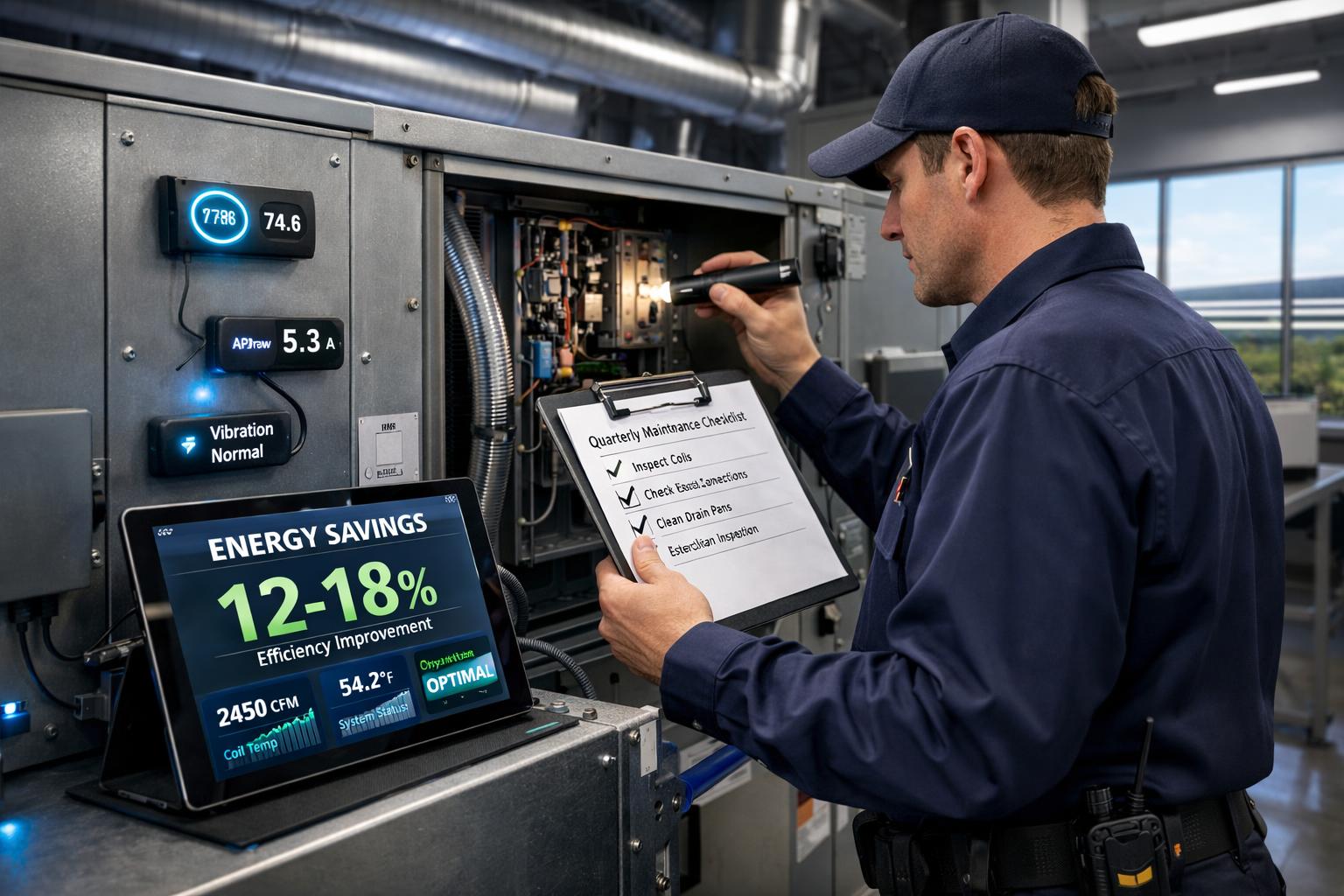
Generally yes, though the best-known numbers are estimates and they are dated. A Pacific Northwest National Laboratory summary of the U.S. Department of Energy's Federal Energy Management Program guidance says studies indicate savings of as much as 12% to 18% on average from preventive over reactive maintenance, and a further 8% to 12% from predictive over preventive (PNNL, O&M Best Practices: Maintenance Approaches, July 2021). Its table puts a typical industry mix at 40% to 60% reactive work, with best-in-class sites under 10%.
Treat those as direction, not a forecast for your building. They are program-wide maintenance cost estimates drawn from older federal guidance, and they do not tell you what an air handler repair will cost in San Jose. What they support is the logic: planned work is cheaper to schedule, stock and staff than an emergency, and it does not take tenants offline.
For a closer look at the planning side, see our guide to preventive maintenance programs.
Where they replace guesswork with a trigger. Filter pressure drop is the clearest case: instead of changing every filter on the same date, you change them when they are loaded, which matters in a smoke season. Motor current, temperatures and run hours can flag a unit working harder than it used to.
The research on the energy side is encouraging but mixed in scope. The Department of Energy reports that re-tuning projects with federal agencies typically produced building energy savings of 5% to 25% (U.S. DOE FEMP, O&M challenges and solutions). A Lawrence Berkeley National Laboratory meta-analysis of 643 non-residential buildings found median whole-building energy savings of 16% in existing buildings from commissioning, with a median payback of 1.1 years, based on the third of projects that had the data (Mills, 2011, LBNL). That work is about correcting operating problems, which monitoring helps to find, and it is more than a decade old.
Monitoring is worth buying when it changes a decision. A small building with a few rooftop units may get more from disciplined filters, coils and schedules than from a platform. A larger building with a building automation system should at least review its trend data and schedules each season.
They add recordkeeping and a repair clock for larger equipment. Since January 1, 2026, the U.S. EPA's leak repair requirements apply to appliances with a charge of 15 pounds or more of an HFC or certain substitutes. Comfort cooling equipment must be repaired when its annual leak rate exceeds 10%, within 30 days of adding refrigerant, with verification tests afterward (U.S. EPA leak repair fact sheet, January 2026). Residential and light commercial air conditioning is excluded, but chillers and certain variable refrigerant flow systems are not.
California adds its own program: the Air Resources Board requires facilities with more than 50 pounds of high-GWP refrigerant to register, conduct and report periodic leak inspections, repair leaks promptly and keep service records on site (CARB Refrigerant Management Program). Which of your units fall under which rule depends on the equipment, so ask your HVAC contractor to list them and confirm who keeps the records.
Ask for the plan in writing and judge it on documentation. HVAC repair and service is performed by licensed mechanical contractors, and a facility manager's job is to write the scope, schedule the work and hold the contractor to it. Good questions include:
Red flags are "we come when you call" with no scheduled visits, no written reports, and no refrigerant records.
How often should commercial HVAC filters be changed? ENERGY STAR advises changing or cleaning filters every month during peak cooling or heating season (ENERGY STAR). The EPA notes recommended filter changes of 1 to 6 months in general, and more often during smoke events (U.S. EPA). Your equipment and occupancy decide where in that range you land.
Is there a standard for how to maintain commercial HVAC? Yes. ANSI/ASHRAE/ACCA Standard 180 sets minimum inspection and maintenance requirements for commercial building HVAC systems (ICC). Manufacturers' instructions apply in addition and may require more.
Do refrigerant leak rules apply to office buildings? They can. The EPA's 2026 leak repair requirements cover appliances with 15 pounds or more of covered refrigerant and include chillers, though residential and light commercial air conditioning is excluded (U.S. EPA). California's program applies above 50 pounds of high-GWP refrigerant (CARB).
Does MAFM repair HVAC equipment? No. HVAC service is done by licensed mechanical contractors. MAFM plans the maintenance calendar, schedules and coordinates the contractors, tracks the paperwork and keeps the rest of the building services lined up around it.
A written inventory, a seasonal calendar and a vendor who reports back are most of what separates a planned building from a reactive one. MAFM's facility management team can build that calendar with you and coordinate the contractors who do the work. Talk to us about facility management.
MAFM offers comprehensive facility management solutions tailored to your business needs.
Get in Touch