Maintenance / Technology
Beyond the Boiler: Reprogramming Your Building Automation System for Fall in Silicon Valley
August 26, 2026
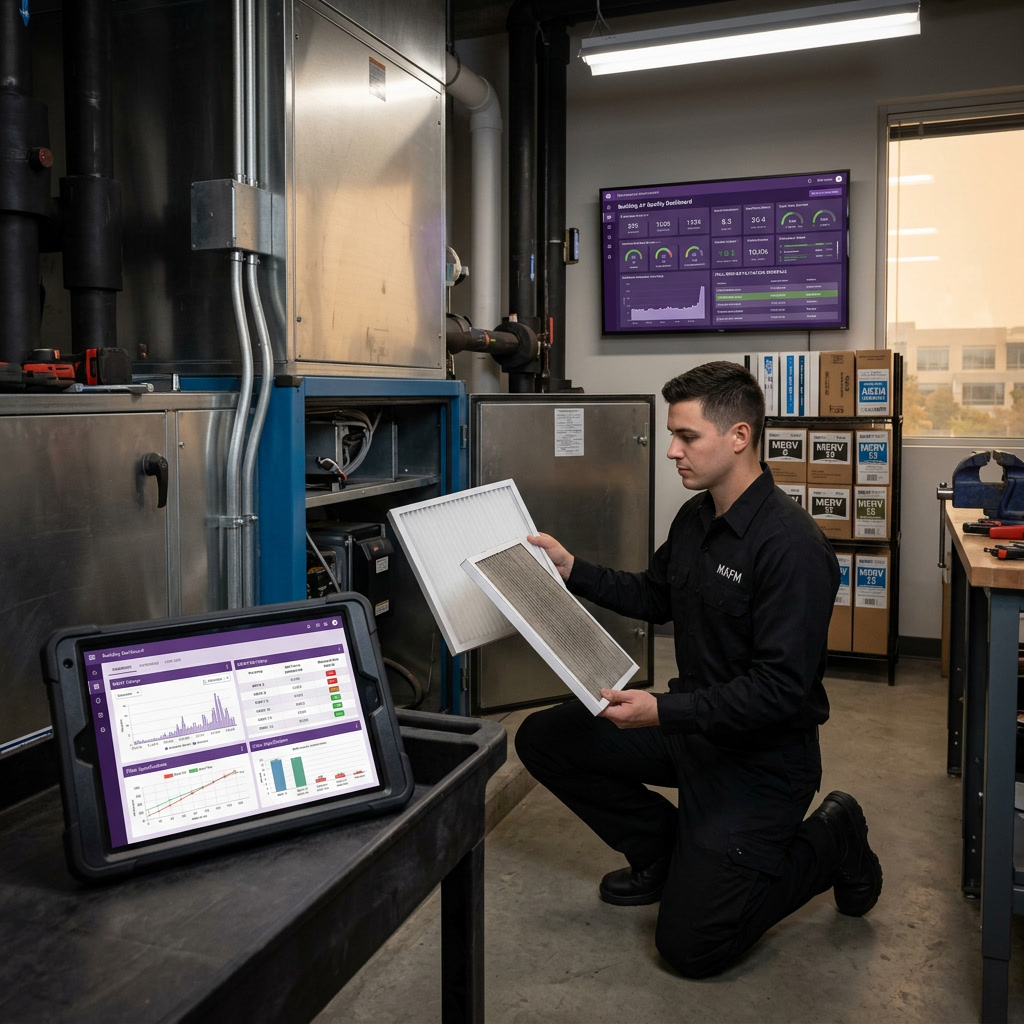
Earlier this week we mapped out the fall filter replacement calendar and talked through why September changeovers matter more here than almost anywhere else in the country, thanks to wildfire season overlapping with the return of building occupancy. Today we're going one layer deeper into a decision that gets made once a year but affects air quality, energy bills, and equipment life for the following twelve months: what MERV rating should actually be running in your air handlers.
We get this question constantly from property managers who inherited a building's HVAC specs from a previous owner or a tenant improvement contractor and have no idea whether the MERV 8 filters currently installed were a deliberate choice or just what the original installer had on the truck. The answer matters. A mismatched MERV rating either leaves your tenants breathing wildfire smoke and diesel particulate from 101 and 237, or it chokes down airflow across an aging air handler until the compressor starts short-cycling and the electric bill jumps 15 percent.
This post breaks down what the MERV scale actually measures, what rating makes sense for the building types we service most across Santa Clara, San Mateo, and Alameda counties, and where the real cost tradeoffs sit — because "just install the highest MERV you can find" is bad advice for about a third of the buildings we walk.
MERV stands for Minimum Efficiency Reporting Value, and it's a scale from 1 to 20 established by ASHRAE that measures how effectively a filter captures particles in three size ranges — the smallest being 0.3 to 1.0 micron, roughly the range of wildfire smoke, bacteria, and some viral aerosols. A MERV 8 filter, still the default in a lot of older commercial buildings, captures maybe 20 percent of particles in that smallest band. A MERV 13 captures upward of 85 percent. That gap is the entire reason ASHRAE and the CDC both pushed MERV 13 as the practical ceiling for standard commercial air handlers during the pandemic, and it's the same reason it matters for wildfire season.
Where facility managers get tripped up is assuming MERV is a pure air-quality dial you can just crank up. It isn't. Higher MERV filters have denser media, which means more resistance to airflow — measured in static pressure drop, expressed in inches of water column. An air handler engineered around a MERV 8 filter at 0.5 inches of static pressure will see that number climb toward 0.9 or higher with a MERV 13 of the same nominal thickness, and most rooftop units and older air handling units weren't sized with that headroom. The blower motor works harder, amperage draw climbs, and on units already running near their service life, you can trip overload protection or accelerate bearing wear.
The fix isn't avoiding higher MERV filters — it's matching filter depth and media design to the equipment. A 4-inch pleated MERV 13 filter has dramatically more surface area than a 1-inch MERV 13, which cuts the pressure drop penalty substantially. If your building still runs 1-inch filter racks, jumping straight to MERV 13 without evaluating rack depth is how you end up with an emergency service call in October instead of a routine changeover in September.
For general office space — the multi-tenant three- and four-story buildings we service throughout Mountain View, Sunnyvale, and Santa Clara — MERV 13 has become our standard recommendation, and most Class A landlords in the area have already adopted it as a baseline in their tenant improvement guidelines. The occupant density is high, the HVAC systems in buildings built after 2005 generally have the static pressure margin to handle it, and tenants — particularly tech companies with employee wellness programs — increasingly ask about it directly during lease negotiations.
Lab and R&D spaces are a different calculation entirely, and this is where we see the most inconsistency across the portfolios we manage. Wet labs with fume hood exhaust and dedicated makeup air units often run MERV 14 or HEPA-level filtration on specific air handling units serving cleanroom or controlled environment space, while the general office areas of the same building might stay at MERV 13. The mistake we catch most often during fall walkthroughs is a single filter spec applied uniformly across a building that actually has three or four distinct air handling zones with different requirements, which either overspends on filtration where it isn't needed or underprotects a sensitive lab zone.
Older buildings — anything with rooftop package units installed before 2010, which describes a meaningful share of the light-industrial and flex space stock in Fremont, Milpitas, and parts of San Jose — need an engineering check before any MERV upgrade. We've had clients try to move from MERV 8 to MERV 13 across an entire flex building and end up with three units in alarm within two weeks because the original blower motors simply couldn't overcome the added static pressure. In those buildings, MERV 11 is often the realistic ceiling without a parallel investment in blower motor upgrades or variable frequency drives, and we say that to clients directly rather than oversell a rating their equipment can't support.
Filter cost alone shouldn't drive this decision, but it's real and worth being precise about. A standard 24x24x2 MERV 8 pleated filter runs roughly $4 to $7 per unit in bulk commercial pricing; the same size in MERV 13 runs $12 to $18. For a mid-size office building with 40 air handling units and roughly six filters per unit, that's a jump from around $1,600 to $4,300 per changeover cycle — a difference of over $2,500 four times a year if you're on a quarterly cycle, which most Bay Area buildings should be given our wildfire and pollen exposure.
But filter cost is the smallest number in the equation. The larger cost variable is energy: a poorly matched high-MERV filter that spikes static pressure can increase blower energy consumption by 10 to 20 percent, which on a building with a $180,000 annual electric bill is a far bigger number than the filter media itself. Conversely, right-sized MERV 13 filtration in 4-inch media cabinets, installed on equipment engineered for it, typically adds only 3 to 5 percent to blower energy draw while cutting particulate infiltration dramatically — a tradeoff nearly every property owner accepts once the numbers are laid out side by side.
The number that gets ignored most often is compressor and blower motor longevity. Running a system chronically under-filtered lets particulate accumulate on evaporator coils, which reduces heat transfer efficiency and forces compressors to run longer cycles to hit setpoint — the kind of wear that shows up as a $6,000 to $9,000 coil cleaning or an early compressor replacement three to five years sooner than it should happen. We've pulled coils during fall PM visits that hadn't seen an adequate filter in two years and found airflow restriction alone had cost the building more in extra run-hours than a full MERV 13 program would have cost over the same period.
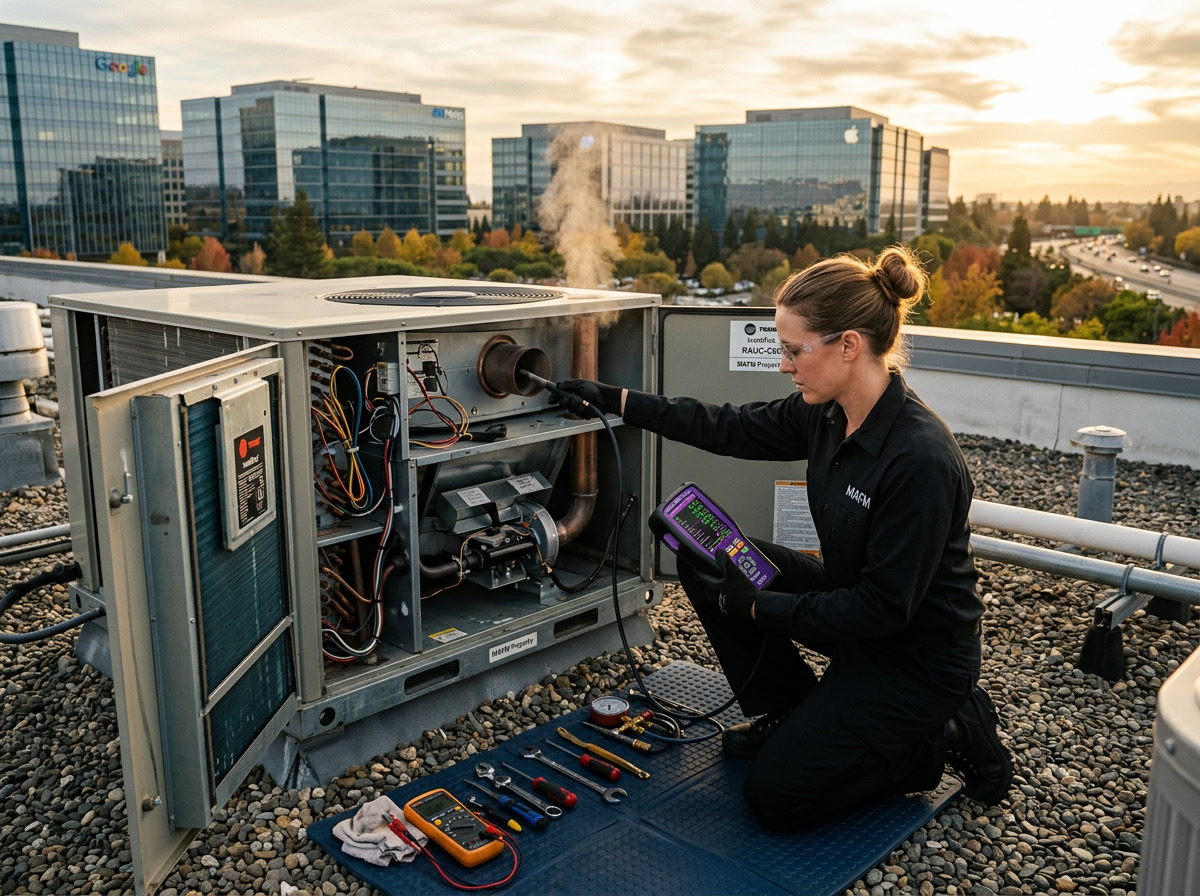
Before we recommend moving any building up or down the MERV scale, our technicians run a static pressure reading on a sample of air handling units with the current filter installed and compare it against the manufacturer's rated external static pressure for that unit. This takes about fifteen minutes per unit and tells us immediately whether there's headroom for a higher-MERV filter or whether the equipment is already running close to its ceiling.
We also verify filter rack dimensions and depth, because this is the single most common obstacle to a MERV upgrade — a building physically built for 1-inch or 2-inch filters can't accept 4-inch media without a rack retrofit, and that retrofit, while inexpensive (typically $150 to $400 per unit for the rack hardware), needs to be budgeted and scheduled rather than discovered mid-changeover when the new filters don't fit.
Finally, we look at the building's actual occupancy pattern and tenant mix, because a life sciences tenant running sensitive equipment has a different filtration conversation than a general office tenant, and a building with a daycare or medical tenant on one floor may warrant a higher standard building-wide even if the rest of the tenant mix wouldn't independently justify it. This is a conversation we have directly with property managers every September, and it's one that pays for itself when it happens before the changeover rather than after a tenant complaint.
The right MERV rating for your building isn't a single universal number — it's a decision that depends on your air handler's static pressure capacity, your filter rack depth, your tenant mix, and your appetite for the energy tradeoff that comes with denser filtration media. What's consistent across nearly every building we service in Silicon Valley is that MERV 13, properly matched to equipment that can handle it, has become the practical baseline for fall changeover given our wildfire smoke exposure and tenant expectations around air quality.
Getting this right during the September changeover — rather than reacting to a smoke event or a tenant complaint in October — is the difference between a routine maintenance line item and an emergency service call. Later this week we'll look at how to build the documentation and compliance trail around your filter program, which matters more than most facility managers realize when a tenant or insurer asks for proof of your air quality practices.
MAFM's fall changeover service includes a free static pressure assessment on your air handling units before we recommend any MERV upgrade — contact us to schedule your building's evaluation before the next filter cycle.
Link back to Monday's post introducing the fall filter changeover calendar and series overview, and forward to Friday's synthesis post on documentation and tenant communication for the fall filtration program.
ASHRAE's guidance on MERV ratings and filtration (ashrae.org) and the EPA's guidance on air filtration during wildfire smoke events (epa.gov).
August 26, 2026
October 6, 2026

October 16, 2026
MAFM offers comprehensive facility management solutions tailored to your business needs.
Get in Touch