Facility Maintenance
Commercial HVAC Maintenance for Silicon Valley Offices
February 12, 2026
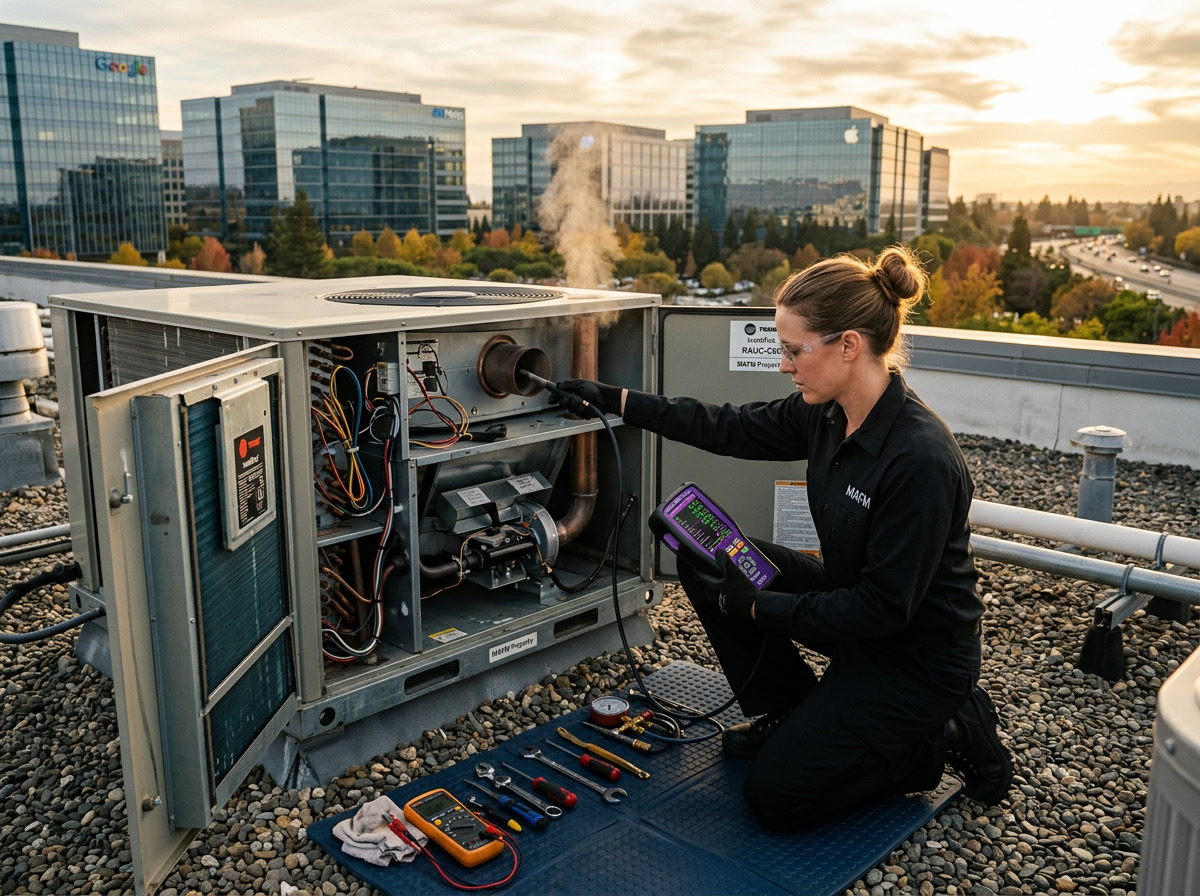
Combustion analysis means measuring what a gas-fired heater actually puts out, with a calibrated analyzer, instead of confirming that warm air is coming from the vents. A heat exchanger inspection checks the metal wall that keeps flue gas out of the air your tenants breathe. Both belong in every heating startup, and both are easy to leave out of a vendor's scope without anyone noticing.
The reason is simple: a flame can look normal while the burner is making carbon monoxide. The CDC describes carbon monoxide as an odorless, colorless gas that kills without warning, and lists gas- and oil-burning furnaces among its common sources. You cannot see or smell it, so you have to measure it.
A comfortable room tells you the unit can heat. It tells you nothing about how cleanly it burns or whether the heat exchanger is intact.
OSHA's carbon monoxide fact sheet says CO comes from the incomplete burning of fuels such as natural gas, and that employers should keep equipment that can produce CO, including water heaters and space heaters, in good working order. It also gives the OSHA permissible exposure limit for CO as 50 parts per million averaged over eight hours.
A work order that closes when the thermostat is satisfied does not show any of that. A measured reading does.
A combustion analysis reads the flue gas with a handheld analyzer while the equipment runs steadily. The U.S. Department of Energy's Operations and Maintenance Best Practices Guide (Release 3.0, 2010) recommends a combustion analyzer to measure combustion efficiency and excess air, and says modern analyzers report these values:
The DOE steam tip sheet on combustion efficiency explains why the oxygen reading matters. Too little excess air leaves unburned fuel, soot, smoke and carbon monoxide. Too much wastes heat up the stack. Either way, the number tells a technician something a visual check cannot.
Ask for the manufacturer's acceptable ranges for each unit and have the technician record the readings against them. Targets differ by equipment type, so do not accept a single number as a universal pass.
Test at steady operation, not in the first moments after ignition when readings are unstable. On two-stage or modulating equipment, ask for readings at each firing stage the unit uses, since a unit can be well adjusted at one stage and off at another.
Alongside the flue gas readings, a thorough startup also covers:
The DOE guide adds a useful interval for boilers: tune them at least annually, and high-use boilers at least twice a year, depending on use.
A heat exchanger is the sealed chamber that separates flame and flue gas from the air supplied to the building. If it cracks or corrodes through, combustion products can reach the supply air.
Technicians typically inspect it with a mirror or a borescope, and some cracks open only when the metal heats up. For that reason, ask whether the inspection includes a look after the unit has run through a full cycle, and whether analyzer readings were watched for a change in oxygen or carbon monoxide during the run.
The CDC advice for fuel-burning heating equipment is to have it serviced by a qualified technician every year. That is written for homes, but the logic carries over to commercial rooftop units and boiler rooms: yearly service before the heating season, with the results written down.
Age matters too. If a building's heating equipment is original to an older tenant improvement, put heat exchanger condition on the startup list as its own line, not as an afterthought. Manufacturer documentation for the specific unit is the right place to confirm service life and replacement guidance. We have no sourced industry-wide cost or lifespan figure to quote, so we leave one out.
They can, for boilers and process heaters, but not for ordinary packaged rooftop units. The Bay Area Air Quality Management District's Regulation 9, Rule 7 limits nitrogen oxides and carbon monoxide from industrial, institutional and commercial boilers, steam generators and process heaters. It sets emission limits by rated heat input, and for gas-fired units rated at 10 million BTU per hour or more it includes a carbon monoxide limit of 400 ppmv, dry at 3 percent oxygen.
The rule also requires tune-ups done by the procedure in the District's Manual of Procedures. If your central plant falls under it, the same analyzer data you collect at startup helps support your records. Check the rule and your district permit to see whether a specific boiler is covered.
For a 400 ppmv figure, note the units: it is a regulatory emission limit for boilers at a stated oxygen reference, not a safe indoor air level and not a pass mark for a rooftop unit.
Make the deliverable the evidence, not the signature. A usable startup record includes:
File it against the asset so next year's readings can be compared. If a vendor cannot produce analyzer data, treat the combustion check as not done.
Heating equipment repair and testing is specialist work, and it is done by licensed mechanical contractors. MAFM does not perform it. What a facility management partner does is write the scope, schedule the startups before cold weather, coordinate vendor access, and keep the records in one place. For related reading, see our guide to commercial HVAC maintenance for Silicon Valley offices.
Can a technician check combustion by looking at the flame?
No. A flame that looks normal can still be producing carbon monoxide, which has no color or odor. A calibrated analyzer reading is the only reliable way to confirm clean combustion.
How often should gas-fired heating equipment be tested?
The DOE guide says boilers should be tuned at least annually, and high-use boilers at least twice a year. For rooftop units, follow the manufacturer's instructions and test before each heating season at a minimum.
Does a carbon monoxide detector replace combustion analysis?
No. A detector warns you after carbon monoxide has already entered the space. Combustion analysis and heat exchanger inspection are meant to find the problem before that happens.
Who is responsible for heating startup testing?
Licensed mechanical contractors perform it. The property or facility manager decides what the scope includes and whether the records are delivered.
MAFM is a facilities management company, and we plan and coordinate seasonal equipment startups with your mechanical vendors for Bay Area buildings. If you want a clear scope and tidy records before the next heating season, see our facility management service, our San Jose page or contact us.
MAFM offers comprehensive facility management solutions tailored to your business needs.
Get in Touch