Wildfire Smoke Air Quality Management: The Building Operations Protocol That Protects Occupants When the Air Outside Turns Orange
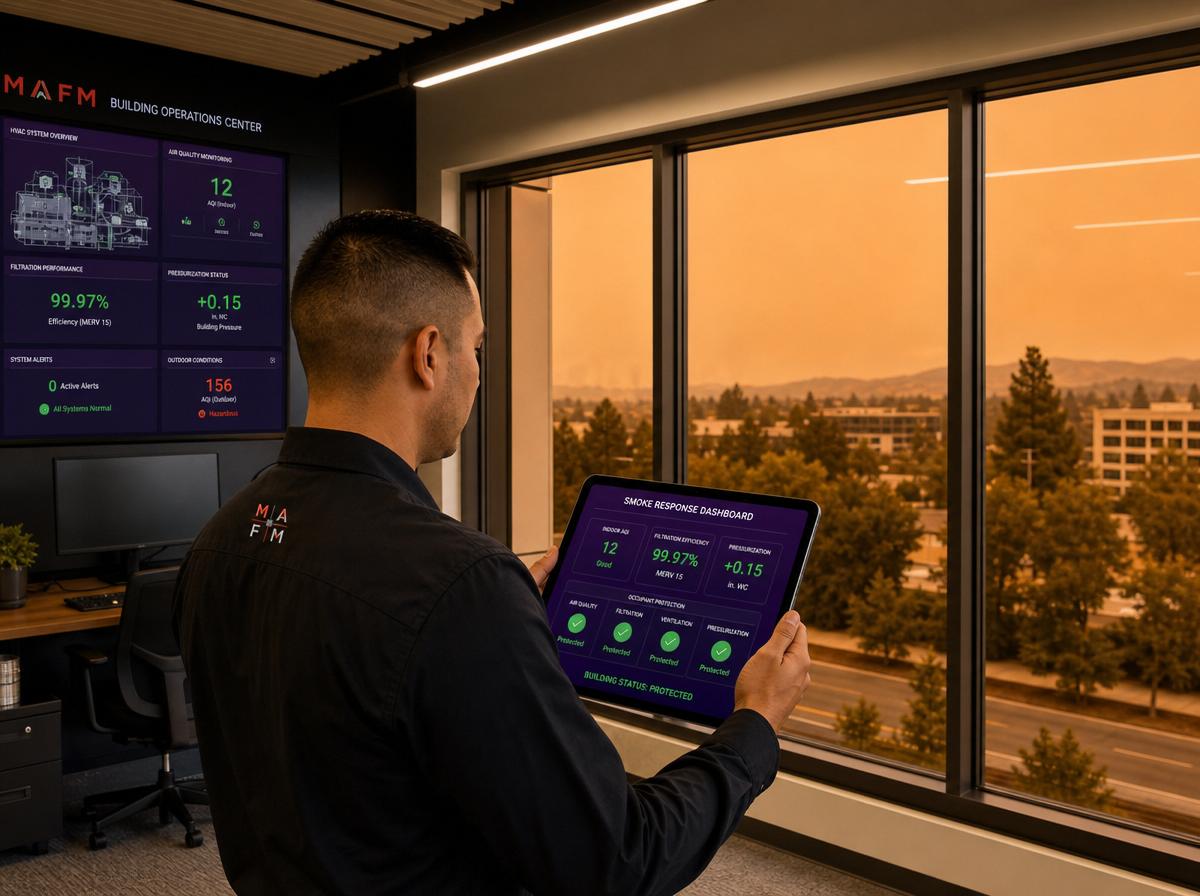
Wildfire Smoke Air Quality Management: The Building Operations Protocol That Protects Occupants When the Air Outside Turns Orange
The images have become familiar across Silicon Valley: orange skies over the Bay Area, the acrid smell of smoke reaching from fires hundreds of miles distant, and AQI readings that climb past 200 before most employees have arrived at work. These events no longer surprise anyone. But they still catch many buildings unprepared, because knowing that smoke events happen and having a documented, tested protocol for managing them are entirely different things.
Indoor air quality during wildfire smoke events is directly determined by building management decisions. Buildings with functional recirculation capability, appropriate filtration, and a tested response protocol maintain indoor AQI levels 60–80% below the outdoor conditions that drive tenants to demand to work from home. Buildings that take no specific action during smoke events allow outdoor air quality to establish itself indoors within two to four hours, at which point the building provides no meaningful protection to its occupants.
The protocol that follows is the operational standard that allows your building to function as a refuge during smoke events rather than a liability.
The Four-Tier Response Framework
Wildfire smoke events vary in intensity, and the appropriate building response should scale with outdoor conditions rather than applying a single protocol to all smoke scenarios.
Tier 1, Air Quality Advisory (AQI 51–100, Moderate): Outdoor air quality is moderate and sensitive individuals may experience effects. At this level, normal building operation is appropriate for healthy occupants. Ensure your HVAC filters are in good condition and consider activating air quality monitoring to track developing conditions. Communicate an advisory to tenants that outdoor conditions are entering the moderate range and that the building is monitoring the situation.
Tier 2, Air Quality Alert (AQI 101–150, Unhealthy for Sensitive Groups): At this level, sensitive groups including those with respiratory conditions, heart disease, older adults, and children face meaningful health risk. Activate enhanced filtration if your system has variable filtration capability. Increase ventilation to sensitive spaces. Communicate to tenants that the building is activating enhanced air quality protocols and advise occupants with respiratory sensitivities to consider their comfort level.
Tier 3, Air Quality Emergency (AQI 151–200, Unhealthy): Healthy occupants begin experiencing respiratory effects at this level. Initiate full building recirculation, close all outdoor air dampers and circulate only interior air. Activate supplemental portable HEPA filtration in high-occupancy areas. Communicate clearly to all tenants that outdoor air quality is unhealthy and the building has activated smoke protection protocols.
Tier 4, Extreme Air Quality Event (AQI 201+, Very Unhealthy to Hazardous): At these levels, all occupants face health risk and building operation decisions become more complex. Continue recirculation and maximum filtration. Assess whether the building can maintain acceptable indoor conditions given current smoke penetration rates and recirculation effectiveness. Communicate with ownership and tenants about the potential need for building closure if indoor conditions become untenable. Document your decisions and conditions throughout the event.
HVAC Recirculation Mechanics and Limitations
Full building recirculation provides meaningful protection during smoke events but operates within limitations that facility managers must understand to set appropriate expectations.
Recirculation effectiveness depends on building envelope integrity, how well the building's shell prevents unfiltered outdoor air from infiltrating through envelope gaps. A well-sealed building with recirculation active can maintain indoor AQI significantly below outdoor levels for several hours. A building with significant air infiltration through older windows, worn weather stripping, and unsealed penetrations will experience more rapid indoor-outdoor equilibration even with recirculation active.
The recirculation oxygen depletion concern is frequently raised by tenants and occasionally by facility managers who have not investigated the actual numbers. A fully occupied 50,000 square foot office building in complete recirculation consumes oxygen at a rate that takes approximately 36 hours to reach concentrations that affect cognitive performance, far beyond any practical recirculation event duration. CO2 buildup is the more relevant concern, and CO2 monitoring allows the building to modulate outdoor air intake when indoor CO2 levels approach the 1,000 ppm threshold that affects concentration.
HVAC system temperature management during recirculation requires attention because the system is no longer able to moderate the temperature of incoming air through the economizer cycle. In summer conditions, the building's cooling load must be managed entirely through mechanical cooling of recirculated air, which may affect both energy consumption and zone temperature control. In mild conditions, the building's thermal mass provides adequate temperature regulation through recirculation periods of several hours.
Supplemental portable HEPA units in high-occupancy spaces provide an additional layer of filtration that addresses the residual smoke penetration that occurs even in buildings with active recirculation. A single commercial-grade HEPA unit rated for 1,000 square feet provides meaningful supplemental filtration in conference rooms, break rooms, and dense open office areas where occupants spend extended periods. Have these units staged and ready for rapid deployment at Tier 3 conditions.
Real-Time Air Quality Monitoring
The ability to monitor outdoor and indoor air quality in real time transforms smoke event management from reactive to proactive.
Outdoor AQI monitoring requires multiple data sources because AQI readings vary significantly by location and the nearest official monitoring station may not accurately represent conditions at your building. Use the EPA's AirNow platform as the official reference, supplemented by PurpleAir sensor data from the nearest community monitoring locations. When official and community data diverge significantly, the community sensor network typically provides more locally representative readings.
Indoor air quality monitoring using PM2.5 sensors in multiple building zones provides the real-time data needed to verify that your building's protection protocols are working. If outdoor PM2.5 is 150 µg/m³ and indoor levels are 120 µg/m³ after two hours of recirculation, your building envelope is providing less protection than expected and supplemental measures are needed. If indoor levels are 30 µg/m³, your protocols are working effectively.
Sensor placement for meaningful indoor monitoring should prioritize the breathing zone, approximately 3–4 feet above floor level, in occupied spaces rather than at ceiling level where sensors are easier to mount but less representative of occupant exposure. Position sensors in locations that represent different parts of the building: a perimeter office, a central open office area, and a common space area provide a representative indoor profile.
Dashboard and alerting configuration should trigger automated notifications to the facility management team when either outdoor or indoor AQI exceeds your response tier thresholds. Real-time data without automated alerting relies on someone actively monitoring displays, which is not sustainable during extended events that span multiple days and shifts.
Tenant Health Communication
Smoke events create health anxiety that building management can either amplify or defuse through the quality of its communication.
Factual, calibrated communication is the standard. During a smoke event, tenants want to know what the outdoor conditions are, what the building is doing to protect them, and what they should do if they have health concerns. They do not need alarming descriptions of health risks beyond what the AQI scale already communicates, and they do not need vague reassurances that the building is fine when conditions are clearly affecting air quality.
Health resource information for occupants with respiratory conditions, including a reminder to those with asthma, COPD, or heart disease to consult their healthcare provider's guidance for wildfire smoke exposure, demonstrates appropriate care without exceeding the facility manager's appropriate scope. Direct anyone with active respiratory symptoms to contact building management and to seek medical attention if symptoms concern them.
Remote work authorization communication should come from tenants' own employers rather than from building management. The facility manager's role is to communicate building conditions accurately and let tenants make their own employment decisions within their employer's policies. Buildings that accurately report both outdoor and indoor conditions empower appropriate decisions.
Post-Smoke-Event Recovery
After outdoor air quality returns to safe levels, several actions restore building conditions and capture lessons for future events.
Filter inspection and replacement assessment should occur within 24 hours of event conclusion. Filters that protected the building through a significant smoke event may be loaded enough to warrant replacement regardless of their calendar schedule. Check pressure drop across each air handler's filter section and replace if pressure drop has increased significantly from pre-event baseline.
Building flush-out using full economizer operation for 2–4 hours when outdoor AQI is consistently below 50 replaces the recirculated interior air with fresh outdoor air, removing any residual smoke odor compounds that accumulated during the event. This flush-out is particularly important in buildings where some smoke infiltration occurred during the event.
Event documentation including outdoor AQI data, indoor monitoring data, HVAC actions taken, tenant communications, and any system performance issues creates the record that improves future event response and supports insurance documentation if smoke damage occurred.
Conclusion
Wildfire smoke events are a known, recurring hazard for Silicon Valley commercial buildings, and the quality of the management response during each event directly determines occupant health outcomes. Buildings with documented, tested, tiered response protocols consistently maintain indoor air quality 60–80% better than outdoor conditions during smoke events. Buildings without these protocols expose their occupants to the same air their tenants could experience working from home, which is not a condition that justifies the commute.
Test your recirculation capability this week. Verify your filter status. Stage your portable HEPA units. Build your four-tier response framework. When orange skies return to the Bay Area, and they will, your building will be ready.
MAFM has documented wildfire smoke management protocols that protect occupants at every outdoor AQI level. Contact us to assess your building's smoke event readiness.
Schedule your consultation: Contact MAFM.PRO
Ready to Optimize Your Facilities?
MAFM offers comprehensive facility management solutions tailored to your business needs.
Get in Touch