Health & Safety
Slip and Fall Prevention for Bay Area Commercial Buildings
January 24, 2026
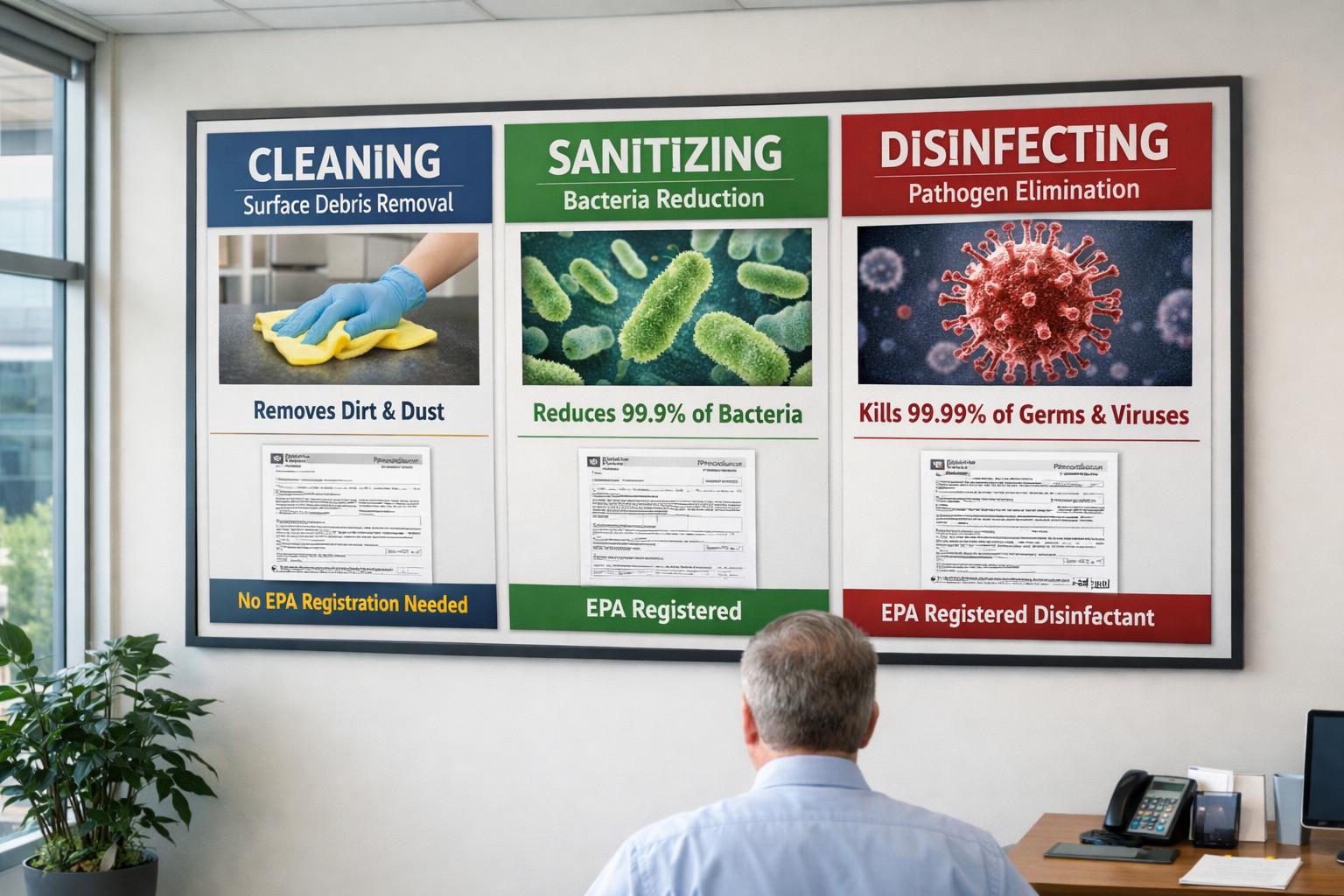
Commercial disinfection standards come down to three things a facility manager can check: an EPA-registered product (also registered in California) whose label covers the germ and the surface, a surface cleaned first, and a surface that stays wet for the full contact time printed on the label. Skip any one of them and the surface was cleaned, not disinfected.
Cleaning still does most of the work. The CDC's guidance for facilities says that "in most situations, cleaning regularly is enough to prevent the spread of germs," and reserves disinfection for areas where people have obviously been ill, busy spaces where you choose to add it, and outbreak instructions from health authorities (CDC). The standard to hold a vendor to is doing each one correctly where it belongs.
They are three different results, and contracts often blur them. The CDC and EPA define them this way:
The order matters. A disinfectant applied to a dirty surface is fighting the dirt as well as the germs, which is why EPA's six-step guidance puts pre-cleaning before application whenever the label calls for it or the surface is visibly dirty (EPA).
Registration and the label. EPA's guidance is direct: "The only way to accurately identify a product is by the EPA registration number," which is printed on the label, and users must read the label to confirm the product is approved for the intended site and pest (EPA).
California adds a second registration. The Department of Pesticide Regulation lists antimicrobials among the pesticides it regulates and "must register any pesticide before it can be sold or used in California," normally after EPA has registered it (DPR). A product bought online from another state is not automatically legal to use in a San Jose building.
EPA also keeps lists of registered products tested against specific germs (EPA). The ones most relevant to offices:
A product on List N is not automatically on List G. Match the product to the germ you are dealing with, and keep at least one product on hand that covers a vomiting cleanup.
For green cleaning programs, EPA's Design for the Environment certification marks registered disinfectants that meet extra criteria for human health and the environment, including excluding ingredients that might pose long-term health risks. It is a useful filter when you specify products in a contract.
Because the label's kill claim only holds if the surface stays wet that long. The CDC says to leave disinfectant on the surface long enough to kill the germs and that "the surface should stay wet during the entire contact time" (CDC). EPA's six steps say the same: find the contact time in the directions and keep the surface wet the whole time (EPA).
Contact times differ by product and by germ, and a single label can list different times for different organisms. That is why a vendor's answer to "how long do you leave it on?" should name the product and the germ, not a habit.
The failure to watch for is spraying and wiping in one motion. It removes soil and leaves a clean-looking surface, but the product never had its contact time. A crew can disinfect without standing around by working in sequence, which is how a restroom should be run:
Pre-saturated wipes follow the same rule. One wipe stretched across a long conference table can dry before the contact time ends, so use enough wipes to keep the surface visibly wet.
When illness, body fluids or a health authority calls for it, and on the high-touch points you decide to add it to. Following the CDC's facility guidance, the clear cases are:
Everywhere else, regular cleaning done well is the standard. Disinfecting every desk every night adds chemical exposure and labor that the CDC's guidance does not call for.
Disinfectants are hazardous chemicals for the crews who use them, and OSHA treats them that way. The hazard communication standard requires safety data sheets "readily accessible during each work shift" and "effective information and training" on the chemicals in the work area at initial assignment (29 CFR 1910.1200). The consumer product exemption is narrow: it covers a product used for its intended purpose only when the duration and frequency of exposure is "not greater than the range of exposures that could reasonably be experienced by consumers," so do not assume a crew's products are exempt.
Two more rules apply on every shift:
Electrostatic sprayers and foggers deserve a close look. EPA says it "does not recommend using these methods to apply disinfectants" unless the product label includes directions for that method, and that it "has not evaluated the product's safety and efficacy for methods not addressed on the label" (EPA). The CDC also says these methods are not recommended as primary methods of surface disinfection. If a vendor proposes one, ask to see the label line that allows it.
Ask for documents and watch a shift. These questions separate a disinfection program from a cleaning program with a disinfection line in the proposal:
Then write the answers into the scope. A contract that says "clean and disinfect restrooms" leaves room for spray-and-wipe. One that names the surfaces, the frequency, EPA-registered products used to label directions including contact time, and a monthly log of product names and registration numbers gives you something to inspect against.
For seasonal planning, see our posts on flu season protocols and green cleaning certifications in California.
Is sanitizing the same as disinfecting? No. EPA defines sanitizers as reducing microorganisms to levels public health codes consider safe, while disinfectants destroy or irreversibly inactivate infectious fungi and bacteria on surfaces, plus any viruses their labels list. Use a sanitizer where its label fits the surface and the job, and a disinfectant where you need a kill claim for a specific germ.
What is disinfectant contact time? It is how long the surface must stay wet with the product for the label's kill claim to hold. The CDC and EPA both say to keep the surface wet for the entire contact time, and the time can differ by product and by germ.
Do disinfectants need to be registered in California? Yes. California's Department of Pesticide Regulation must register any pesticide, antimicrobials included, before it can be sold or used in the state, normally after EPA registration. Ask your vendor for both registrations on every product used in your building.
Should offices disinfect every surface every night? No. The CDC says regular cleaning is enough in most situations. Disinfect where people have been ill, after blood or body fluid spills, on high-touch points in busy shared spaces you choose to add, and when health authorities recommend it.
A program that names its products, contact times and surfaces is easy to verify and easy to trust. MAFM's janitorial crews work from written product and procedure lists, including what to do when someone is sick at work. Talk to us about janitorial services.
MAFM offers comprehensive facility management solutions tailored to your business needs.
Get in Touch