Sustainability & Energy
De-Icing Solutions for California Facilities: What Works
January 28, 2026
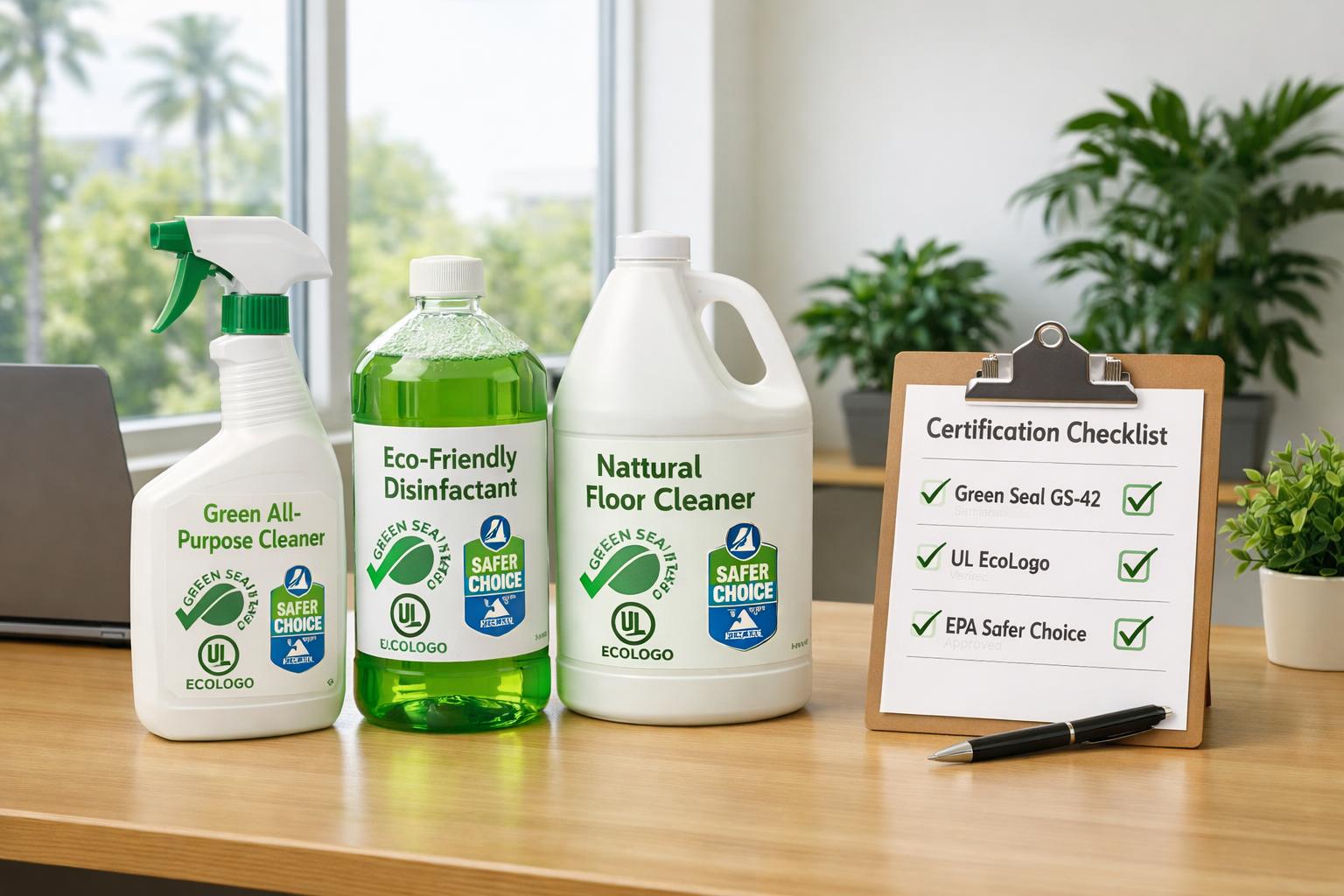
Green cleaning certifications fall into two groups, and the first step is knowing which one a vendor is claiming. Some certify a product (Green Seal GS-37, UL ECOLOGO, EPA Safer Choice). Others certify the cleaning operation itself (Green Seal GS-42, ISSA CIMS-GB, Safer Choice cleaning service certification). A proposal that says "green" without naming a standard, a certificate and a scope has told you nothing you can check.
For a California building, the practical test is simple. Ask which standard, which products or services it covers, and where you can look the certificate up. Everything below is built around those three questions.
They certify either a product formula or a cleaning program, never "greenness" in general. Mixing the two up is how a vendor can truthfully say "we use certified products" while running a cleaning program nobody has ever audited.
The vague words are the problem. The FTC's Green Guides say that unqualified general environmental benefit claims "are difficult to interpret and likely convey a wide range of meanings," and that marketers should not make them. "Eco-friendly" and "sustainable" on a proposal are marketing. A standard number is something you can verify.
Three programs matter most for the chemicals a crew carries: Green Seal, UL ECOLOGO and EPA Safer Choice.
Green Seal GS-37 covers industrial and institutional cleaners for routine use in offices, institutions, warehouses and industrial facilities, including general-purpose, restroom, glass and carpet cleaners. Per Green Seal's standard page, its requirements include:
Green Seal states that certification to the standard is awarded only by Green Seal, so a vendor cannot hold it through a self-issued badge. The page shows Edition 7.8 from 2022.
UL ECOLOGO is a voluntary, multi-attribute, life-cycle-based program. UL's program page lists UL 2700 for general cleaning products and UL 2777 for hard floor care as current, and shows several older cleaning standards, including UL 2792 and UL 2759, as expiring on December 31, 2027. If a vendor cites an ECOLOGO number, check it against that list.
EPA Safer Choice is an EPA program, not an outside certifier. The agency's Safer Choice and Design for the Environment Standard sets ingredient criteria that every ingredient in a formulation must meet. Its sister logo, Design for the Environment (DfE), is used on antimicrobial products registered under federal pesticide law.
Service certifications look at the operation, which is closer to what a facility manager is actually buying. Three exist.
The service standards matter because they audit habits: training, written plans and purchasing records. A certified product in the hands of an untrained crew that mixes it wrong is still a poor result.
LEED for existing buildings accepts both product and service certifications, but the details depend on which version your building is using. In the LEED v4.1 Operations and Maintenance guide (a November 2018 beta edition), the Green Cleaning Policy prerequisite can be met two ways: by writing your own policy, or by cleaning the project with a service certified under GS-42 or CIMS-GB.
The separate Green Cleaning credit includes a products option. It requires that at least 75% of all cleaning products and materials, by cost, meet a listed standard, including GS-37, several UL ECOLOGO standards and the EPA Safer Choice Standard. Compliance can be shown from a product inventory or from total annual purchases.
LEED has since been revised, and credit structures change between versions. Confirm the version and the credit text with your LEED consultant before you write a cleaning scope around it.
Look for a standard number, a certificate and a scope. If any of the three is missing, treat the claim as marketing until proven otherwise.
EPA's own advice for buyers is to be careful in interpreting vague or generic claims, and to use its search tools for Safer Choice and DfE products. Green Seal keeps a certified directory you can browse by product, company or facility type.
California adds ingredient transparency that helps you check what a crew is actually using. The Cleaning Product Right to Know Act covers general cleaning products and polish or floor maintenance products used for janitorial or institutional cleaning, plus other categories. According to ISSA's summary, manufacturers had to meet the online ingredient disclosure requirements on or after January 1, 2020, and the labeling requirements for products sold in California on or after January 1, 2021.
That means the ingredient list for most products your vendor uses should be on the manufacturer's website. It also gives you a plain way to compare a "natural" claim against what is actually in the bottle. A separate provision of the Labor Code requires employers to provide this disclosure information to employees, per the Environmental Law Institute's summary of the statute, so it is worth keeping it next to your safety data sheets.
Write the standard into the scope, ask for proof, and audit it. A contract clause is only as good as the check behind it.
Be wary of comparing prices without comparing scope. A certified program may cost more or less depending on products, training and documentation. Ask for an itemized proposal so the difference is visible instead of buried in a total.
Is "green cleaning" a legally defined term in California?
Not as a general label. The FTC's Green Guides warn against unqualified environmental claims, and California law focuses on specific duties such as ingredient disclosure. The reliable approach is to require a named standard rather than the phrase "green."
Is Green Seal GS-37 or UL ECOLOGO better?
Neither is better in every case, because they test different criteria. LEED's products option accepts both, along with EPA Safer Choice, so the right choice often comes down to which products your cleaning crew can source consistently and which standard your building's certification requires.
Does a green cleaning certification mean the products disinfect?
No. GS-37 excludes disinfecting products, and a Safer Choice label alone is not a germ-kill claim. For disinfectants, look for EPA registration and, if you want an additional screen, the Design for the Environment logo.
Do I need a certified cleaning company for LEED?
Not necessarily. Under the LEED v4.1 guide, the Green Cleaning Policy prerequisite can be met with your own written policy or with a service certified under GS-42 or CIMS-GB. Check which version of LEED your building uses.
MAFM is a facilities management company, and our janitorial teams can put a product list, a disinfectant procedure and a training and inspection routine into writing for your building. We also coordinate the vendors and supply sourcing that sit behind them. See our janitorial services or contact us to walk your building and scope the program.
MAFM offers comprehensive facility management solutions tailored to your business needs.
Get in Touch