Budgets & Contracts
Reduce Facility Operating Costs in Silicon Valley, 2026
January 12, 2026
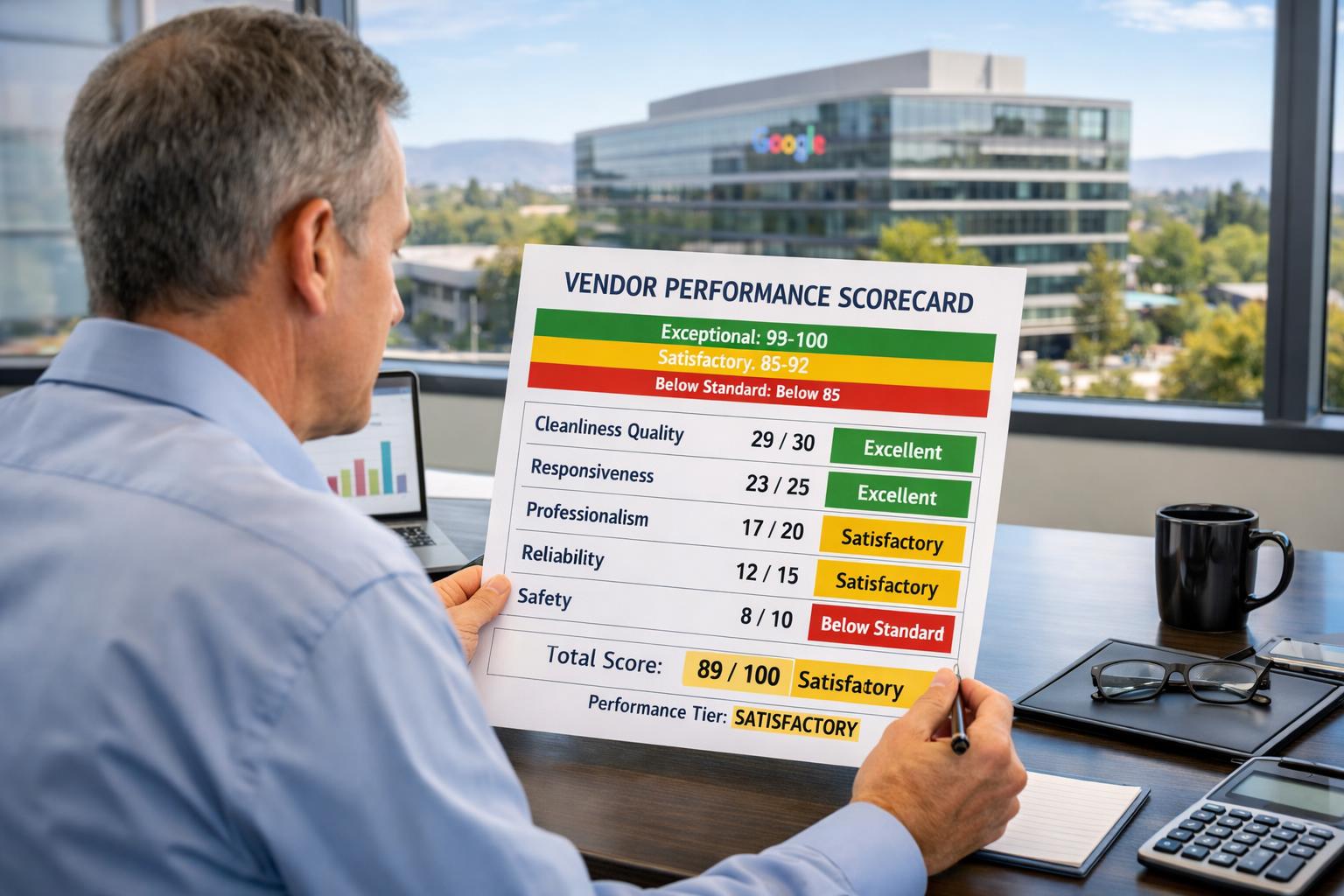
A vendor performance scorecard is a short, repeatable inspection form that turns "the building seems fine" into dated scores you can compare month to month. Build it around a handful of outcomes (cleanliness, response, reliability, communication, safety), score them the same way every time, and tie the result to a corrective action process in the contract. That is the whole idea, and the rest is making it consistent enough to hold up in a conversation with a vendor.
It matters most for services where the work happens out of sight, like overnight janitorial. If your only signal is complaints, you are measuring who is willing to complain, not how the work is going.
Complaints only capture the problems people notice and bother to report. A complaint log tells you about the lobby and the executive restroom long before it tells you about a stairwell, a storage room or the third-floor break room that nobody visits.
Four blind spots show up in most buildings:
Government contracting runs into the same problem and has a formal answer. The federal acquisition rules call for quality assurance surveillance plans that specify the work requiring surveillance and the method of surveillance, and say they should be prepared in conjunction with the statement of work. A scorecard is the private-sector version of that idea, sized for one building.
Measure outcomes you can observe, not activity you can only trust. "The crew was on site eight hours" is activity. "The restroom was stocked, the floors were clean and the issue was fixed" is an outcome.
A workable scorecard covers five areas:
Keep it short. A form that takes 15 minutes a week gets used, and a form that takes two hours gets abandoned within weeks. Twenty to thirty line items across the five areas is plenty, scored on a simple one to five scale.
Define what each score means in writing, with a shared reference, before anyone inspects. Otherwise "4" means one thing to you and another to your vendor's supervisor.
APPA, the association for educational facilities, publishes a five-level vocabulary for this. In its custodial appearance levels, Level 1 is "Orderly Spotlessness," Level 2 is "Ordinary Tidiness," and Level 5 is "Unkempt Neglect." At Level 2, surfaces are clean, though up to two days' worth of dust or dirt may be present. APPA says a custodial audit documents current practices and helps establish a baseline, evaluate procedure changes and support performance evaluations and feedback.
APPA's guidelines were written for educational facilities, so treat them as a shared vocabulary rather than a rule for an office. The useful move is to pick the appearance level you want for each type of space, write it into the scope and score against it.
Two habits keep scoring honest:
Weight the areas by what matters in your building, then keep the weights fixed for a full year so trends mean something. One example, not an industry standard, is to weight cleanliness highest, then responsiveness, then reliability, communication and safety.
Some rules that make the numbers usable:
Put the scorecard into the agreement, or it becomes a suggestion. The sequence that works is a clear standard, a documented shortfall, a corrective action plan and a stated consequence.
The federal model is useful as a reference. A QASP template from the National Institutes of Health says its purpose is to monitor performance and "to ensure that the government pays only for the level of services received." It lists random monitoring, 100 percent inspection and periodic inspection as surveillance methods, and says that a contractor who misses the acceptable quality level may be asked to develop a corrective action plan and may face a deduction from the monthly payment. For certain critical activities it sets the desired performance level at 100 percent, and ties other levels to the task's importance.
The federal acquisition rules also address nonconforming services. FAR 46.407 says that when services with critical or major nonconformances are accepted, the contracting officer must modify the contract to provide for an equitable price reduction or other consideration.
For a private building, that translates into contract language you can actually use:
Have counsel review the exact wording. A consequence that was never written down is hard to enforce later.
Share it before you use it. Vendors who understand how they will be evaluated generally perform to it, and the first month should be a calibration period where you and the vendor's supervisor walk the building together and agree on what each score means.
Send good news as well as bad. A scorecard that only ever delivers criticism teaches the vendor to avoid it. For a broader annual review, see our vendor scorecard framework, and for the warning signs that usually show up first, see seven red flags a janitorial service is underperforming.
If the vendor holds a management certification, it can make the conversation easier. ISSA's Cleaning Industry Management Standard describes itself as defining "the core principles and best practices" of a high-quality, customer-focused cleaning organization, though a certificate does not replace your own inspections.
Most failures come from inconsistency, not from the design of the form.
What is a vendor performance scorecard?
It is a standard form used to rate a service vendor on the same measures each time, such as work quality, responsiveness, reliability, communication and safety. The scores build a record that supports honest conversations, corrective action and renewal decisions.
How often should we score a janitorial vendor?
Short weekly checks of a few spaces plus a fuller monthly review work for most buildings. The right frequency depends on traffic and risk, so spend more inspection time where problems cost the most.
Should the vendor see the scorecard?
Yes. Share the form and the scale before you use it and review each score with the account manager. A vendor who knows what you measure can fix problems early, and a score they helped define is harder to dispute.
Can a scorecard be used to end a contract?
It can support that decision if the agreement describes the standard, the cure process and the termination rights. The scorecard provides the documented history, and the contract provides the rights, so both need to exist.
MAFM is a facilities management company. We plan, schedule and coordinate cleaning and building services, and we walk spaces with checklists that record what was found. If you want a scorecard built around your building, talk to us about facility management or contact us to set up a walkthrough.
MAFM offers comprehensive facility management solutions tailored to your business needs.
Get in Touch