Budgets & Contracts
Reduce Facility Operating Costs in Silicon Valley, 2026
January 12, 2026
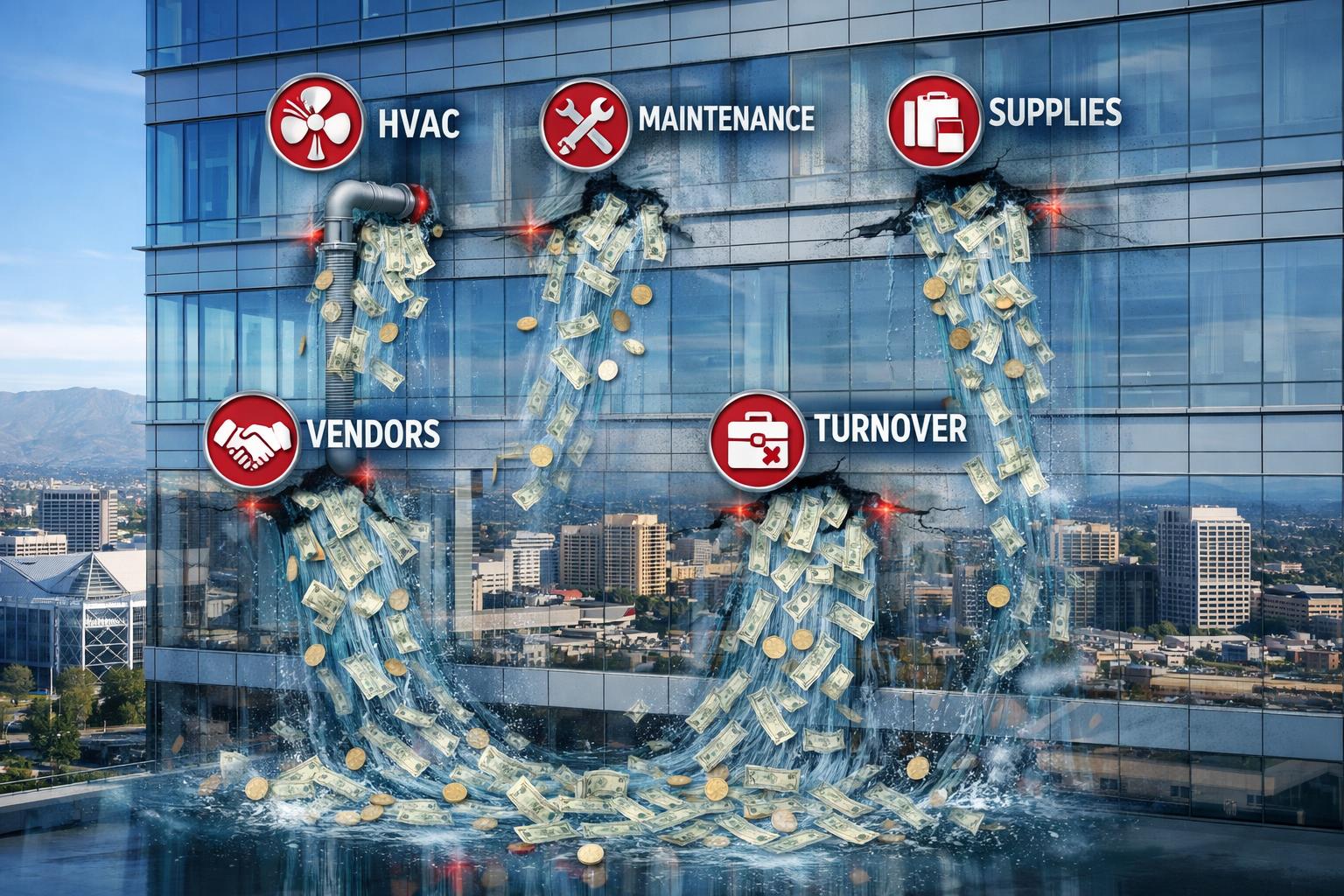
Hidden facility costs are the expenses that no single budget line owns: work two vendors both do, systems left running while a crew cleans, supplies bought one emergency order at a time, repairs that arrive as emergencies, and the cost of a cleaning crew that keeps changing. None of them shows up as a line item called "waste", which is why they survive budget reviews.
For San Jose office buildings the pattern is the same as anywhere, with one local twist: labor costs are high, so any inefficiency in how crews and vendors are scheduled gets expensive quickly. Below are the five places to look first, what the evidence says about each, and how to check your own building without buying anything.
Overlap costs money because two vendors can bill for the same area while a third area has no owner at all. This happens when contracts are written at different times, by different people, with phrases like "common areas" or "as needed" standing in for a real list of spaces.
Typical places it shows up:
The check is a floor-by-floor walk with every contract in hand. List each space once, write down which vendor owns it and at what frequency, and mark anything that appears twice or not at all. A single coordinator who holds all the scopes, whether in house or a facility management partner, is what keeps that list true after the first walk.
Night cleaning can mean lighting and conditioned air in a building that is otherwise empty, and the cost of that rarely gets charged to the cleaning contract. It lands on the utility bill, where nobody connects it to the cleaning schedule.
ENERGY STAR's operations checklist for commercial buildings makes three relevant points. It says to "revise janitorial practices to reduce the hours that lights are turned on each day," to "consider switching to day-cleaning, which takes place while occupants are in the building," and to "set back the thermostat in the evenings and other times when the building isn't occupied" (ENERGY STAR checklists).
Day cleaning is not right for every building, since it puts crews among occupants. The practical options are narrower and cheaper to try:
Pull a month of interval data from your utility if you have it. If the load stays high through the cleaning hours and drops after the crew leaves, you have found a number worth acting on.
Supplies cost the most when they are bought in a hurry, in small lots, with nobody tracking what is on the shelf. The pattern is familiar: a closet full of one product, an empty shelf of another, and a rush order to fix it.
Three habits drive it:
There is a compliance angle too. Under OSHA's hazard communication standard, an employer "shall have a safety data sheet in the workplace for each hazardous chemical which they use," and must keep it readily accessible during each work shift (OSHA 29 CFR 1910.1200). Every extra cleaning chemical is another data sheet to obtain and maintain, so a short, standard product list is easier to run safely.
Build your own benchmark rather than borrowing one. Track cases of towels, tissue, soap and liners against square footage or headcount for a few months. A building that uses far more than its own baseline in one month has a dispensing, theft or ordering problem worth chasing.
Skipped preventive work usually costs more than it saves, because failures arrive at the worst time and are repaired under pressure. The U.S. Department of Energy's Federal Energy Management Program, in a 2010 guide, describes reactive maintenance as running equipment until it breaks and lists "increased labor cost, especially if overtime is needed" and possible damage to other equipment among its disadvantages. It also says studies indicate preventive maintenance can save as much as 12% to 18% on average compared with a program that only reacts (DOE FEMP O&M Best Practices Guide, Release 3.0).
That guide is from 2010 and written for federal facilities, so treat the percentage as a direction rather than a promise for your building. What holds in any office building is the sequence: a missed filter change or belt inspection becomes a failed unit, the failure happens on the hottest day, and the fix costs overtime, rush parts and a disrupted floor.
A workable preventive program is simple:
MAFM does not repair HVAC or electrical systems itself. What a facility management partner does is hold that calendar, schedule the licensed vendors, confirm the work was done and follow up on findings. For more on structuring the program, see our guide to preventive maintenance programs.
A cheap janitorial contract can cost more once you count what turnover does to quality and supervision. A crew that changes often has to relearn your building, and each new person needs training, keys or badges, and a walkthrough. The vendor covers some of that, and you cover the rest in rework, complaints and your own time.
Research gives a sense of scale. A 2012 Center for American Progress review of turnover studies found the typical cost of replacing a worker in a position earning under $30,000 a year was 16 percent of annual pay (Center for American Progress). That is a general finding across occupations, not a janitorial figure, but it shows why the price per hour is only part of the story.
Wages are a floor, not a differentiator, in San Jose. The state minimum is $16.90 per hour in 2026, and San Jose's own minimum is $18.45 for calendar year 2026, against a national median for janitors and building cleaners of $17.71 per hour in May 2025. A bid far below what your neighbors pay deserves a question about how it is reached.
Ask each vendor for:
Run a four-step review before your next contract renewal or budget cycle, using only documents you already have.
If you want an outside reference point on total spend, IFMA's North America operations and maintenance benchmarking report covers janitorial, maintenance and utilities cost per square foot by sector and climate zone. Its 2022 edition drew on nearly 40,000 facilities and 12 months of pre-pandemic data (IFMA), so use it for relative position, not as a current price. Our post on vendor performance scorecards shows how to keep the results in front of vendors afterward.
What are the most common hidden costs in a commercial facility budget?
The recurring ones are overlapping or missing vendor scopes, building systems running during after-hours cleaning, supplies bought without par levels, emergency repairs that follow skipped maintenance, and the supervision and rework that come with high crew turnover. Which matters most depends on your building, which is why the review starts with your own contracts and invoices.
Is day cleaning cheaper than night cleaning?
It can be, because the building does not need lights and conditioned air while empty, and ENERGY STAR suggests considering it. It also puts crews among occupants, which some tenants will not accept, so many buildings choose zoned night cleaning instead. Compare your own after-hours utility load before deciding.
Does preventive maintenance really cost less than reactive repair?
The Department of Energy's 2010 federal guide says studies indicate savings of as much as 12% to 18% on average. Your result will depend on your equipment age and current habits, but emergency labor, rush parts and downtime are real costs that a schedule avoids.
How often should we audit for hidden costs?
Once a year is a reasonable rhythm, timed ahead of your budget cycle and before any contract renewal, so findings can change the next agreement rather than just explain the last one. A quick check of scopes and emergency repair calls each quarter keeps problems from piling up.
If you suspect your building has overlap, gaps or after-hours waste, MAFM can walk your San Jose property with you, map who is responsible for each space and help you set up the scopes, schedules and vendor coordination that keep it that way. Talk to us about facility management or see how we work in San Jose.
MAFM offers comprehensive facility management solutions tailored to your business needs.
Get in Touch