Smart Landscaping Programs for Silicon Valley Commercial Properties in the Drought Era
Smart Landscaping Programs for Silicon Valley Commercial Properties in the Drought Era
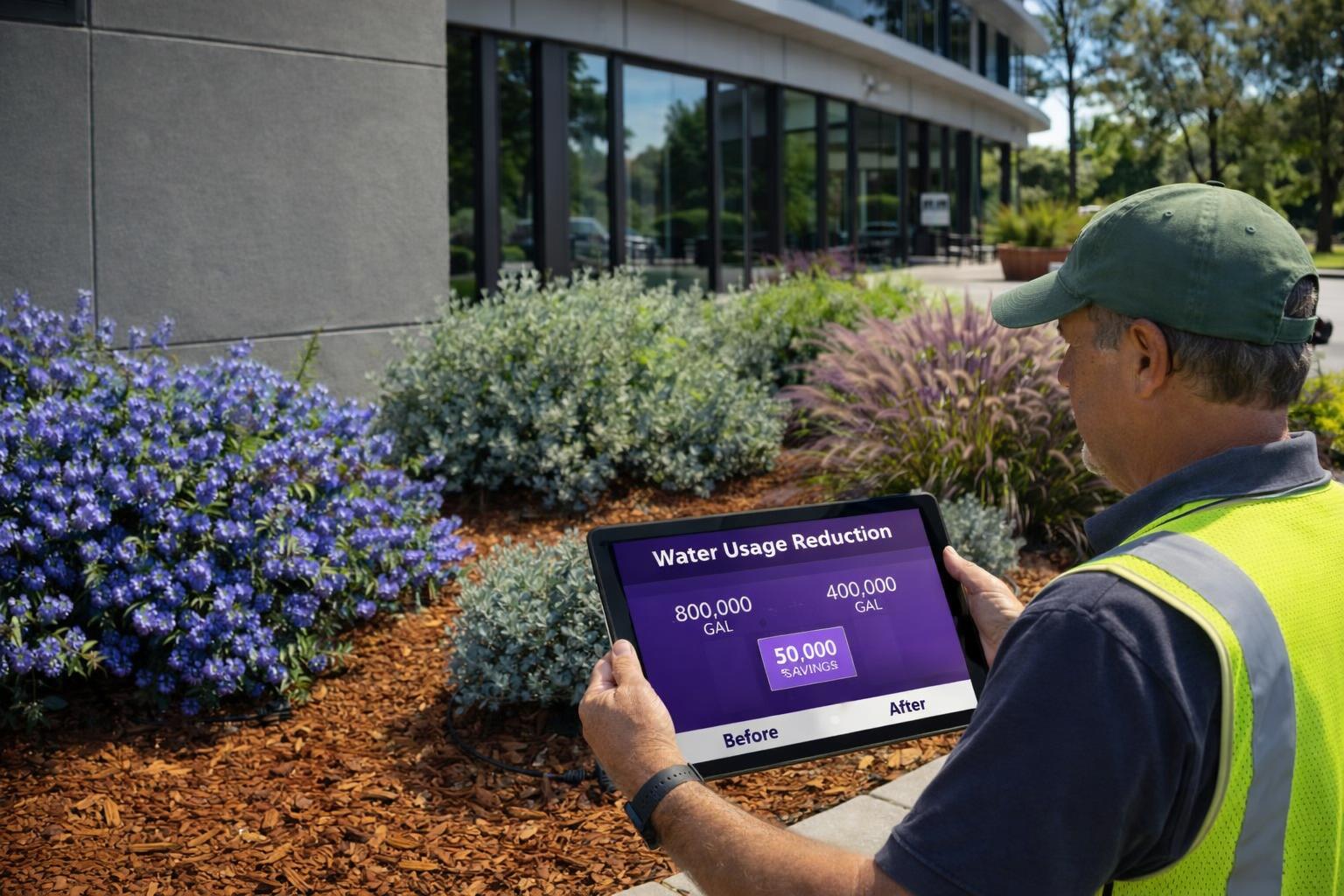
California's ongoing water challenges and regulatory restrictions make traditional water-intensive commercial landscaping unsustainable, both environmentally and economically. A typical Silicon Valley office building with 20,000 square feet of irrigated landscape uses 800,000-1,200,000 gallons of water annually for landscaping at costs of $2,400-$4,800. State and local water restrictions increasingly limit this consumption with mandatory conservation targets and penalties for excessive use.
The transition from traditional turf-heavy landscaping to drought-tolerant, California-native designs reduces water consumption 40-60% while maintaining (often improving) property appearance and value. Modern smart irrigation technology, native plant selection, and efficient maintenance programs create attractive landscapes using 60% less water and 30% less maintenance labor than conventional approaches.
This isn't about brown lawns and dead plants, it's about strategic landscaping designed for California's Mediterranean climate rather than transplanted from wetter regions. Here's the framework Silicon Valley commercial properties use to create water-efficient, attractive, and regulatory-compliant landscapes.
Understanding California's Landscaping Requirements
Water Restrictions and Regulations
State-level requirements (California Executive Orders):
Mandatory water conservation during drought declarations
Outdoor irrigation limited to specific days and times
Prohibition on irrigation causing runoff onto streets or sidewalks
Required irrigation efficiency standards for new and renovated landscapes
Local ordinances (Silicon Valley cities):
Mountain View: Outdoor watering limited to 3 days per week
Palo Alto: Mandatory 20% reduction from baseline water use
San Jose: Irrigation prohibited 10:00 AM - 6:00 PM
Santa Clara Valley Water District: Stage-based restrictions becoming stricter during drought
Sunnyvale: Smart irrigation controller required for commercial properties
Penalties for non-compliance:
Warnings for first violation
Fines $100-$500 for repeat violations
Water service restrictions for chronic violators
Tenant and community complaints creating reputational risk
Model Water Efficient Landscape Ordinance (MWELO):
Applies to new landscapes and renovations >1,000 sq ft
Maximum applied water allowance (MAWA) calculated based on plant type and area
Irrigation efficiency requirements (distribution uniformity >75%)
Mandatory soil amendments and mulching
A Cupertino office park received water district notice:
Violation: Irrigation during prohibited hours (observed 3x in 30 days)
Fine: $250 first occurrence
Warning: Additional fines and potential service restriction
Cause: Irrigation controller not adjusted for current regulations
Fix: Smart controller with automatic compliance programming
Cost: $1,800 controller upgrade vs. ongoing fines and restrictions
Water Budget Calculations
Commercial properties must operate within assigned water budgets.
Calculating Maximum Applied Water Allowance (MAWA):
MAWA = (ETo × PF × HA) / IE
ETo = Evapotranspiration rate (climate-specific, ~50 inches annually for Silicon Valley)
PF = Plant Factor (0.1 for very low water use, 0.8 for high water use)
HA = Hydrozone area (square feet)
IE = Irrigation efficiency (typically 0.75)
Example calculation:
20,000 sq ft of low-water-use plants (PF = 0.3)
ETo = 50 inches
IE = 0.75
MAWA = (50 × 0.3 × 20,000) / 0.75 = 400,000 gallons annually
Traditional turf (PF = 0.8): 1,067,000 gallons annually
Water savings: 667,000 gallons (62% reduction)
Cost savings at $3/1,000 gallons: $2,001 annually
Transitioning to Drought-Tolerant Landscaping
Plant Selection Strategy
California native and drought-adapted plants:
Require 60-80% less water once established
Better adapted to local climate (minimal maintenance)
Support local ecosystem (birds, pollinators, wildlife)
Often more visually interesting than traditional turf monoculture
High-performing drought-tolerant species for Silicon Valley:
Groundcovers: Carex (sedge), dymondia, yarrow
Shrubs: Ceanothus (California lilac), manzanita, sage
Ornamental grasses: Purple fountain grass, Mexican feather grass, blue oat grass
Accent plants: Agave, kangaroo paw, lavender
Trees: Coast live oak, Western redbud, Crape myrtle
Avoiding common mistakes:
"Drought-tolerant" doesn't mean "no water", establishment period requires regular irrigation
Mixing high-water and low-water plants in same irrigation zone creates inefficiency
Non-native "drought-tolerant" plants may be invasive or poorly adapted
Turf Reduction and Alternatives
Strategic turf retention:
High-visibility areas (building entries)
Functional areas (outdoor seating, event spaces)
Minimize or eliminate purely decorative turf
Turf alternatives:
Decomposed granite pathways
Permeable pavers
Native groundcover plants
Mulched planting beds
Hardscape features (decorative stone, boulders)
Transition approach:
Phase 1: Replace remote, low-visibility turf (back of building, side yards)
Phase 2: Replace high-maintenance, problematic turf (steep slopes, narrow strips)
Phase 3: Evaluate remaining turf for functional vs. aesthetic value
A Palo Alto office complex transitioned 35,000 sq ft of turf to drought-tolerant landscape:
Before:
Annual water: 1,240,000 gallons
Annual cost: $3,720
Mowing + maintenance: $8,400
Total annual: $12,120
After:
Annual water: 420,000 gallons (66% reduction)
Annual cost: $1,260
Maintenance: $5,200 (38% less labor)
Total annual: $6,460
Annual savings: $5,660
Conversion cost: $52,000
Payback period: 9.2 years
Additional benefits: Eliminated weekly mowing noise, improved appearance, LEED credit contribution
Smart Irrigation Technology
Weather-Based Irrigation Controllers
Traditional timer-based controllers water on fixed schedules regardless of weather, wasting water during rain and cool periods.
Weather-based controllers (ET controllers):
Use local weather data (temperature, humidity, rainfall, wind)
Calculate daily evapotranspiration (water loss from plants and soil)
Adjust irrigation automatically based on actual plant water needs
Reduce water use 30-50% vs. timer-based systems
Controller types:
On-site weather station: Most accurate but higher cost ($2,500-$4,000 installed)
Internet-connected using nearby weather data: Less expensive, very accurate ($800-$1,800 installed)
Hybrid systems: Combines on-site rain sensor with internet weather data
Required features for commercial properties:
Multiple programs for different plant types (turf vs. shrubs vs. trees)
Remote access for monitoring and adjustments
Flow monitoring detecting leaks and line breaks
Compliance with local watering restrictions (automatic day/time compliance)
ROI typical:
System cost: $1,200-$3,000
Annual water savings: $800-$2,400
Payback: 12-30 months
Ongoing savings: Continue indefinitely
Irrigation System Efficiency
Even best controller wastes water if distribution system inefficient.
Common irrigation inefficiencies:
Sprinkler heads maladjusted (watering sidewalks, buildings)
Broken or clogged heads (uneven coverage)
High-pressure misting (water evaporates before reaching plants)
Runoff from excessive application rate
Mixed head types on same zone (different precipitation rates)
Efficiency improvements:
Quarterly irrigation audit (walk system while running, observe coverage)
Pressure regulation (reduce misting, improve distribution uniformity)
Convert spray heads to rotary nozzles (60% more efficient)
Install check valves on sloped areas (prevent low-head drainage)
Drip irrigation for shrub beds (90% efficiency vs. 60% for spray)
Distribution Uniformity (DU) testing:
Professional measurement of irrigation evenness
Target DU: >75% (required by MWELO)
Poor DU: <60% (some areas over-watered, others under-watered)
Test annually, adjust system to maintain DU
A Mountain View property conducted irrigation audit:
Issues identified: 23 broken heads, 8 heads watering hardscape, 4 zones with 55% DU
Repair cost: $1,800
Water savings: 240,000 gallons annually ($720)
Payback: 2.5 years
Landscape appearance: Improved (eliminated brown spots from poor coverage)
Drip Irrigation Conversion
Converting spray irrigation to drip for appropriate plant types.
Best applications for drip:
Shrub beds
Individual trees
Groundcover areas
Planter boxes
Advantages:
85-95% efficiency (vs. 50-70% for spray)
No evaporation loss
No wind drift
Delivers water directly to root zone
Reduced weed growth (surface stays dry)
Disadvantages:
Higher installation cost
Requires maintenance (clogged emitters)
Not suitable for turf
Potential rodent damage to lines
Cost and ROI:
Drip conversion: $1.50-$3.00 per square foot
Water savings: 30-50% for converted areas
Payback: 3-6 years depending on water costs and area size
Maintenance Practices for Water Efficiency
Mulching Programs
Mulch reduces water needs 25-35% by reducing evaporation and moderating soil temperature.
Mulch depth and type:
Depth: 3-4 inches (too shallow ineffective, too deep harms plants)
Type: Shredded bark, wood chips, or compost (avoid dyed mulch)
Coverage: All shrub beds, tree wells, groundcover areas (not turf)
Mulch maintenance:
Annual replenishment (settles and decomposes over time)
Pull mulch back from plant stems (prevent rot)
Break up compacted mulch (restore water penetration)
Cost and benefit:
Mulch material: $25-$50 per cubic yard
Application: $80-$120 per cubic yard (labor)
Coverage: 1 cubic yard covers ~100 sq ft at 3" depth
Water savings: 25-35% for mulched areas
Ancillary benefits: Weed suppression, erosion control, aesthetic improvement
Soil Amendment and Aeration
Healthy soil reduces water needs by improving water retention and root development.
Soil testing:
Test every 3-5 years
Identifies deficiencies (nutrients, organic matter, pH)
Guides amendment program
Cost: $50-$150 per test
Organic matter incorporation:
Compost improves water retention in sandy soil
Aerates and lightens heavy clay soil
Target: 5-8% organic matter content
Application: 2-4 inches tilled into top 6 inches of soil
Lawn aeration:
Core aeration reduces compaction
Improves water penetration and root development
Frequency: Annually for turf areas
Cost: $0.08-$0.15 per square foot
Seasonal Adjustment
Water needs vary dramatically by season in Silicon Valley.
Irrigation adjustment by season:
Summer (June-September): 100% of calculated water need
Spring/Fall (March-May, October-November): 60-80% of summer
Winter (December-February): 20-40% of summer (rainfall provides most water)
Weather-based controllers automate this, but manual systems require monthly adjustment.
A San Jose property failed to adjust irrigation seasonally:
Winter irrigation: Running at summer levels
Excess water applied: 280,000 gallons (November-February)
Wasted cost: $840
Landscape damage: Fungal issues from overwatering
Runoff violations: Water district notice
Fix: Seasonal irrigation schedule programming
Cost: $0 (programming change only)
Landscape Contractor Selection and Management
Specifications for Water-Efficient Maintenance
Contract should specify:
Irrigation system inspection and adjustment monthly
Distribution uniformity testing annually
Seasonal irrigation schedule adjustments
Mulch depth maintenance
Weed control preventing competition for water
Selective pruning (removing dead/diseased material reducing water draw)
Performance metrics:
Water consumption vs. budget
Plant health visual inspection scores
Compliance with local water restrictions
Response time to irrigation failures
Green industry certifications:
Qualified Water Efficient Landscaper (QWEL) certification
California Certified Irrigation Auditor
WaterSense certification
Landscape Industry Certified (NALP)
Cost Structures
Typical commercial landscape maintenance pricing:
Small property (<10,000 sq ft landscape): $800-$1,800 per month
Medium property (10,000-30,000 sq ft): $1,800-$4,500 per month
Large property (>30,000 sq ft): $4,500-$12,000+ per month
Drought-tolerant landscape maintenance:
Typically 20-35% less expensive than traditional turf-heavy landscape
Less mowing, edging, fertilization
More monitoring and specialized care during establishment
Create Sustainable, Water-Efficient Landscapes
MAFM coordinates drought-tolerant landscaping programs for Silicon Valley commercial properties, including plant selection, smart irrigation design, regulatory compliance, and maintenance specifications that reduce water consumption while maintaining property appearance and value.
Schedule your consultation: Contact MAFM.PRO
Ready to Optimize Your Facilities?
MAFM offers comprehensive facility management solutions tailored to your business needs.
Get in Touch