Sustainability & Energy
Green Cleaning Certifications: What They Mean in California
February 6, 2026
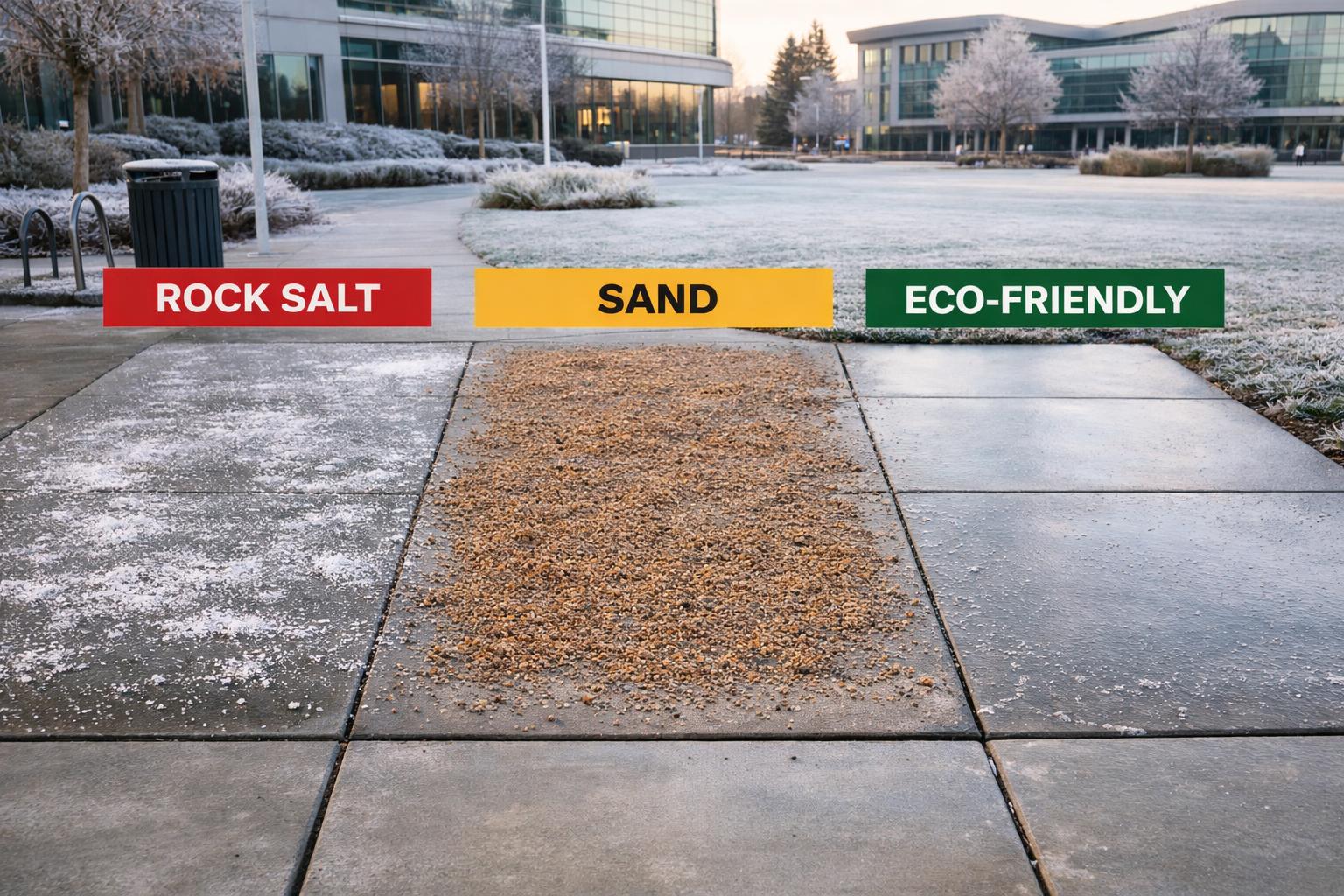
De-icing a California facility mostly comes down to doing very little, early and in the right places. Frost is rare in the Bay Area, so the best plan is a short written one: know the few spots that ice up, keep a measured amount of sand or a low-damage de-icer staged, and treat only the routes people actually walk.
That matters because products sold for snow country carry costs even when you use them a handful of times a year. Chloride salts can mark concrete, stress landscaping and wash untreated into creeks and the Bay. Below: how often it really freezes, what the safety rules expect, how the common products compare and how much to put down.
Rarely. NOAA's 1991 to 2020 climate normals for San Jose's airport station show an average of 3.2 days a year with a minimum temperature at or below 32°F: 1.4 in December, 1.4 in January, 0.2 in February and 0.2 in November, and none from March through October (NOAA NCEI U.S. Climate Normals).
That is one station, and it is a baseline rather than a count for your site. Cold air settles in low ground, and a shaded walkway or a north-facing entry can stay slick after an exposed lot has warmed. Ice also needs moisture, so a spot that stays wet from irrigation overspray, a leaking hose bib or a downspout is the first place to check on a cold morning.
A crew may use de-icer only a few times a year, so nobody builds habits around it. That is why a written plan helps more than a stocked shed.
They expect you to find the hazard and deal with it, not to use a particular product. Federal OSHA's walking-working surfaces rule says surfaces must be kept free of hazards such as snow and ice, that they must be inspected regularly and as necessary, and that a hazard which cannot be fixed immediately must be guarded so employees do not use that surface until it is corrected (29 CFR 1910.22).
California's rule for working areas asks for permanent floors that are reasonably free of oil, grease or water, and for slippery surfaces to be protected with mats, grates, cleats or equivalent protection (Cal/OSHA, Title 8 section 3273).
Neither names a de-icer, a rate or a temperature. The practical reading is that a documented morning check of the known cold spots, plus a fast response, is what shows you took the hazard seriously. Closing an icy north entrance and sending people to a dry door is a defensible first move while the sun does its work.
Usually not, and the reasons are about cleanup and damage rather than performance. Salt works fine at California frost temperatures: Minnesota's pollution control agency lists sodium chloride's lowest practical melting temperature as 15°F, and at a pavement temperature of 30°F one pound of salt melts about 46 pounds of ice in around five minutes (MPCA deicer fact sheet, April 2023). The trouble is what it leaves behind.
Sand makes sense where you need traction fast and want no chemistry at all. Minnesota's guidance puts it bluntly: winter sand never melts anything and provides traction only (MPCA). UW-Madison Extension notes that abrasives do not harm plants, but they do not melt ice or snow either (UW-Madison Extension).
Use it on shaded ramps, stair approaches and short walkway stretches where ice lingers until the sun reaches it. The costs are tracking and cleanup. Because storm drains in the valley carry runoff untreated to the creeks, plan to sweep sand up once the ice is gone instead of letting the next rain move it.
If a surface is merely frosty, closing the route until it warms is cheaper than spreading sand you will have to collect.
For California, the low-temperature range of a product barely matters, so choose on damage and cost. MPCA's table of lowest practical melting temperatures runs calcium chloride -20°F, potassium acetate -15°F, magnesium chloride -10°F, sodium chloride 15°F and calcium magnesium acetate 20°F (MPCA). Every one of them covers a Bay Area frost. The agency also tells buyers to go by the lowest practical melting temperature, not the lower eutectic figure often printed on the bag.
Less than a snow-state table suggests, and measured rather than eyeballed. A few rules from MPCA's winter maintenance guidance carry over directly (MPCA):
Timing helps too. If the forecast low is near freezing and the sun hits the entrance before opening, you may only need to hold the door, set out cones and spot-treat the shadow. Pre-treating priority spots the evening before is cheaper than chasing ice that has already bonded.
One page is enough. It should name:
For wider slip prevention, see our guide to slip and fall prevention in Bay Area buildings.
What is the best de-icer for a California office building?
For the rare thin frost most Bay Area buildings see, sand or a measured anti-icing treatment at a few entrances is usually enough. If you want a chemical, acetate-based products avoid chloride but cost far more than salt. The right choice depends on your concrete, your landscaping and how close a storm drain is.
Can de-icer go down a storm drain in the Bay Area?
It should not. The City of Milpitas says anything other than rainwater entering the storm system is an illegal discharge, and storm drains in the valley run untreated to local creeks and the Bay. Sweep up leftover product and store it covered.
How much de-icer do I need for a thin layer of frost?
Much less than a snow table suggests. MPCA's anti-icing guidance for frost or black ice is 0.3 to 0.6 gallons of salt brine per 1,000 square feet, and its granular rates are targets to work downward from. Calibrate your spreader so you know what a pass really delivers.
Do I have to treat the whole parking lot?
Not usually. Employers are responsible for keeping walking surfaces free of ice hazards and for guarding any that cannot be fixed right away. In practice that means treating or closing the pedestrian routes, entrances and ramps, and leaving the general lot to warm up.
A short walk of your entrances and shaded routes now will tell you where the plan needs to go. MAFM is a facilities management company: we help Bay Area properties write the plan, schedule the checks and coordinate the crew and any exterior vendors so the right spots are handled on the right mornings. Talk to us about facility management or see how we work across San Jose.
MAFM offers comprehensive facility management solutions tailored to your business needs.
Get in Touch