Maintenance
Spring Deep Cleaning: The Complete Facility Transformation Checklist for Silicon Valley Buildings
March 2, 2026
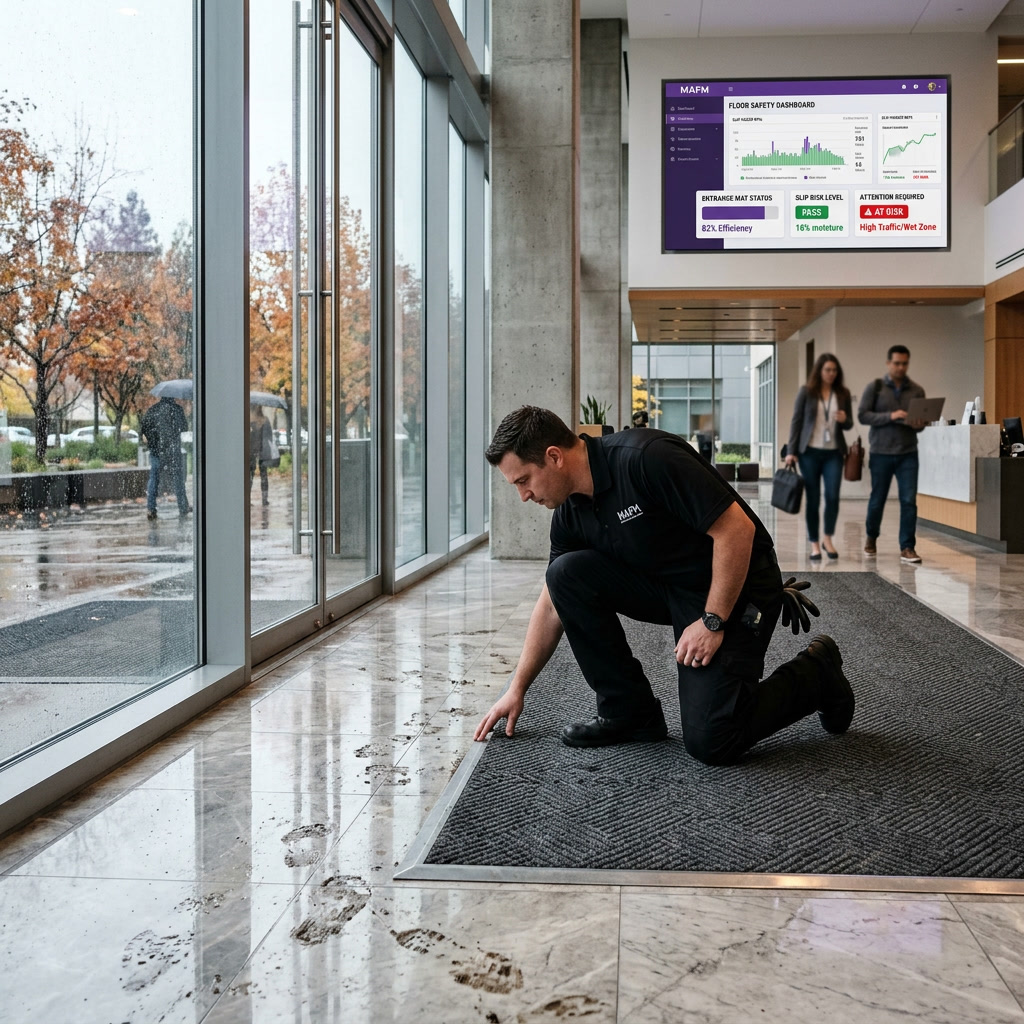
Most facility managers in Santa Clara and San Mateo counties think of matting as a maintenance afterthought — something the janitorial vendor handles, a line item that doesn't get attention until someone slips near the lobby doors. That approach works fine from June through September, when the worst thing tracked in off a parking lot is dust and pollen. It stops working the moment the first real storm rolls through in October, because by then it's too late to fix a matting program that was never sized for wet-weather conditions.
This is the fourth installment in our fall floor care series, and it addresses a facet of transition planning that gets skipped in most maintenance calendars: the entry zone itself. Everything downstream — finish longevity, slip liability, carpet replacement cycles, even HVAC humidity load — traces back to how much water, grit, and petroleum residue actually makes it past the front door. A well-designed matting system stops roughly 80-85% of soil and moisture within the first 15 feet of entry, according to industry testing from the ISSA. A poorly sized one lets nearly all of it through, and your floor crew spends the next six months chasing the damage instead of preventing it.
For Silicon Valley properties specifically, the timing matters. Our first meaningful rain events typically land in the first two weeks of October, but the matting order, install, and staff training need to happen now — early September — because commercial mat vendors see a surge in demand across the Peninsula the moment the forecast turns, and lead times on custom-cut mats stretch to three to four weeks during that window.
Industry guidance from ISSA and mat manufacturers like Crown and 3M calls for a three-zone approach at every high-traffic entrance, and most buildings we assess in Q3 have at most one zone in place — usually an undersized logo mat that looks fine but does almost none of the functional work.
Zone one is the outdoor scraper mat, positioned on the exterior walkway before the door threshold. This needs a rigid, ribbed surface — aluminum or heavy-duty rubber — that physically knocks debris and coarse grit off shoe soles before anyone crosses into the building. Most Silicon Valley office and retail entrances skip this zone entirely because the recessed vestibule doesn't have exterior space for it, which shifts the entire soil load onto whatever mat sits just inside the door.
Zone two is the scraper/wiper mat immediately inside the entrance, typically a tackified or waffle-pattern mat that grabs remaining grit and starts absorbing surface moisture. This is where most buildings put their only mat, and it's undersized: a 3-foot by 5-foot logo mat handles maybe two footsteps' worth of scraping action. ISSA's own tracking studies recommend a minimum of 10-15 feet of matting length per entrance in climates with real wet-weather seasons, which for most Bay Area lobbies means extending matting well past the vestibule into the first section of hard-surface lobby floor.
Zone three is the wiper/finishing mat, a lower-pile, more absorbent surface that pulls remaining moisture and fine soil off shoes before tenants and visitors reach the elevator lobby or carpet line. This zone is the one that protects your VCT finish and your carpet simultaneously, and it's the zone we see removed first when buildings try to cut janitorial costs — usually right before the season when it matters most.
Not all matting material performs the same way against Bay Area fall and winter conditions, and the wrong choice creates its own maintenance burden. Nylon and olefin blend mats hold up well against the oil-and-water mix common in parking structure runoff — a real issue for campuses near 101 and 280 corridor office parks where structured parking feeds directly into ground-floor lobbies. Straight olefin mats are cheaper but mat down and lose absorbency faster under heavy commuter traffic, typically within 12-18 months versus 3-4 years for a quality nylon blend.
For properties with structured or underground parking — common across San Jose, Sunnyvale, and Mountain View campuses — we recommend a specific accommodation: an additional mat zone at the parking structure entrance itself, not just the building's public entrance. Tenants walking from garage to elevator lobby track in oil sheen and standing water from ramps that never gets addressed by front-door matting because it enters through a completely different path. Buildings that skip this secondary zone see disproportionate finish wear concentrated along that garage-to-elevator route, visible as dulling or yellowing well before the rest of the lobby floor shows wear.
Sizing calculations should account for daily foot traffic count, not just square footage of available vestibule space. A building with 400 daily entries needs proportionally more matting surface area — and more frequent extraction — than one with 80. As a rule of thumb, budget for mat replacement or deep extraction cleaning at a frequency inversely related to traffic: high-traffic entrances (300+ daily crossings) need vacuum extraction twice weekly during wet months versus once weekly in dry season, and full mat rotation/cleaning through a commercial laundering service every 2 weeks rather than monthly.
Cost-wise, a properly sized three-zone system for a mid-size Silicon Valley office lobby (roughly 2,000-3,000 square feet of entry/lobby space) typically runs $3,000-$6,000 for quality rental or owned matting depending on custom sizing and logo requirements, plus $200-$400 monthly for a mat service contract covering rotation and laundering through the wet season. Compare that to the cost of a single slip-and-fall claim or an emergency finish strip-and-recoat on 3,000 square feet of lobby tile — easily $4,000-$8,000 done on an emergency basis versus half that scheduled proactively — and the matting investment pays for itself inside one wet season.
Matting handles the soil and bulk moisture problem, but Silicon Valley's fall transition brings a secondary issue that gets far less attention: interior humidity swings as buildings shift from cooling-dominant HVAC operation to a mixed heating/cooling schedule. When outdoor air carries more moisture and HVAC systems aren't yet dialed into fall setpoints, hard-surface floors — particularly polished concrete and VCT — can develop condensation-related tackiness or hazing, especially near glass curtain walls and lobby entrances where temperature differentials are greatest.
Facility teams should coordinate the floor care schedule with the HVAC transition schedule discussed elsewhere in this series. Specifically, request that building engineering confirm dehumidification setpoints in lobby and entry zones are adjusted before the first rain event, not after tenants start complaining about a slick feel near the doors. A floor that tests fine on a dry September afternoon can develop a measurably different coefficient of friction during a humid October morning, and that's exactly the scenario OSHA and Cal/OSHA general duty clause violations get built around after an incident.
Beyond HVAC coordination, this is also the right week to walk every entrance with your janitorial supervisor and physically identify moisture accumulation points — thresholds with poor exterior drainage, canopy gaps that let wind-driven rain reach the door, and interior floor drains near loading docks that haven't been tested since last spring. We recommend documenting this walk with photos and a simple checklist, because it becomes your evidence trail if a slip-and-fall claim surfaces in November and someone questions whether reasonable preventive steps were taken.
The physical matting and moisture controls only work if custodial staff and building engineering execute the operational side consistently, and this is where fall transitions typically break down. Wet-weather floor protocols need to be a documented, dated policy — not a verbal reminder passed along in late September and forgotten by November.
Specifically, your janitorial contract or in-house schedule should specify a trigger-based wet floor sign protocol: signage deployed automatically whenever exterior precipitation is active, not left to staff discretion about whether the floor "looks wet enough" to warrant it. Buildings with unionized or contracted janitorial staff should confirm this trigger language is written into the fall service addendum now, since renegotiating scope mid-storm-season creates friction and delay exactly when you need fast response.
Mat rotation frequency also needs a written fall-season schedule distinct from the summer schedule, ideally posted where both your facilities team and janitorial vendor can reference it without a phone call. A simple version: daily visual mat check every morning before 8 a.m. tenant arrival, mid-day check after any rain event, and full extraction cleaning per the frequency outlined in Section 2. Assign this to a specific role — not "whoever's available" — because ambiguous ownership is the most common reason mat programs fail during the first storm of the season, right when performance matters most.
Finally, loop your property management or ownership group into a brief written summary of the transition protocol. Many Silicon Valley commercial leases include language about common area maintenance standards, and a documented, proactive fall floor care plan is one of the more concrete ways to demonstrate you're meeting that obligation — useful both for tenant relations and for any insurance or liability conversation that arises later in the season.
Entryway matting doesn't get the attention that a full strip-and-refinish project does, but it's arguably the highest-leverage floor care decision you'll make this fall. A properly sized three-zone system, matched to your actual traffic counts and coordinated with HVAC humidity management, prevents the bulk of the moisture and grit damage that would otherwise force emergency finish work in December. The order needs to go in now, while lead times are still reasonable and before the first storm turns matting availability into a scramble.
Pair this with the finish protection and traffic-pattern planning we've covered earlier this week, and your entry zones — the single highest-wear, highest-liability area in any commercial property — will be ready well before the Bay Area's wet season actually arrives.
MAFM's facilities team can audit your building's entry points, calculate proper mat sizing for your traffic volume, and coordinate a wet-season matting and moisture protocol before the fall rains hit — contact us to schedule a walkthrough this month.
Reference earlier posts in this week's Floor Care for Fall series covering hard-surface finish transition schedules and HVAC/humidity coordination for autumn maintenance.
ISSA (International Sanitary Supply Association) entrance matting and soil control guidelines; OSHA general duty clause guidance on walking-working surfaces and slip hazard prevention.
March 2, 2026
August 17, 2026
October 5, 2026
MAFM offers comprehensive facility management solutions tailored to your business needs.
Get in Touch