
Janitorial & Cleaning
Winter Lobby Floor Protection for Silicon Valley Buildings
January 19, 2026
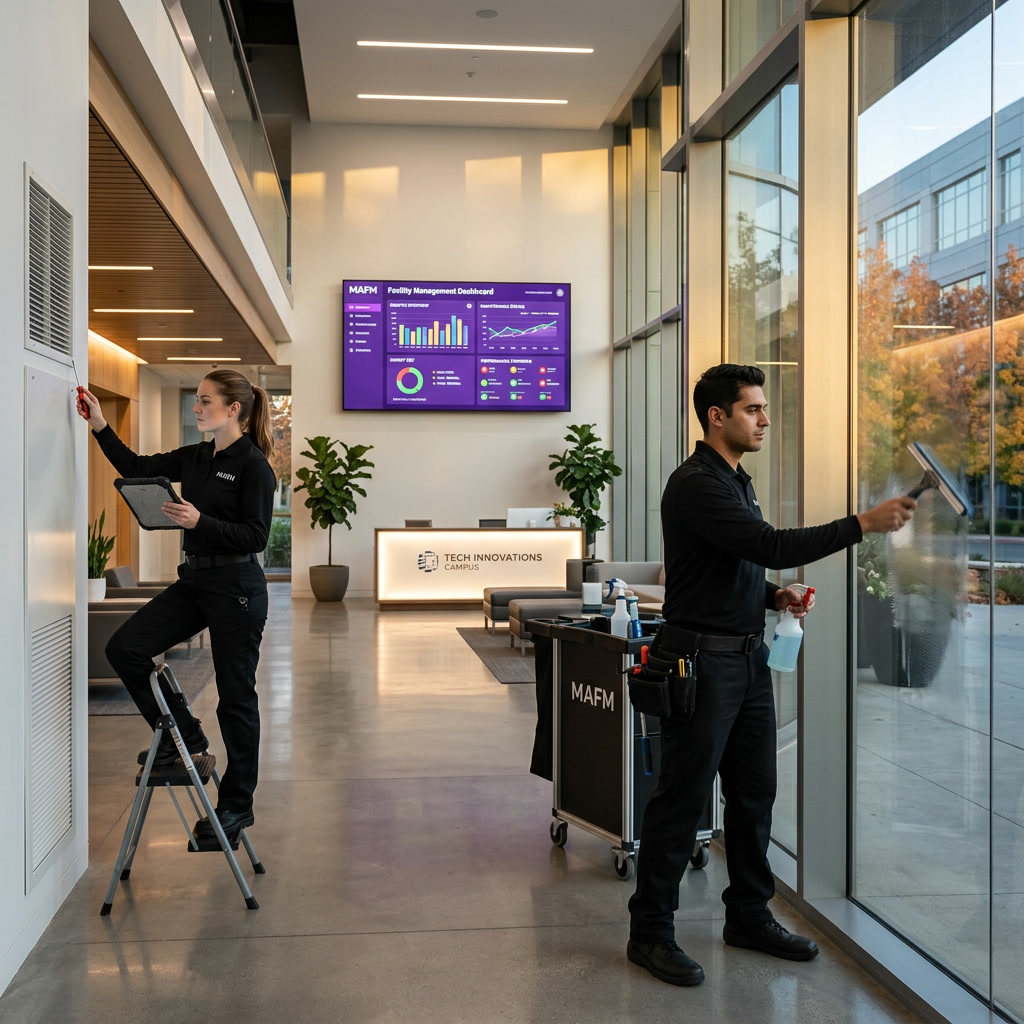
Fall deep cleaning for commercial buildings pays off because October is the last stretch of the year when the weather is mild, the rain has barely started and the work can still be scheduled on your terms. Used that way, it is less a cleaning event than a maintenance reset: you clean what routine service cannot reach, look at what you find, and fix small problems before winter turns them into emergencies.
In San Jose, that window is real but short. NOAA's 1991 to 2020 climate normals for the San Jose airport station show October averaging a daily high of 75.8 degrees F and 0.53 inches of rain. By December the normal is 2.29 inches, and January's average high is 59.8 degrees F. Treat those as long-run averages, not a forecast for any one year.
October is the right time because three pressures are still low: heat, rain and schedule congestion. Each one makes deep work easier now than it will be in two months.
There is also a budgeting reason. Whatever you find in October (a fouled coil, a worn carpet lane, a leaking seal) arrives while next year's plan is still open for changes. Our fall maintenance checklist for Silicon Valley buildings covers the broader inspection list; this post is about the cleaning side of the reset.
Deep cleaning means reaching the soil and equipment that nightly service is not designed to touch, and writing down what you find. Routine janitorial keeps a building presentable. Deep cleaning protects the assets underneath.
The Carpet and Rug Institute (CRI) draws the same line for carpet. In its guide to keeping carpet clean in a facility, vacuuming comes first (daily in high-traffic areas), interim maintenance refreshes the surface on a schedule, and "an annual deep cleaning will remove the deepest, ground-in dirt." CRI's indoor air quality bulletin puts extraction cleaning at every 12 to 18 months and says to "clean more often in high-traffic, commercial areas."
A fall reset typically covers four groups of work:
Not all of that is janitorial work, and it should not be. The point of the reset is one plan that sequences all of it.
Mechanical service goes first because it moves dust, and you want that dust settled before anyone cleans the floor. If coils, returns and filters are serviced after a floor is extracted or refinished, the crew is cleaning the same surface twice.
The reasons to do the mechanical work in fall are practical. ENERGY STAR's checklist for commercial buildings says to clean evaporator and condenser coils, because "dirty coils inhibit heat transfer," and to change or clean HVAC filters monthly during peak cooling or heating season, since dirty filters "overwork the equipment" and lower indoor air quality. It also recommends an annual maintenance contract that includes pre-season tune-ups, and notes that regular maintenance lowers the chance of an emergency breakdown.
That last point is the honest version of the old "avoid the January failure" argument. Maintenance lowers the odds of a failure; it does not remove them. We would not put a dollar figure on a single repair here, because costs vary with the unit, the season and the vendor. For the HVAC detail, see our September HVAC reset checklist if you have not already run it.
On average, yes, but the best-known figure is old and federal, so read it as a range, not a promise. The Department of Energy's 2010 Operations and Maintenance Best Practices Guide (Release 3.0) is the source. Pacific Northwest National Laboratory's summary of maintenance approaches restates it: preventive maintenance savings "can amount to as much as 12% to 18% on average" compared with a purely reactive program.
The same page makes a point that matters more for a reset. It says that proper O&M "increases the probability that the design-life expectancy of equipment will be achieved," and that the costs of early equipment failure "are usually not budgeted for." An October reset is one way to turn that unbudgeted cost into a scheduled one.
The figure comes from federal facilities, which differ from a Silicon Valley office floor. Use it to argue for the practice, then track your own work orders for a year to see what it does for your building.
Plan it in September, with a written scope, an owner for each item and a sequence. A reset that starts with "let's see what we can fit in" tends to become routine service with a longer invoice.
Weather will move some of this. Keep one or two spare dry days in the schedule for exterior work.
Document what you found and what you did, because the record is what makes the reset useful in budget season. A clean floor is gone in a month; a dated note is still there when you build the plan for next year.
On a walkthrough, a facilities crew typically records the following:
Keep these in whatever system you already use, tied to the asset or room. If your team uses a punch list, add a line for each item with an owner and a due date.
When should fall deep cleaning happen in San Jose?
Most of it fits in October, with the exterior and roof-level work done first while it is still dry. NOAA's 1991 to 2020 normals show rainfall rising from 0.53 inches in October to 1.33 inches in November, so exterior work is the part to move up. Interior work can follow into November.
How often should commercial carpet be deep cleaned?
CRI recommends extraction every 12 to 18 months and more often in high-traffic commercial areas. It also describes an annual deep cleaning as the baseline in its facility guide. Pairing it with the fall reset gives you a fixed point on the calendar.
Is deep cleaning the same as a post-construction or move-out clean?
No. A post-construction or move-out clean resets a space between uses. Fall deep cleaning is a scheduled maintenance pass on an occupied building, built around the assets that routine service does not reach.
Does MAFM handle HVAC service as part of a fall reset?
MAFM does not repair HVAC equipment itself. As a facilities management company, we plan the reset, coordinate your mechanical and other vendors, sequence the janitorial work behind them and keep the record. The cleaning itself is done by our janitorial crews.
If you want a written scope, a sequence and a vendor schedule for your building, talk to MAFM about facility management. We will walk the property, list what needs doing and line up the janitorial and vendor work around your tenants.
MAFM offers comprehensive facility management solutions tailored to your business needs.
Get in Touch
