Office Moves & Workplace
Tenant Satisfaction Surveys: How to Measure and Act
February 18, 2026
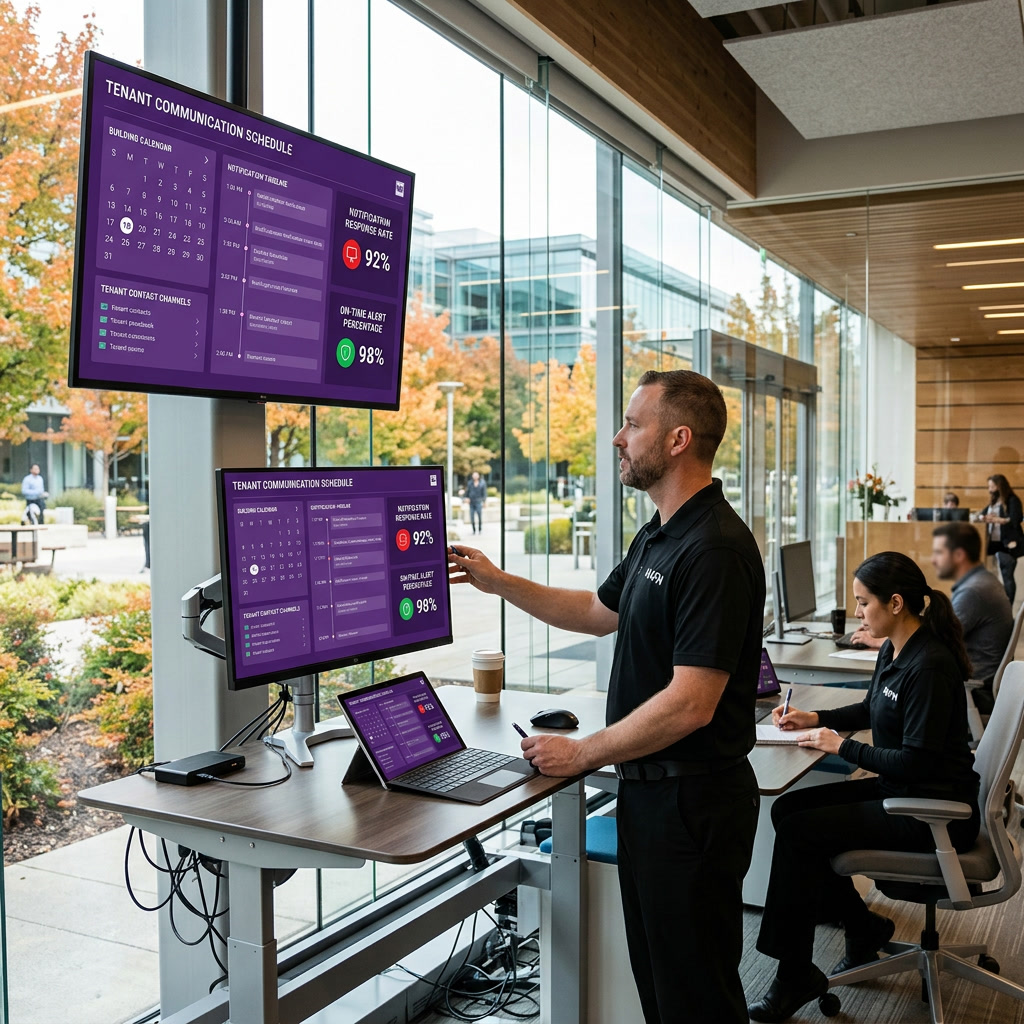
Every September, we field the same calls from property managers across Sunnyvale, Santa Clara, and San Jose: tenants blindsided by HVAC changeover notices, confused about who to call for a leaking roof drain, or frustrated that a scheduled fire alarm test happened during an all-hands meeting. None of these are facilities failures in the mechanical sense. They're communication failures. The chiller worked fine. The alarm test was code-required. What broke was the message: timing, channel, tone, or all three.
This week we broke down the pieces of a fall tenant communication framework that actually holds up under the operational pressure of Silicon Valley's commercial real estate market: dense multi-tenant buildings, hybrid work schedules that make "normal occupancy" a moving target, and tenants who increasingly expect the same real-time transparency from their landlord that they get from a SaaS status page. Earlier posts this week covered the seasonal transition calendar that drives what you're communicating and when, the channel mix that determines how messages actually reach people, the escalation protocols for when routine notices turn into urgent ones, and the documentation habits that protect you when a tenant disputes what was said.
Today's post is the synthesis: how these pieces fit together into a single operating rhythm you can run from now through the December shutdown period. If you've been treating tenant communication as a series of one-off notices, this is the roadmap for turning it into a system.
The biggest mistake we see in Q4 planning is building communication plans around problems instead of around the calendar. Fall in Silicon Valley has a predictable rhythm: HVAC changeover in September and October, fire and life safety testing that clusters around annual compliance deadlines, roof and gutter inspections ahead of the rainy season, and holiday staffing transitions that affect everything from janitorial coverage to after-hours security response. Each of these has a known date range. There's no excuse for any of them showing up as a surprise email three days before the work happens.
The framework we laid out earlier this week starts with mapping every planned fall activity, vendor-scheduled or in-house, onto a single calendar 60 to 90 days out. That includes the boring stuff: irrigation winterization, exterior lighting timer adjustments, the annual elevator inspection your vendor already scheduled in July. Once that calendar exists, your communication plan becomes a scheduling exercise instead of a scramble. You know on August 1st that you'll need a changeover notice by September 5th, a fire alarm testing notice by September 20th, and a holiday coverage memo by November 15th. The message content can be drafted in batches, reviewed once, and released on schedule.
For portfolios with multiple properties, this calendar also becomes your staffing tool. If three buildings need roof inspections in the same two-week window, you know that in advance and can stagger vendor visits instead of having your property management team fielding tenant questions about ladder trucks and access badges on the same Tuesday across every asset.
The second piece we covered was channel selection, and it's worth restating the core rule: the channel should scale with the operational impact on the tenant, not with whatever's easiest for the property management office to send. A routine landscaping schedule change is a tenant portal post or a lobby digital sign update. A planned power shutdown affecting server rooms or lab equipment is a phone call to the facility contact, followed by written confirmation, at least 10 business days out, with a reminder 48 hours before.
We see too many properties running everything through one channel, usually email, because it's low-effort. That works until the week you need a same-day acknowledgment that a tenant's IT director actually saw the notice about a planned network closet power interruption. Email doesn't guarantee read receipts in any meaningful way, and a blast to a shared building distribution list often means the person who actually needs to act on it never sees it.
The channel framework matters even more in Silicon Valley's hybrid-work buildings, where occupancy on any given day might be 30% of lease capacity. A notice posted only on a breakroom bulletin board reaches almost nobody. Digital channels (tenant portal, SMS alerts for urgent items, a maintained facility contact list segmented by criticality) do the work that physical postings used to do in a fully-staffed office environment. If your tenant communication plan hasn't been updated since 2019, this is very likely the gap costing you the most goodwill.
The third post this week addressed what happens when routine becomes urgent: the burst pipe found during a planned roof inspection, the fire panel that throws unexpected trouble codes during scheduled testing, the HVAC changeover that reveals a compressor failure affecting occupied floors. These situations expose whether your communication framework is real or just a set of templates for good news.
An escalation ladder defines, in advance, who gets notified at each severity level, within what time window, and through which channel: and critically, who has the authority to send that notification without waiting for sign-off from someone who's in a board meeting. We've worked with properties where a two-hour delay in tenant notification about a water intrusion event turned a contained issue into a multi-suite damage claim, simply because the on-site engineer wasn't authorized to send anything without property manager approval, and the property manager was unreachable.
The fix isn't complicated: pre-approved message templates for the five or six most likely fall emergency scenarios (water intrusion, power loss, life safety system fault, elevator entrapment, HVAC failure affecting a full floor), pre-authorized sending rights for on-site staff during business hours, and a defined handoff protocol for after-hours events. This is the piece of the framework that has nothing to do with writing skill and everything to do with organizational design: deciding, on a calm Tuesday, who's allowed to hit send during a bad one.
The final piece from earlier this week was documentation: and it's the section property managers most often skip because it feels like paperwork rather than tenant relations. It's actually both. A tenant who receives a clear, timestamped, well-organized communication record during a dispute is far less likely to escalate that dispute into a legal claim or a lease renewal problem. A tenant who gets a vague "we told you about this" with no retrievable proof is far more likely to.
The practical version of this: every tenant-facing notice should exist somewhere searchable and dated, a portal post log, a sent-email archive tied to the property management system, or at minimum a shared drive folder organized by month and category. When a tenant disputes receiving notice of a scheduled water shutoff that affected a client meeting, you want to produce the exact notice, the exact timestamp, and the exact distribution list within five minutes, not after a weekend of searching inboxes.
This also protects your team internally. When staff turnover happens (and in Silicon Valley facility management, it does) the next person managing that tenant relationship needs to be able to see the full communication history without relying on institutional memory that walked out the door with the last property manager.
None of these four pieces work in isolation. A perfectly mapped seasonal calendar doesn't help if the notices go out through a channel nobody checks. A well-designed channel strategy doesn't matter if there's no escalation authority when something goes wrong. And none of it protects you legally or reputationally without documentation that holds up under scrutiny. The framework is a system, and like any system in facilities management, it needs an owner, a review cadence, and buy-in from whoever is authorized to hit send.
As you move into Q4, the properties that handle fall transitions smoothly aren't the ones with the fewest problems: they're the ones where tenants already know what to expect, who to call, and that someone will tell them the truth quickly when something goes wrong.
If your property's communication plan is still living in someone's inbox rather than a documented system, MAFM can help you build and run the calendar, channels, escalation protocols, and documentation practices covered this week: reach out for a fall readiness communication audit.
Link back to this week's earlier posts on the seasonal fall maintenance calendar for tenant notices, channel selection and tenant portal best practices, escalation protocols for facility emergencies, and documentation practices for tenant dispute protection.
BOMA International's tenant communication and emergency preparedness guidelines; IFMA's research on occupant communication in hybrid-occupancy commercial buildings.
MAFM offers comprehensive facility management solutions tailored to your business needs.
Get in Touch