Operations / Tenant Experience
Visitor Management and Hospitality Standards: How Your Building's Guest Experience Shapes Tenant Business Outcomes
June 12, 2026
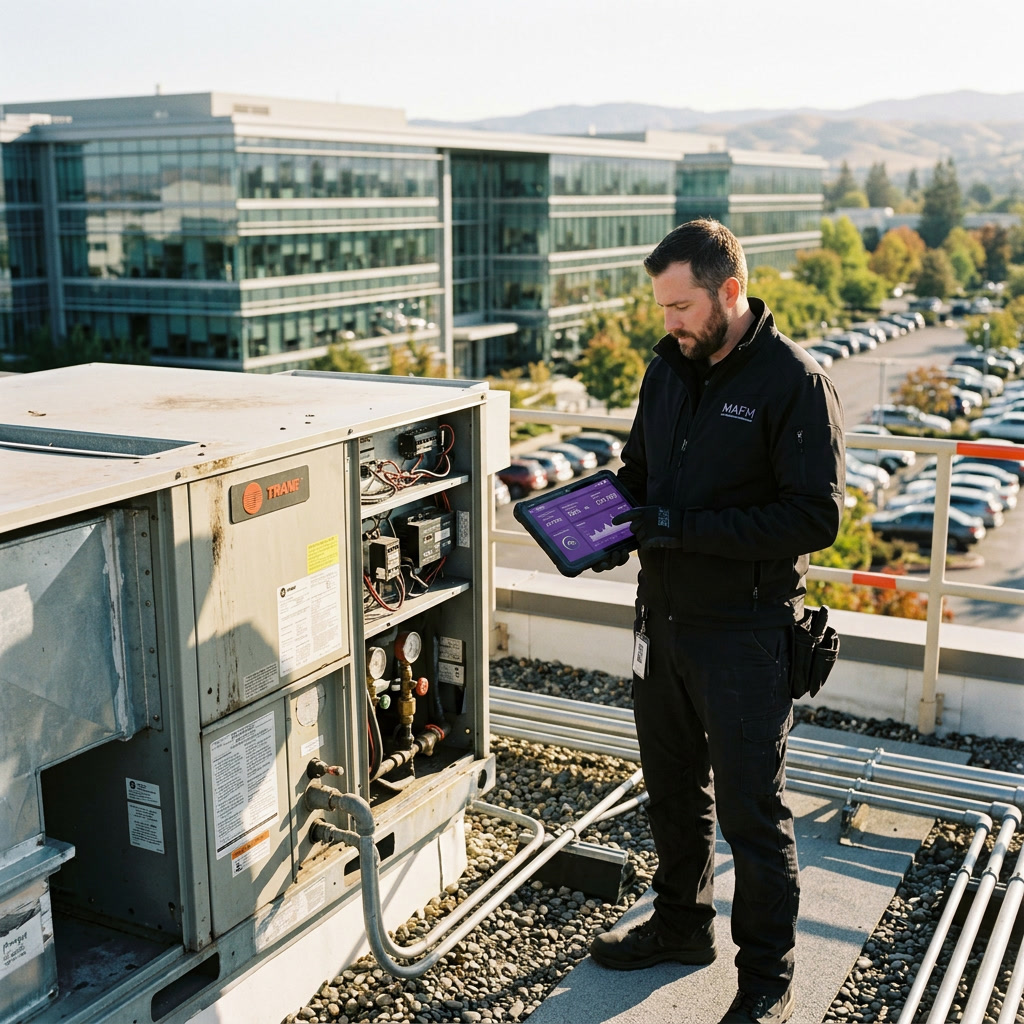
Every facility manager in Silicon Valley has lived this moment: the Tuesday after Labor Day, the parking lot fills up by 8:15 a.m. instead of trickling in until 10, and by 10:30 the third floor is already logging comfort complaints. The conference rooms that sat empty all August are suddenly booked back-to-back, the kitchenettes are running through cold brew twice as fast, and somewhere on the roof, a rooftop unit that spent ten weeks cycling at 40% capacity is now being asked to condition a space at 90% occupancy without anyone having touched its setpoints since June.
This is the part of the September surge that doesn't show up in occupancy reports or lobby traffic counts — it's mechanical, it's buried in a building automation system nobody's opened since spring, and it's exactly where facility teams lose the most ground in the first two weeks of the fall ramp. HVAC systems don't scale linearly with headcount. A building running at 45% occupancy and one running at 88% occupancy aren't the same load profile with a bigger number attached — they're different buildings, with different ventilation requirements, different economizer logic, and in many cases, different utility cost exposure.
This post is a deep dive into one specific piece of the post-Labor Day rebound: how to recalibrate mechanical systems — HVAC, BMS scheduling, and indoor air quality controls — for the jump from summer skeleton-crew occupancy to full fall staffing, without blowing through your utility budget or fielding two weeks of "it's freezing in here" tickets.
Most Silicon Valley office and R&D buildings spend July and August at 35-55% occupancy. Facilities engineers — correctly — use that window to trim energy costs: VAV boxes get throttled back, unoccupied-zone setbacks get more aggressive, chiller staging gets simplified, and BMS schedules get adjusted to start later and end earlier because nobody's badging in before 9. That's good practice. The problem is that almost nobody resets it in reverse.
Come the Tuesday after Labor Day, occupancy in a lot of campuses we service jumps from summer lows into the 75-90% range within a single week, especially at companies enforcing three- or four-day RTO mandates that kick in with the new fiscal quarter. The mechanical system is still running summer logic — the same start times, the same minimum outside air percentages, the same VAV box maximums calibrated for a quarter of the people who are now actually in the building. The result is a lag: it takes the system two to three days to "catch up" to actual demand, and during that lag window, tenants experience stuffy conference rooms, warm perimeter zones by early afternoon, and CO2 levels creeping past 1,000 ppm in dense open-plan areas before anyone notices.
The fix isn't reactive — it's a scheduled recalibration that should already be sitting on your September 1-8 punch list, done before the surge, not after the first complaint ticket.
The single highest-leverage move is resetting occupied/unoccupied schedules in the building automation system a full week ahead of expected headcount increases, not after. If your BMS currently has occupied mode kicking in at 8:30 a.m. and dropping to setback at 5:30 p.m. based on August traffic, and your property management team knows RTO enforcement starts the Tuesday after Labor Day, that schedule change should have gone in on September 1 — pre-conditioning the space so the building is at comfort setpoint by 7:30 a.m., not chasing it at 9:15.
Economizer and outside-air damper minimums need the same review. Many buildings run reduced minimum OA percentages in summer to manage humidity load and cooling costs when occupancy is low. At full occupancy, that same minimum OA setting is now undersized for the ventilation rate ASHRAE 62.1 requires per person — which matters both for comfort and for documentation if your building is tracking indoor air quality commitments to tenants. We typically see minimum OA dampers needing a 10-15% increase in position when occupancy jumps from summer lows to fall highs, and that adjustment has to be paired with a chiller or RTU capacity check, because more outside air in September in Silicon Valley — when afternoon temps are still hitting 85-90°F inland — means more latent and sensible load, not less.
VAV box maximum airflow settings are the other piece people forget. If a zone's VAV was trimmed down during the summer to save reheat energy on a mostly-empty floor, and that floor now has 40 more people in it, the box may be capped below what the space actually needs, even if the AHU has capacity to deliver it. This is a five-minute fix per box in the BMS graphics, but someone has to actually walk the trend logs zone by zone — it's not something you catch from the front-end dashboard alone.
September in Silicon Valley carries an added complication that doesn't exist in the spring occupancy ramp: wildfire smoke season overlaps almost exactly with the return-to-office surge. That means facility teams are managing two opposing pressures at once — more people means more outside air is needed for CO2 dilution and IAQ, but poor air quality days (AQI over 100, which the Bay Area sees on a handful of days most Septembers) mean you need to be ready to shift into recirculation mode and lean on filtration instead.
This is where filter specification matters more than people budget for. If your air handlers are still running MERV 8 filters from a spring maintenance cycle, they were adequate for a lower-occupancy summer but they're not doing meaningful particulate capture on a smoke-impacted day in September. Upgrading to MERV 13 where your AHUs have the static pressure capacity to support it — and confirming that with a fan curve check, not just an assumption — is a standard piece of MAFM's fall readiness scope for tenants who've asked for it, and it typically adds $3-6 per filter versus MERV 8, offset easily against a single sick-day-avoidance calculation for a 150-person floor.
CO2 monitoring is the other lever, and it's underused. Buildings with CO2 sensors tied into demand-controlled ventilation can let the BMS modulate outside air automatically as occupancy climbs through September rather than running a fixed OA percentage all month. For buildings without DCV, a simpler stopgap is manually spot-checking CO2 levels with a handheld meter in your three or four densest zones — usually large conference rooms and open-plan engineering floors — during the first week of full occupancy, and adjusting OA minimums based on what you actually find rather than what the design documents assumed five years ago.
None of this recalibration is free, and pretending otherwise does a disservice to owners who are going to see the utility bill. PG&E's commercial demand charges are structured around your peak 15-minute kW draw in a billing cycle, and the September occupancy jump is exactly the kind of event that creates a new peak — more people, more equipment running simultaneously, chillers staging up faster in the afternoon heat, elevators cycling more, kitchen equipment running longer hours. A building that sets a new demand peak in September can carry that higher demand charge on its bill for months, even after the load drops back down, depending on the rate schedule.
The offset is staged startup, not "everything on at once." Rather than letting the BMS ramp every AHU and chiller to full occupied mode simultaneously at 6:30 a.m., staggering startup times across mechanical zones by 10-15 minutes each avoids stacking multiple large motor starts and compressor stages into the same 15-minute demand window. This is a scheduling change, not a capital expense, and it's the kind of thing that gets skipped when facility teams are focused on comfort complaints and haven't looked at the demand profile on the utility portal in a few weeks. Pulling last September's interval data and comparing it against this September's first two weeks is worth an hour of someone's time — it's usually the clearest signal you'll get that the recalibration actually worked.
The mechanical side of the September surge doesn't get the attention that staffing and access control get, mostly because it's invisible until it isn't — until the third floor is 74 degrees at 2 p.m. and the help desk has nine tickets that all say the same thing. But the fix is almost entirely proactive: reset BMS schedules ahead of the occupancy jump, not after it; check VAV box maximums zone by zone; upgrade filtration for the smoke-season overlap; and stagger equipment startup to protect against a new demand charge peak. None of it requires new capital equipment — it requires someone actually walking the system before the complaints start.
If your building's mechanical systems are still running on summer logic, MAFM's facilities engineering team can run a same-week BMS and IAQ recalibration audit before your occupancy fully rebounds — reach out to schedule a walkthrough before the next heat spike hits.
Link to Monday's Week 33 series opener on the broader post-Labor Day occupancy rebound, and forward-link to later posts this week covering janitorial staffing surges and parking/access control demand during the September ramp.
ASHRAE Standard 62.1 ventilation rate guidance (ashrae.org); PG&E commercial demand charge rate schedule documentation (pge.com).
MAFM offers comprehensive facility management solutions tailored to your business needs.
Get in Touch