Office Moves & Workplace
Tenant Satisfaction Surveys: How to Measure and Act
February 18, 2026
Every prospective client visit, job candidate interview, investor meeting, and partner engagement that your tenants host begins the moment the visitor arrives at your building. Before they reach the tenant's suite, before they meet a single employee, before any business discussion begins, your building has already formed a first impression that colors everything that follows.
This reality makes visitor management and building hospitality a tenant business outcome issue, not merely a building operations function. A candidate who experiences a disorganized lobby arrival, confused building staff, a slow elevator wait, and a scuffed corridor walk to the suite is not starting their interview with the clean slate the tenant intended. A client whose first meeting begins with a parking frustration, an unmanned security desk, and a 10-minute delay because visitor registration did not work is already behind before the pitch begins.
Buildings that treat visitor experience with genuine hospitality standards transform their lobby, security, and common areas from necessary overhead into business assets that their tenants leverage to compete for talent, clients, and capital.
Understanding what your building's visitor experience actually delivers requires walking the journey yourself, as a first-time visitor with no institutional knowledge of how the building works.
The pre-arrival experience begins with the information visitors receive before they come to your building. Can a visitor find clear parking instructions, building access information, and visitor check-in guidance through the tenant's communication? Does your building have a visitor information page or resource that tenants can share? Is the building address and suite information searchable and accurate on mapping platforms?
The parking and arrival experience covers everything from approaching the building to entering the lobby. Is parking clearly signed for visitors? Is the visitor parking area reasonably close to the building entrance? Is the building entrance obvious, accessible, and welcoming? Is the entrance area clean, well-maintained, and attractive at arrival?
The security and check-in experience is where most visitor journeys encounter their first meaningful friction. An unmanned security desk, a complicated visitor management kiosk, a security guard who communicates with indifference, or a check-in process that requires multiple steps and tenant notification delays all create negative impressions that persist through the subsequent visit.
The escort and wayfinding experience covers how visitors navigate from the lobby to the tenant's space. Clear floor signage, easy-to-use elevator banks, and corridors that are clean and well-lit all contribute to an arrival experience that leaves the visitor feeling oriented and confident.
Map the actual visitor journey through your building by walking it as a stranger would, taking photographs at each decision point, and documenting every friction, confusion, or quality gap you observe. This exercise almost always reveals specific improvement opportunities that building management never encounters because they know the building too well to experience it as a visitor does.
Building staff (lobby attendants, security personnel, concierge staff, and any other employees who interact with visitors) are the human face of your building's hospitality and the element that visitors most consistently remember.
Hospitality training for building staff is fundamentally different from security training. Security training optimizes for threat detection, access control compliance, and emergency response. Hospitality training optimizes for warm greeting, genuine helpfulness, efficient visitor processing, and the kind of personal acknowledgment that makes visitors feel genuinely welcomed.
The standard should be: every visitor to the building is greeted by name (if known from pre-registration), given clear direction to their destination without having to ask, and treated with the same professional warmth that a hotel concierge would provide. This standard requires training, reinforcement, and accountability, not simply the instruction to be friendly.
Visitor registration efficiency sets the tone for the entire visit. A visitor management system that allows tenants to pre-register guests, so that arriving visitors can be processed in under 60 seconds with a photo ID and a pre-printed visitor badge, communicates professional building management. A system that requires manual log books, multiple phone calls, and 5-minute waits communicates the opposite.
Security communication calibration is necessary because the security function, which is necessary and appropriate, can be executed in ways that feel welcoming or in ways that feel adversarial. Training security staff on the language and tone that accomplishes access control while maintaining hospitality is a management investment that pays dividends in every visitor interaction.
Digital visitor management systems have matured to the point where they represent a genuine standard for Silicon Valley commercial buildings rather than a premium amenity.
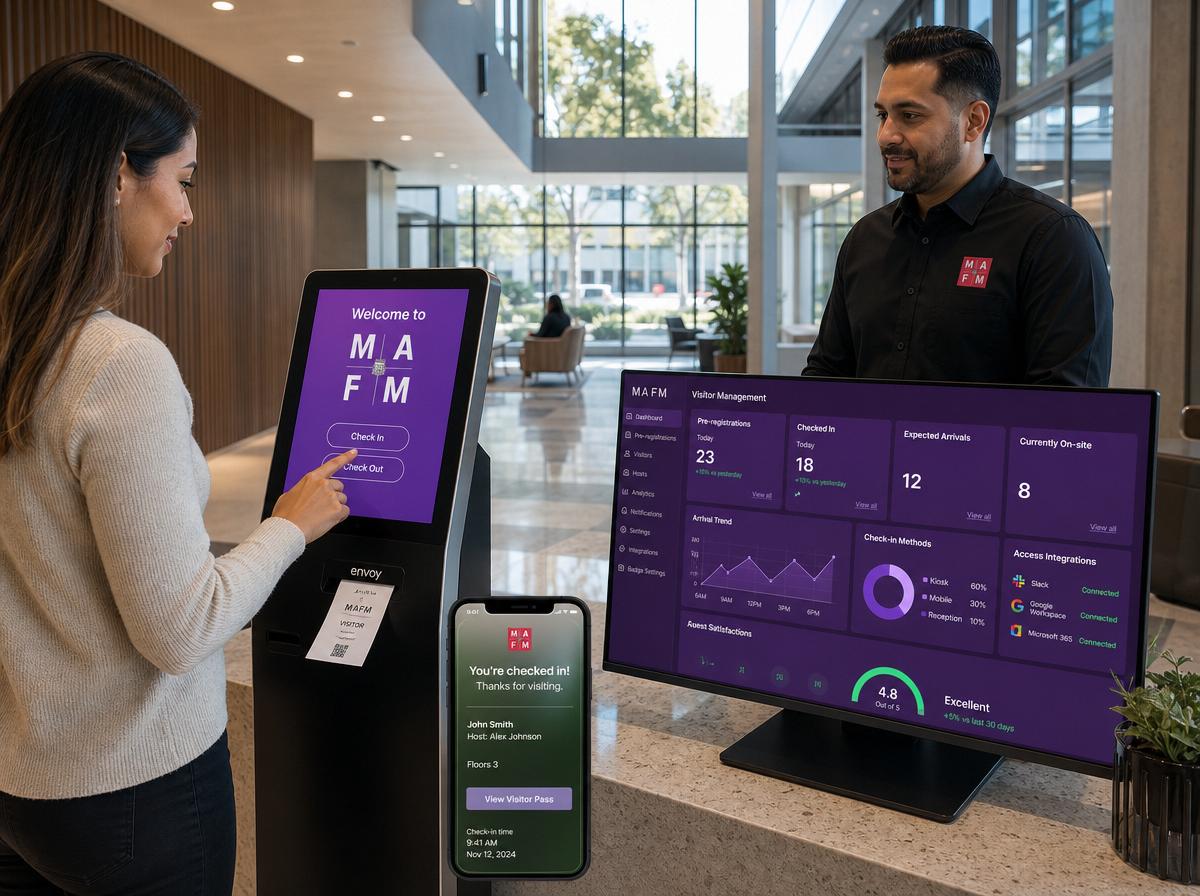
Pre-registration platforms allow tenants to enter visitor information (name, company, contact, visit date and time) in advance, either through a web portal or through integration with the building app. When the visitor arrives, check-in requires only ID verification against the pre-registered record, a process that takes 30-60 seconds.
Self-check-in kiosks allow pre-registered visitors to complete their own check-in without requiring staff assistance, printing their visitor badge and notifying the tenant contact of their arrival simultaneously. These systems reduce lobby staffing requirements while improving the visitor experience by eliminating wait time.
Visitor badge systems that produce professional, printed badges with visitor name, company, host contact, date, and floor access communicate the organized professionalism that reinforces a positive first impression. Handwritten paper visitor logs with generic stick-on name tags communicate the opposite.
Package management integration through the visitor management platform consolidates delivery and package handling into the same system that manages visitor arrivals, reducing the operational complexity of managing these functions separately and providing tenants with the same mobile notification and pickup coordination that residential smart package systems provide.
Access control integration with visitor management systems allows temporary, time-limited building access credentials to be issued to pre-registered visitors, eliminating the escort-to-the-elevator experience that slows lobby operations in high-visit buildings.
The lobby of your building communicates the ownership's values and investment commitment with every person who passes through it. Tenants use it as a backdrop for client meetings, investor visits, and candidate interviews. The impression it creates either enhances or undermines the tenant's own brand positioning.
Lobby aesthetic maintenance requires more than cleaning, it requires curation. Art, plantings, seating arrangements, lighting, and seasonal elements that are thoughtfully maintained and periodically refreshed create a lobby that feels actively managed rather than passively maintained. The lobby that looks the same in December 2026 as it did in January 2025 communicates static management regardless of how clean it is.
Display and information systems in the lobby (building directory boards, welcome screens, art installations, and informational displays) should be current, accurate, and maintained. A building directory with outdated tenants, a welcome screen cycling the same three slides it displayed eighteen months ago, or a broken display panel communicates neglected management at the most visible location in the building.
Seasonal and event programming in the lobby creates community touchpoints while providing the visual interest that makes the lobby an active building experience rather than a pass-through zone. Seasonal floral arrangements, rotating art installations, themed displays around building community events, each creates a specific memory that visitors and tenants associate with the building's character.
Visitor experience management requires specific measurement tools distinct from tenant satisfaction surveys.
Post-visit visitor surveys sent to pre-registered visitors after their building visit provide direct feedback from the people whose experience matters most. A three-question survey, arrival experience rating, check-in experience rating, and one open-ended question about their overall building impression, takes less than two minutes and provides direct visibility into first impressions that building management cannot observe directly.
Tenant feedback on visitor experience quality should be solicited separately from general tenant satisfaction because tenants are in the best position to know how their visitors reacted to the building. A simple quarterly question, "How would you rate the impression your visitors formed of our building?", surfaces the connection between building hospitality and tenant business outcomes.
Mystery visitor assessments conducted quarterly by a staff member or external consultant who visits the building as an unknown visitor and documents the complete visitor journey provide objective, detailed evaluation of the visitor experience from the perspective that matters most.
Visitor management and building hospitality are the facility management functions with the most direct connection to tenant business outcomes, because how your building treats a tenant's visitors directly affects how those visitors perceive the tenant's professional environment. Buildings that invest in genuine hospitality standards become assets in their tenants' business development, recruitment, and investor relations efforts. Buildings that provide mediocre visitor experiences become liabilities that their tenants apologize for.
Conduct your visitor journey walk-through this week. Identify the three highest-impact improvements in your building's visitor experience. Build the hospitality training protocols that elevate your building staff's guest interaction quality. And evaluate your visitor management technology against the standards described here. The visitors who walk through your lobby every day are simultaneously evaluating your building and your tenants, make sure what they see reflects the investment those tenants are making.
MAFM establishes and maintains hospitality standards that transform Silicon Valley building lobbies into business assets for every tenant we serve. Contact us to evaluate your building's visitor experience.
Schedule your consultation: Contact MAFM.PRO
MAFM offers comprehensive facility management solutions tailored to your business needs.
Get in Touch