Facility Maintenance
Commercial HVAC Maintenance for Silicon Valley Offices
February 12, 2026
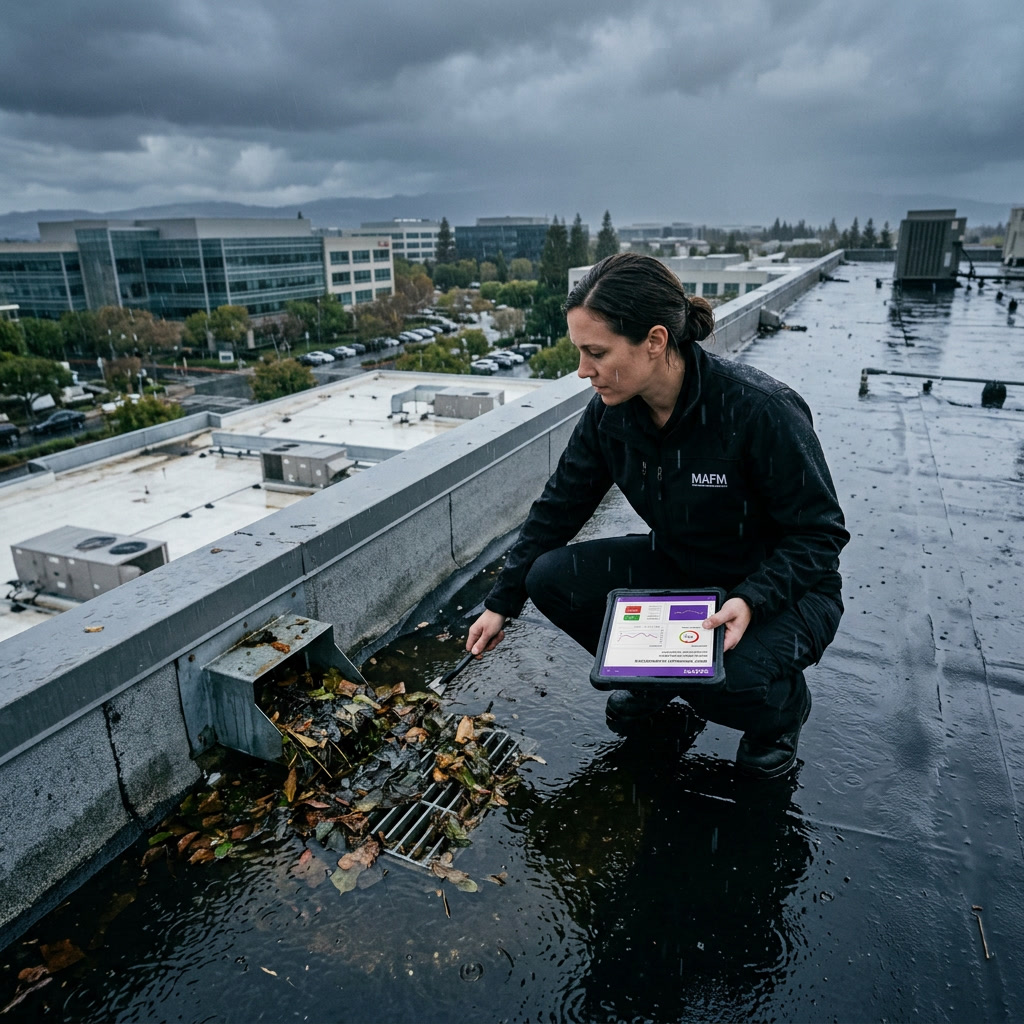
Most facility managers in Silicon Valley are managing buildings with low-slope or fully flat roofs, the standard for the office parks, R&D campuses, and light-industrial buildings that make up the region's commercial stock. That roof geometry works fine nine months a year, but it puts enormous pressure on a handful of small, unglamorous components once the rain starts: roof drains, scuppers, gutters, and downspouts. When those fail, water doesn't run off, it pools, backs up, and eventually finds its way through a membrane seam or parapet flashing joint into the ceiling tiles of a conference room or the server closet nobody wants flooded.
This is the second post in our week-long series on preparing Silicon Valley building envelopes for the rainy season. We're focused today on drainage specifically because it's the single most common source of emergency water intrusion calls we get between October and February, and it's also the most preventable. A roof leak from a failed membrane usually takes years to develop and gives warning signs along the way. A drainage failure can flood a floor in a single afternoon storm because a drain strainer was buried under six months of eucalyptus debris and cottonwood seed pods.
The good news is that drainage maintenance is cheap and fast compared to almost anything else on a building envelope program. A thorough roof drain and scupper service for a 50,000 to 100,000 square foot commercial building typically runs a few hours of labor and a modest disposal fee for debris. Compare that to the cost of extracting water from carpet tile, replacing drywall, and remediating mold in a tenant suite, and the math is not close.
Flat and low-slope roofs are the dominant design across the Valley's office and industrial parks built from the 1970s through the 2000s, including the vast majority of properties in Sunnyvale, Santa Clara, Mountain View, and North San Jose. These roofs rely entirely on engineered drainage points, internal drains, roof-edge scuppers, or gutter-and-downspout systems, to move water off the building. There's no gravity assist from a pitched roof doing most of the work for you.
Add to that the landscaping profile common on Silicon Valley corporate campuses: mature oaks, sycamores, and eucalyptus trees planted decades ago for shade and curb appeal, now dropping leaves, seed pods, and bark debris directly onto roof surfaces and into gutter runs. We regularly find drain sumps on tech campus buildings packed with a solid mat of decomposed leaf litter, sometimes six inches deep, that has been building up since the previous rainy season because nobody walked the roof in the dry months.
The other regional factor is how our rain actually arrives. Silicon Valley doesn't get slow, steady rainfall most of the year, it gets atmospheric river events that dump one to three inches in a 24-hour period after months of bone-dry conditions. A drainage system that would keep pace with gradual rain in a different climate gets overwhelmed almost immediately when four inches of debris-clogged drain meets a two-inch atmospheric river day. This is precisely the storm pattern that has caused most of the flooding incidents we've responded to on Valley properties in recent years.
A proper pre-season drainage inspection covers four physical components, and skipping any one of them leaves an opening for water to back up somewhere on the roof.
Roof drains and strainers come first. Every internal drain should have its strainer basket or dome removed, cleared of debris, and checked for cracks or missing sections, since a missing strainer is actually worse than a clogged one because it allows debris straight into the drain leader and creates a blockage inside the pipe where you can't see or reach it. We also run a water test on each drain, pouring several gallons directly into the sump and confirming it clears within a reasonable window, generally under a minute for a properly sized drain.
Scuppers and overflow scuppers are next, and they get overlooked constantly because they're mounted flush with the parapet wall and don't look like drainage infrastructure to an untrained eye. Primary scuppers need to be checked for debris packed into the throat of the opening, and overflow scuppers, which are set slightly higher and only activate when the primary system is overwhelmed, need the same treatment even though they rarely see water. If your overflow scupper is clogged the one time you actually need it, that's the day water tops the parapet and runs down the exterior wall or, worse, pools until the roof membrane itself starts to fail.
Gutters and downspouts round out the exterior sections, especially on buildings with sloped roof sections, mansard-style parapets, or attached canopy structures common on retail and mixed-use properties. Downspouts should be checked from the top opening down to the discharge point, since blockages often sit at elbow joints where debris accumulates and where a simple camera scope or plumber's snake resolves the issue in minutes.
Finally, the roof surface slope itself gets evaluated for ponding. Water sitting more than 48 hours after a rain event anywhere on a flat roof indicates either a drainage point issue or a structural deflection problem, and both need to go on the maintenance plan before the season's first major storm.
Ponding water gets dismissed by a lot of building owners as a cosmetic issue, something that looks bad on the roof but isn't really hurting anything. That assumption is expensive. Standing water accelerates membrane degradation through UV-reflective breakdown and freeze-thaw cycling on the rare cold nights we do get, and it adds significant dead load to the roof structure that most buildings were not engineered to carry indefinitely. A single inch of water across a 10,000 square foot roof section weighs over 5,000 gallons, north of 40,000 pounds, sitting on structural members that were designed with a drainage assumption baked into the calculations.
Beyond the structural concern, ponding water is where roof leaks actually originate in the vast majority of cases we investigate. Water doesn't need a large defect to get through a membrane, it needs time and hydrostatic pressure, and a pond that sits for days after every storm is giving even a pinhole seam failure everything it needs to become an active leak. We've walked roofs where the membrane looked visually intact from a distance, but a ponding area had been slowly working water through a seam for an entire season, and the first sign anyone had was a stain on a drop ceiling tile two floors down.
There's also a tenant experience dimension that gets underweighted in facility budgets. A conference room ceiling stain or a lobby bucket catching a slow drip during a board presentation or an investor walkthrough is a visible, embarrassing failure that reflects on property management regardless of whose responsibility the roof technically is under the lease. For multi-tenant office and R&D buildings across the Valley, drainage failures are one of the fastest ways to generate tenant complaint tickets and erode confidence in building management heading into lease renewal conversations.
The right frequency for drainage service depends on your tree cover and roof size, but as a baseline we recommend two full drainage clearings per year for most Silicon Valley commercial properties: one in early fall before the rainy season starts, timed for late September to early October, and a second mid-season check in December or January after the first few major storms have had a chance to move fresh debris into the system. Properties with heavy tree canopy, campus settings with mature oaks or eucalyptus overhanging the roofline, should add a third visit in November.
Documentation matters more than most facility teams realize, particularly for properties carrying commercial property insurance with water damage exclusions tied to maintenance negligence. A dated service log showing drain and scupper clearing before storm season, along with photos of each drain point before and after service, is exactly the record an insurance adjuster wants to see if a water damage claim ever gets filed. Buildings without that documentation sometimes find claims disputed or delayed on the argument that the damage resulted from deferred maintenance rather than an unforeseeable event.
Staffing this internally is possible for larger owner-occupied campuses with in-house engineering staff, but most third-party managed properties get better results contracting it out to a crew with roof access equipment, fall protection certification, and experience distinguishing a routine debris clog from a sign of a bigger structural or membrane issue. The inspection should always include a written report with photos, not just a verbal "it's clear" from whoever did the walk.
Roof drainage doesn't get the attention that a full membrane replacement or a re-roofing project gets, largely because it's cheap, fast, and invisible when it's working correctly. But invisible is exactly the problem: the buildings we get called to after a flooded suite or a stained ceiling almost always turn out to have drains, scuppers, or downspouts that hadn't been serviced since the previous spring. Getting ahead of the season with a documented four-point inspection now, before October's first real storm, is the highest-leverage exterior maintenance dollar a facility manager can spend this month.
MAFM's exterior maintenance crews are booking pre-season roof drainage inspections now for Silicon Valley commercial and campus properties, contact us to schedule a four-point drain, scupper, and gutter clearing before the first storm hits.
Reference this week's opening post on the overall building envelope preparation series, and point readers ahead to later posts in the series covering roof membrane inspection, parapet and flashing checks, and window/curtain wall sealant maintenance.
National Roofing Contractors Association (NRCA) guidance on roof drainage system maintenance; NOAA/National Weather Service Bay Area seasonal precipitation and atmospheric river outlook resources.
MAFM offers comprehensive facility management solutions tailored to your business needs.
Get in Touch