Technology & Operations
AI Facility Management: What It Can Do for Response Times
January 21, 2026
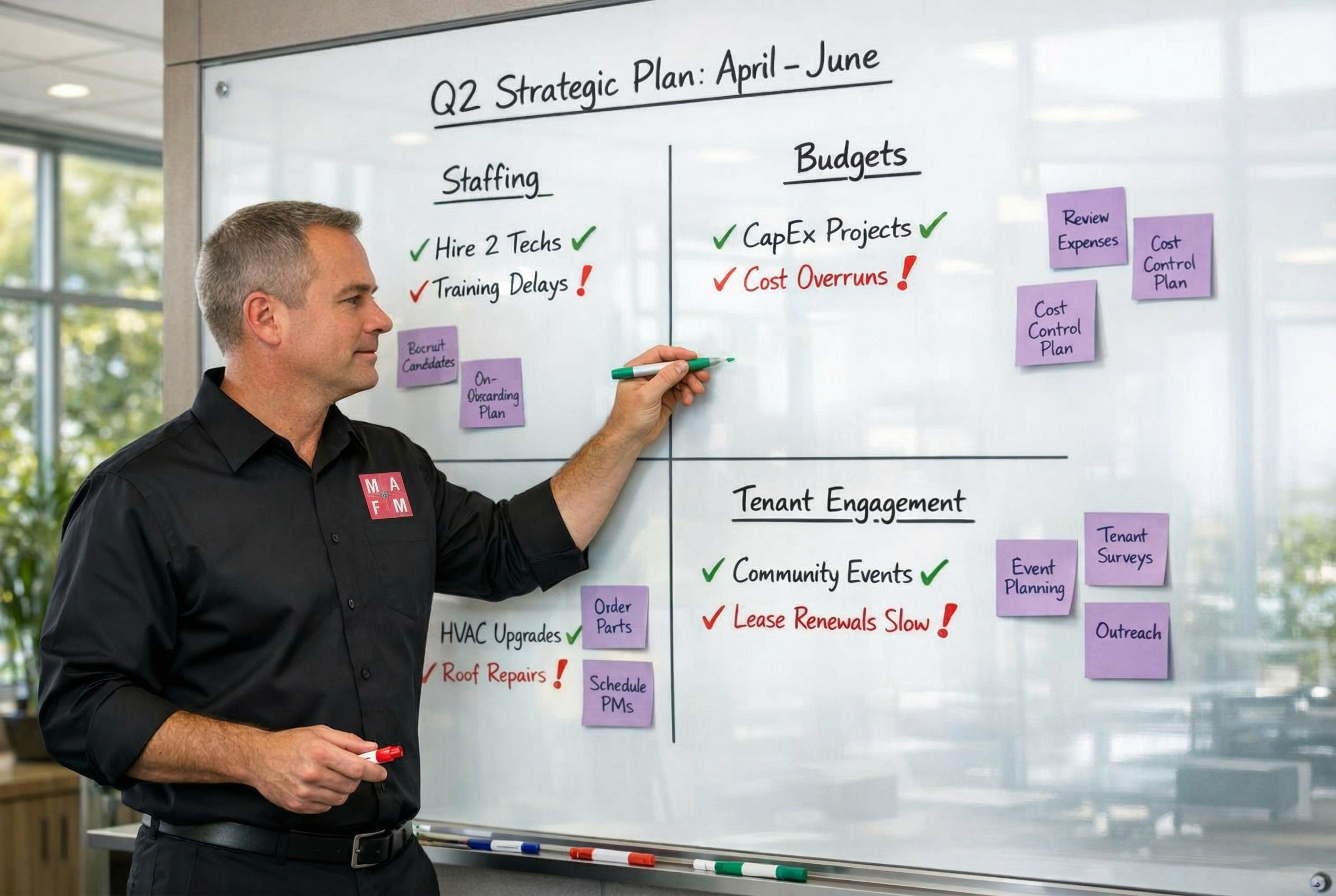
Q2 facility operations planning is a short reset between the first and second quarters: read what the last 90 days of work orders, vendor reports and tenant comments say, then turn that into a dated April to June calendar, a budget position and a list of compliance dates. Done in a few focused sessions, it keeps summer from arriving as a surprise.
The timing helps. At San Jose's airport station, NOAA's 1991 to 2020 normals show 1.07 inches of rain in April, 0.39 in May and 0.18 in June, against 2.80 in January and 2.69 in February (NOAA NCEI U.S. Climate Normals). The wet season is over, which makes spring the practical window for exterior work, roof and drainage checks and mechanical startup before cooling demand builds.
Start with the work order log, because it shows what the building has been telling you. Pull every ticket from January through March and sort it by system, urgency and root cause. Repeat calls in the same zone point to a cause that has not been fixed, and they tend to get louder when occupancy and temperatures rise.
Then work through four questions:
Close the loop on data quality while you are in there. Tickets closed without a resolution note, inconsistent categories and missing timestamps make next year's debrief harder, so fix the habit now. A longer version of this review is in our Q1 facility management review.
Put every item on a dated calendar with an owner, because a list of intentions slips and a calendar gets checked. A workable spring sequence looks like this:
One spring rule deserves emphasis. If anyone pressure washes a plaza, garage or entrance, the wash water cannot go to the storm drain. The Santa Clara Valley Urban Runoff Pollution Prevention Program tells cleaners that federal, state and local regulations prohibit any discharge other than rain to the storm drain, and recommends covering inlets and diverting wash water to the sanitary sewer or landscaping where permitted (Santa Clara Valley Urban Runoff Pollution Prevention Program fact sheet). Write that requirement into any exterior cleaning scope.
Several recurring obligations land in or just after this quarter, and none of them wait for a convenient moment.
Compare Q1 spend to budget line by line, then separate real efficiency from deferred work. An underspend in preventive maintenance is not a saving if the work moved to Q3 and will arrive with summer pricing and a tighter schedule.
The case for protecting preventive work is documented. A federal operations and maintenance guide estimates that well-run programs save 5% to 20% on energy bills without major capital spending (U.S. DOE Federal Energy Management Program, 2010), and Pacific Northwest National Laboratory's summary of that guidance puts the average saving of preventive over purely reactive maintenance at 12% to 18% (PNNL). Those figures come from federal facilities and are older, so treat them as direction, not a promise for your building.
Three practical moves for Q2:
For a view across all four quarters, see our annual facility operations calendar.
Tell tenants what is planned, when it happens and what it means for them, before the first lift or hose appears. People tolerate a closed walkway or noisy rooftop work far better when they know it is scheduled maintenance.
A short routine covers most of it:
Decide on seasonal staffing and vendor commitments in April, while you still have choices. Occupancy tends to shift with the season, so check whether cleaning and maintenance coverage still matches how the building is used.
Training belongs on the Q2 calendar too. Under California's injury and illness prevention rule, employers must train new employees, anyone given a new job assignment, and employees whenever new substances, processes, procedures or equipment represent a new hazard (Title 8 section 3203). Federal hazard communication rules require chemical training at initial assignment and whenever a new chemical hazard is introduced (29 CFR 1910.1200). If you changed products or equipment in Q1, document the refresher.
Confirm specialty vendors, such as floor care, window cleaning, pressure washing and HVAC technicians, for the coming months, and make sure each one's scope includes the stormwater requirement above.
When should a Q2 facility operations plan be finished? Aim to finish it in the first two weeks of April so that exterior work and mechanical startup can use the mild, mostly dry weeks. Planning later compresses the same work into the start of the cooling season.
What is the first thing to review from Q1? The work order log. Sorting tickets by system, urgency and root cause shows repeat problems, vendor gaps and staffing strain faster than any other record.
Does every building need to report energy use by June 1? No. California's benchmarking program applies to buildings with more than 50,000 square feet of gross floor area, with reports due each year by June 1 (California Energy Commission). Check the program's current guidance to confirm whether your building is covered.
Does Cal/OSHA's heat rule apply to office buildings? The indoor rule is based on conditions, not job type: it applies to indoor work areas at or above 82 degrees Fahrenheit (Title 8 section 3396). An office zone that regularly gets that warm with people working in it should be reviewed against the rule.
A good Q2 plan is a dated calendar, a clear budget position and a list of compliance dates, shared with the people who carry it out. MAFM works as a facilities management partner that plans, schedules and coordinates building work and the vendors behind it. Talk to us about facility management if you want help turning your Q1 data into the next quarter's schedule.
MAFM offers comprehensive facility management solutions tailored to your business needs.
Get in Touch