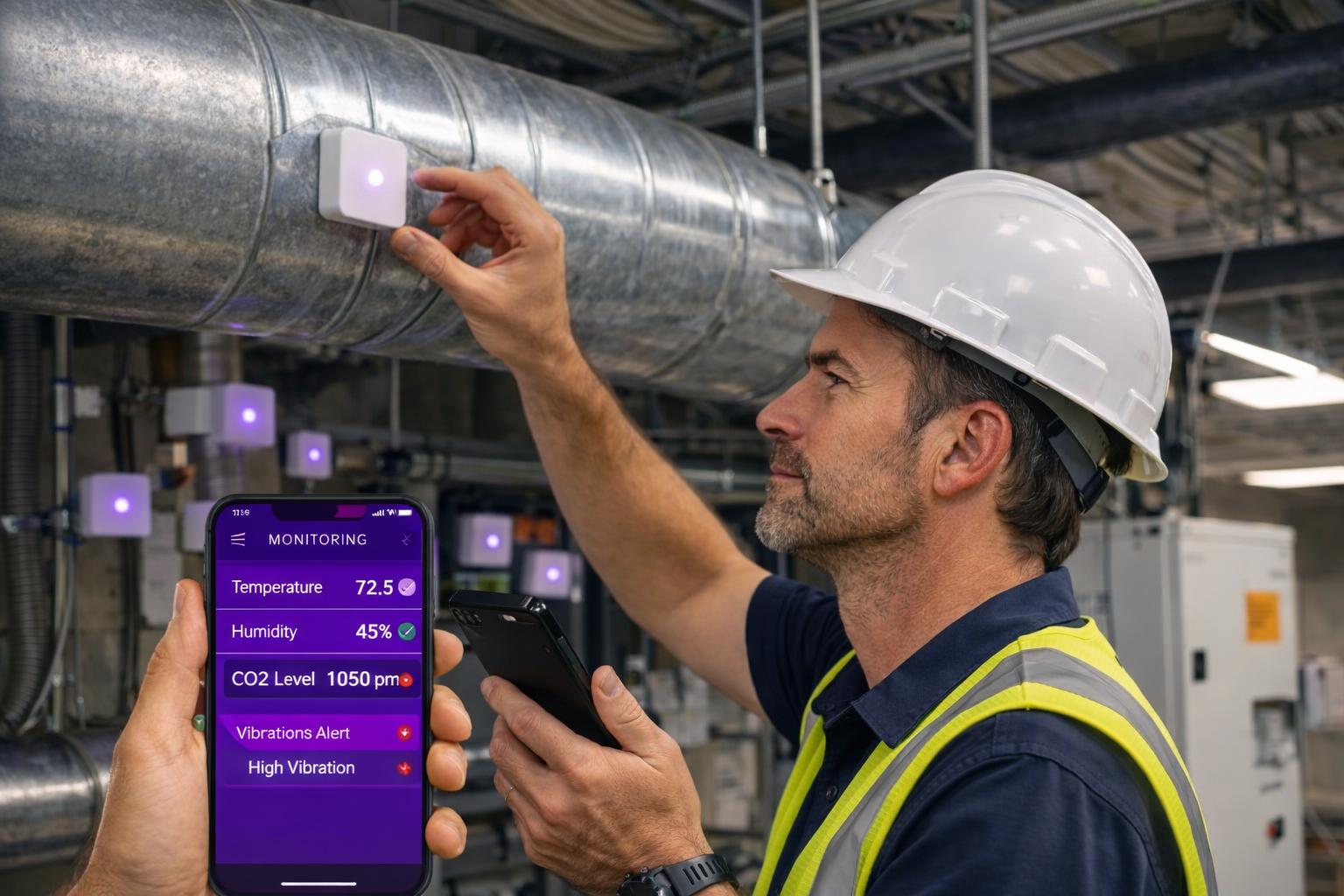
Technology & Operations
Tech Campus Facility Management: What Offices Can Borrow
March 10, 2026
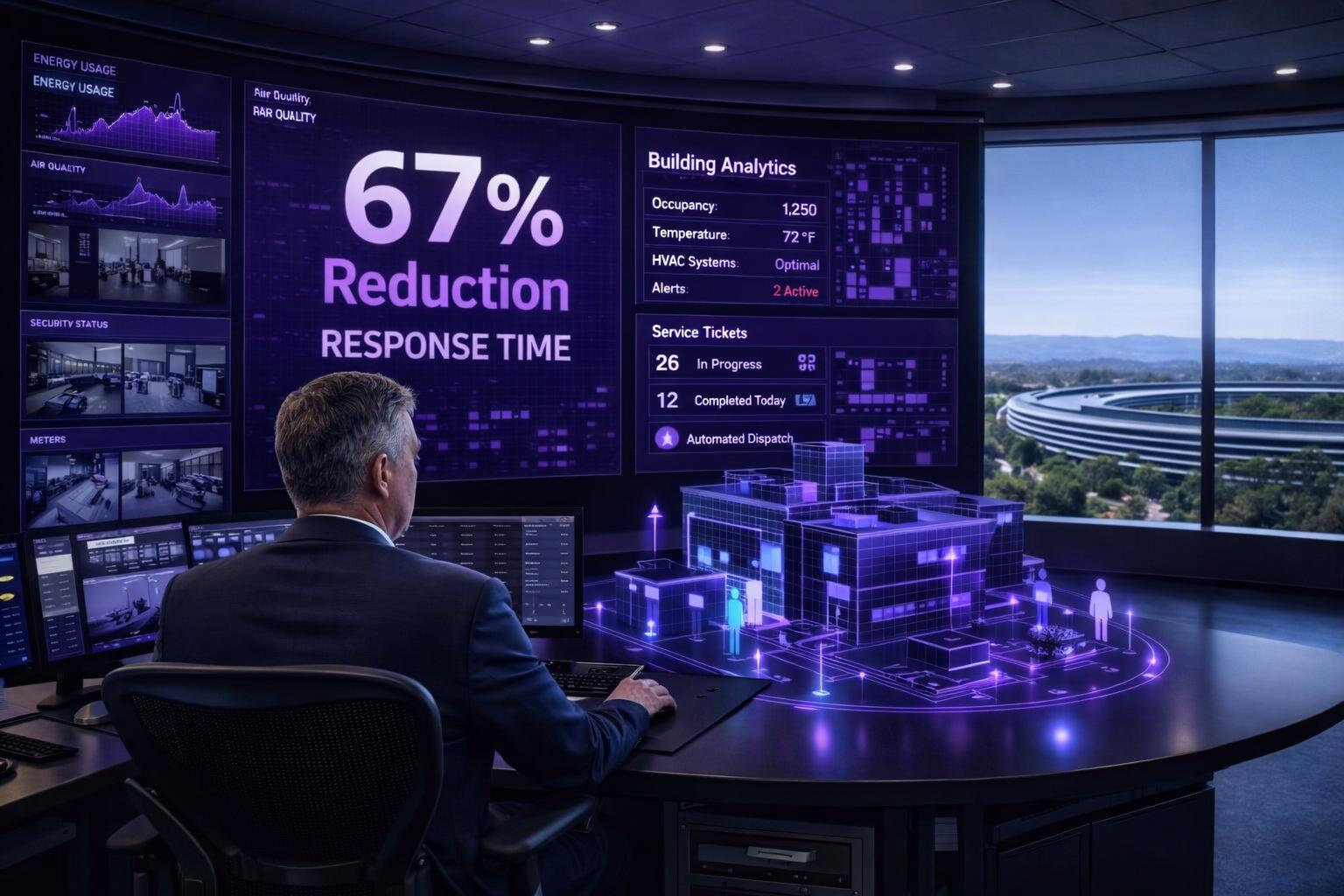
AI facility management can shorten the slow parts of a service request: sorting incoming requests, deciding who should take them, and spotting equipment that is starting to fail. What it cannot do is promise a specific improvement. No independent study we could find supports a figure like "response times cut by two thirds," and any vendor or article quoting one should be asked for its method.
The honest picture is more useful. Most delays in building service are process delays, and software only helps when the process underneath it is sound. This post shows where response time actually goes, what AI tools can reasonably do about it, what the evidence says about predictive maintenance, and how to test any claim in your own building.
Mostly before anyone picks up a tool: in intake, prioritization, scheduling and follow-through. The clearest public evidence comes from an audit rather than a vendor. In 2022 the Office of the District of Columbia Auditor released an audit of the city's Department of General Services, which already had a computerized maintenance management system (CMMS). Across 48,356 completed or closed work orders, an average of 55 days passed between the requested date and completion. The audit also reported that 62% of high priority work orders were not completed within the mandatory 10 days, and that for 17 of 25 sampled work orders supervisors never gave the requester an estimated completion date (Office of the D.C. Auditor, November 28, 2022). The auditor's summary line was that the agency has tools it is not using.
That is a public school system and government buildings, not a Silicon Valley office, so it does not predict your numbers. It does show that owning software and answering requests quickly are different things.
Prioritization is another weak point. A 2024 survey of 71 facility management professionals found that user-driven approaches to prioritizing work orders are the most common today, and that they suffer from inconsistency and subjectivity (Ensafi, Thabet and Besiktepe, 2024). In plain terms, two people looking at the same request often rank it differently.
A typical request passes through these stages, and each is a place where time disappears:
It is best at the sorting stages, where the work is reading messy text and matching it to rules. These are descriptions of what such tools are built to do, not measured results.
None of these replaces the technician. Each only helps if the rest of the chain, such as a crew actually available and parts on hand, can respond to the better information. A well-routed ticket that no one has time to work is still a slow ticket.
It can, though the evidence is about cost and energy rather than response time. The U.S. Department of Energy's Federal Energy Management Program published an operations and maintenance best practices guide in 2010. It describes reactive maintenance as running equipment until it breaks, and estimates, based on past studies, cost savings of as much as 12 to 18 percent for preventive maintenance over a purely reactive program, and 8 to 12 percent for predictive maintenance over preventive maintenance alone (PNNL for DOE FEMP, O&M Best Practices Guide, Release 3.0, 2010). The guide treats these as estimates that depend on the facility's starting condition.
For modern analytics, the better recent evidence comes from Lawrence Berkeley National Laboratory. Using data from a large research and industry partnership covering thousands of buildings, it reported median annual energy savings of 9% for organizations using fault detection and diagnostics (FDD) tools and 3% for energy information systems, measured after two years (Lin and others, Energies, 2022). The same paper points to simpler data integration and more efficient processes for acting on the tools' findings as areas for improvement.
Two cautions follow. These are energy figures, not response-time figures. And the findings still have to be acted on by someone. A fault alert that sits in an inbox saves nothing.
Measure your own baseline first, then compare. Any tool, AI or not, should be judged against numbers from your building. Track these by priority level:
Start with a month or a quarter of baseline data. If you have none, that is the first finding, and fixing it costs little. Then change one thing at a time so you know what moved the numbers. A tool that routes better and a new on-site crew arrive together will blur the result.
Ask any vendor the questions that expose a claim: Measured in which buildings, over what period, against what baseline, and who calculated it? Case studies without a named method are marketing, not evidence.
Digitize first, then automate, and keep people in charge of anything safety-related. A workable order:
If you are comparing systems, our guide to choosing a CMMS covers what to look for. For a closer look at chatbots and ticketing, see AI-powered tenant service, and for equipment monitoring, see predictive maintenance and AI.
A partner sets the response standard and makes sure someone owns it, whatever software sits underneath. The D.C. auditor's comments centered on more supervision, independent oversight of the work and better transparency with clients, not on buying a new system. Those are management habits: written priority levels, a named person who owns the queue, a rule that every request gets an expected completion time, and a regular review of what was slow and why.
MAFM is a facilities management company, and that coordination is the work: planning, scheduling and following up on service requests and the vendors who perform specialist repairs. If you are weighing AI tools for your building, a partner can help you define the baseline, run a small pilot and judge the result honestly.
Can AI really cut facility response times by two thirds? We found no independent study that supports a figure like that. Tools can speed up intake, triage and routing, but the result depends on your starting process and whether crews are available to act. Treat any specific percentage as a claim to test against your own baseline.
Is predictive maintenance worth it for an office building? It can be, especially for critical equipment where a failure disrupts tenants. The DOE guide estimates 8 to 12 percent cost savings over preventive maintenance alone, and Lawrence Berkeley National Laboratory found a 9% median energy saving from FDD tools after two years. Both depend on someone acting on the alerts.
Do we need AI to respond faster? Not necessarily. Many delays come from unclear priorities, missing ownership and no completion estimate for the requester. The D.C. Auditor's report found that having a CMMS did not guarantee those habits.
What should we do first? Put every request into one system, define priority levels, and measure acknowledgment, dispatch and resolution times by priority for a few weeks. That baseline tells you where time is lost and whether a tool is worth buying.
If you want service requests handled with defined priorities, a clear owner and honest reporting, talk to MAFM about facility management. We can help you set the standards first and judge any technology against them.
MAFM offers comprehensive facility management solutions tailored to your business needs.
Get in Touch