Technology & Operations
AI Facility Management: What It Can Do for Response Times
January 21, 2026
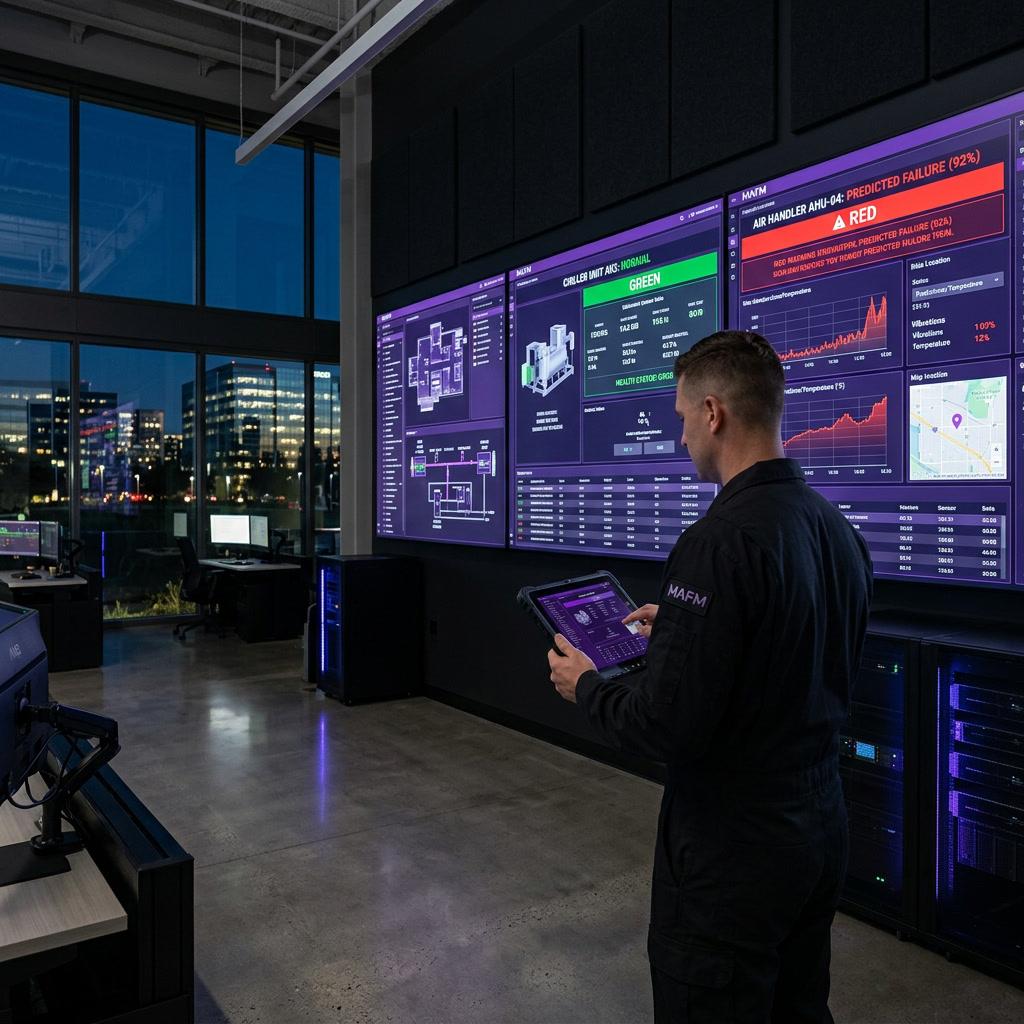
Predictive maintenance for commercial buildings means servicing equipment when its measured condition says it needs it, not when the calendar or a breakdown says so. For most offices the sensible first step is a small pilot on a few critical machines, with a named person who acts on every alert.
The technology is real, but it is not magic and it is not cheap to run badly. The U.S. Department of Energy's Federal Energy Management Program (FEMP) defines it plainly: predictive maintenance "attempts to detect the onset of a degradation mechanism with the goal of correcting that degradation prior to significant deterioration in the component or equipment." The rest of this post covers what gets measured, where it pays off first, and how programs stall.
Preventive maintenance follows a schedule. Predictive maintenance follows the equipment's condition. A quarterly filter change and belt check happens whether the unit needs it or not, while a predictive program watches for a trend (more vibration, higher motor temperature) and triggers work when the trend crosses a threshold.
Reactive maintenance, the "run it till it breaks" mode, sits at the other end. FEMP's 2010 O&M Best Practices Guide, Release 3.0, estimates that preventive maintenance saves 12% to 18% over reactive maintenance, and that "a properly functioning predictive maintenance program can provide a savings of 8% to 12% over a program utilizing preventive maintenance alone." Treat both as older federal estimates from a guide written for government sites, not a promise for your building.
Most buildings need all three. Run-to-failure is fine for a cheap, redundant part. A calendar covers filters, belts and lubrication. Condition monitoring is for the equipment where a surprise failure is costly or disruptive.
For a deeper look at the calendar-based layer, see preventive maintenance programs for Silicon Valley buildings.
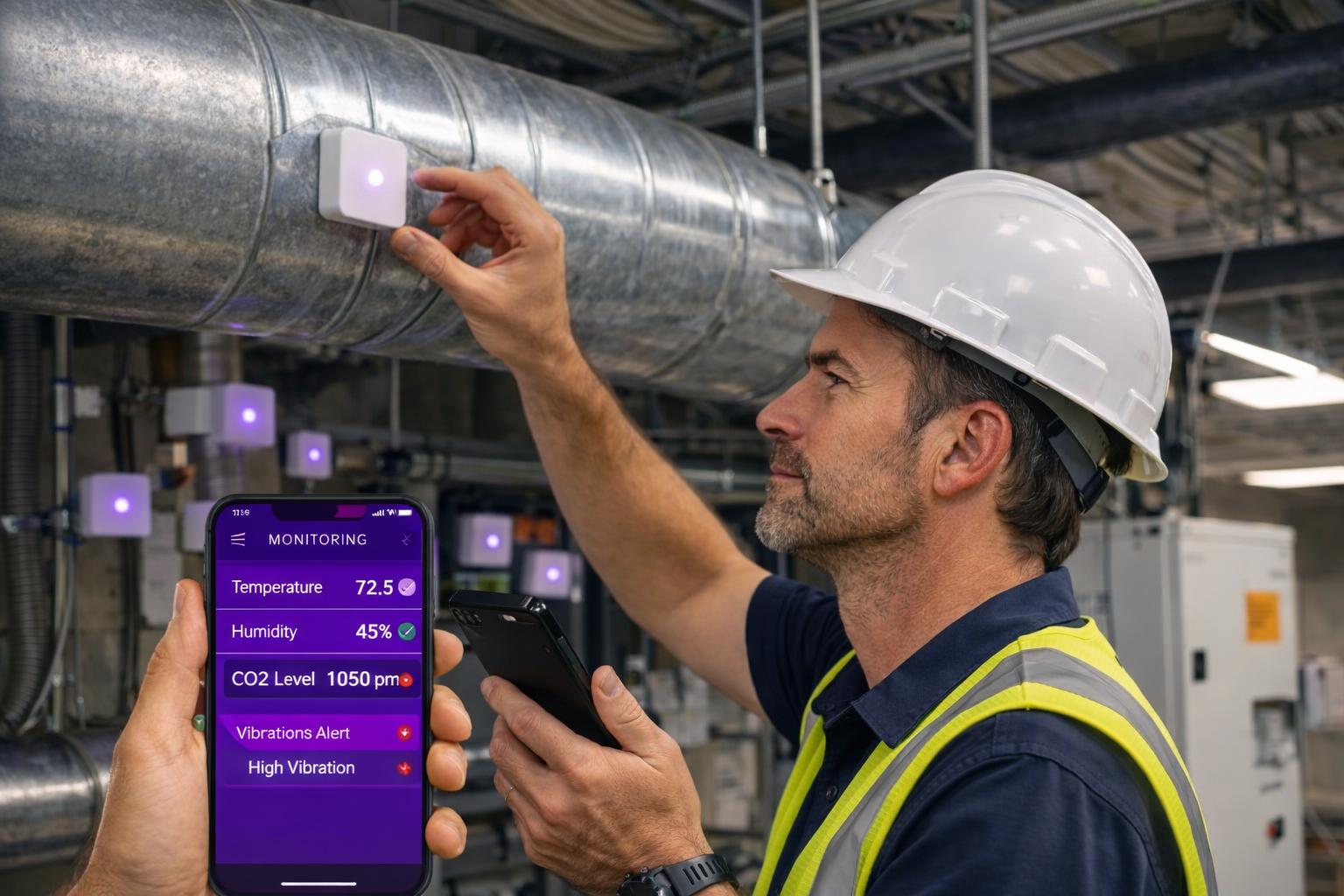
It measures a handful of physical signals and compares today's readings with that machine's own history. The FEMP guide lists the common techniques, among them vibration monitoring, infrared thermography, ultrasonic noise detection, lubricant analysis, motor current signature analysis and performance monitoring.
Vibration is the best known. The guide explains that every rotating part produces its own pattern of vibration, and that "the human touch is not sensitive enough to discern these differences," which is where sensors and signature-analysis software come in. It lists unbalance, misalignment, mechanical looseness and rolling element bearing problems among the faults the method can help diagnose.
In an office building, the signals translate into a few practical checks:
Where does AI fit? In most commercial products, "AI" means software that learns a baseline for each machine and flags drift from it. That can be useful, but vendor claims about how many weeks of warning you will get are marketing until they are shown on equipment like yours. Ask for examples from buildings of similar size and age.
Start where a failure is expensive, visible to tenants, or hard to schedule around, and where the failure shows up in a signal a sensor can read. The FEMP chapter lists pumps, electric motors, diesel generators and heat exchangers among the equipment where these technologies apply, and a rooftop unit, chiller plant, large air handler or pump set usually fits.
Generators matter for a different reason. A standby generator runs rarely, so a developing problem can sit unnoticed until the day you need it. Condition data plus a planned load test gives you a better picture than a nameplate and a log entry.
Elevators deserve a caution. In California, annual elevator inspections are the owner's responsibility, and Cal/OSHA says that when you get a Preliminary Order, written notice of corrections is yours to send: "do not rely on any other agreement." Condition data from your elevator contractor can help plan service, but it does not replace the inspection, the permit or the paperwork.
Water is the other candidate. Leak sensors under mechanical rooms, in ceiling spaces above server rooms and near risers are simple and cheap compared with a flooded floor.
The best public evidence is for energy analytics, and it is modest and conditional. In a report on the U.S. Department of Energy's Smart Energy Analytics Campaign, covering 96 commercial organizations, the DOE reported a median energy savings of 9% for fault detection and diagnostic software after two years, with a simple payback of one to two years.
Read that carefully. The DOE notes the savings "cannot be attributed solely to the operational improvements achieved with the support of the EMIS," because other projects were happening at the same buildings, and the savings depend on corrective action being taken. The report dates from 2019, and the participants were organizations that had volunteered for a campaign, so your result may differ.
The takeaway is not a number to quote to your CFO. It is that software only pays when somebody fixes what it finds.
They stall because nobody owns the alerts. Teams install sensors on everything, get a stream of low-confidence warnings, and learn to ignore the dashboard. The FEMP guide is blunt about the underlying issue: this kind of equipment "should not be purchased for in-house use if there is not a serious commitment to proper implementation, operator training, and equipment monitoring and repair." If that commitment is missing, the guide suggests it may be better to contract the work to an outside vendor.
A pilot that avoids the usual traps looks like this:
Those weekly reviews are the unglamorous part, and they are the part that decides whether the money was well spent.
Predictive maintenance is a coordination problem as much as a technology problem. The sensor vendor, the HVAC contractor, the elevator company and the generator technician each hold part of the picture. Someone has to connect an alert to a scheduled visit, brief the contractor with the trend data, and tell tenants about work that affects them.
That is the role a facility management company plays. MAFM does not install sensors or repair mechanical equipment. It plans the work, schedules and coordinates the specialist vendors, tracks the work orders and keeps the building's records straight. If you are choosing between an in-house build and a partner, the same logic applies as with any maintenance program: decide who owns the alert, then make sure that person has the authority to book the work.
For the broader picture of which technologies suit mid-size properties, see smart building technology for mid-size properties.
Is predictive maintenance worth it for a small or mid-size office building?
Often only for a few assets. A building with one rooftop unit per floor may do well with preventive maintenance and good records. Predictive monitoring earns its place where a failure is costly or hard to schedule around, and where you can commit to acting on the alerts.
Does AI predict equipment failures weeks in advance?
Sometimes, for failure modes that develop slowly, such as bearing wear. No source we found supports a general promise of weeks of warning. Ask any vendor to show lead times from comparable equipment, and treat a bare claim as marketing.
What is the difference between predictive and condition-based maintenance?
In practice the terms overlap. Both mean scheduling work when the equipment's measured condition warrants it, rather than on a preset calendar.
Can sensors replace routine inspections and required tests?
No. Required inspections, such as California's annual elevator inspection, stay in force regardless of what monitoring shows. Sensors help you decide what to service and when, and they add to the walkthrough rather than replacing it.
If you want a pilot planned, vendors coordinated and alerts turned into scheduled work, talk to MAFM about facility management for your building. We will start with your equipment list and your current maintenance calendar.
MAFM offers comprehensive facility management solutions tailored to your business needs.
Get in Touch