
Technology & Operations
AI Facility Management: What It Can Do for Response Times
January 21, 2026
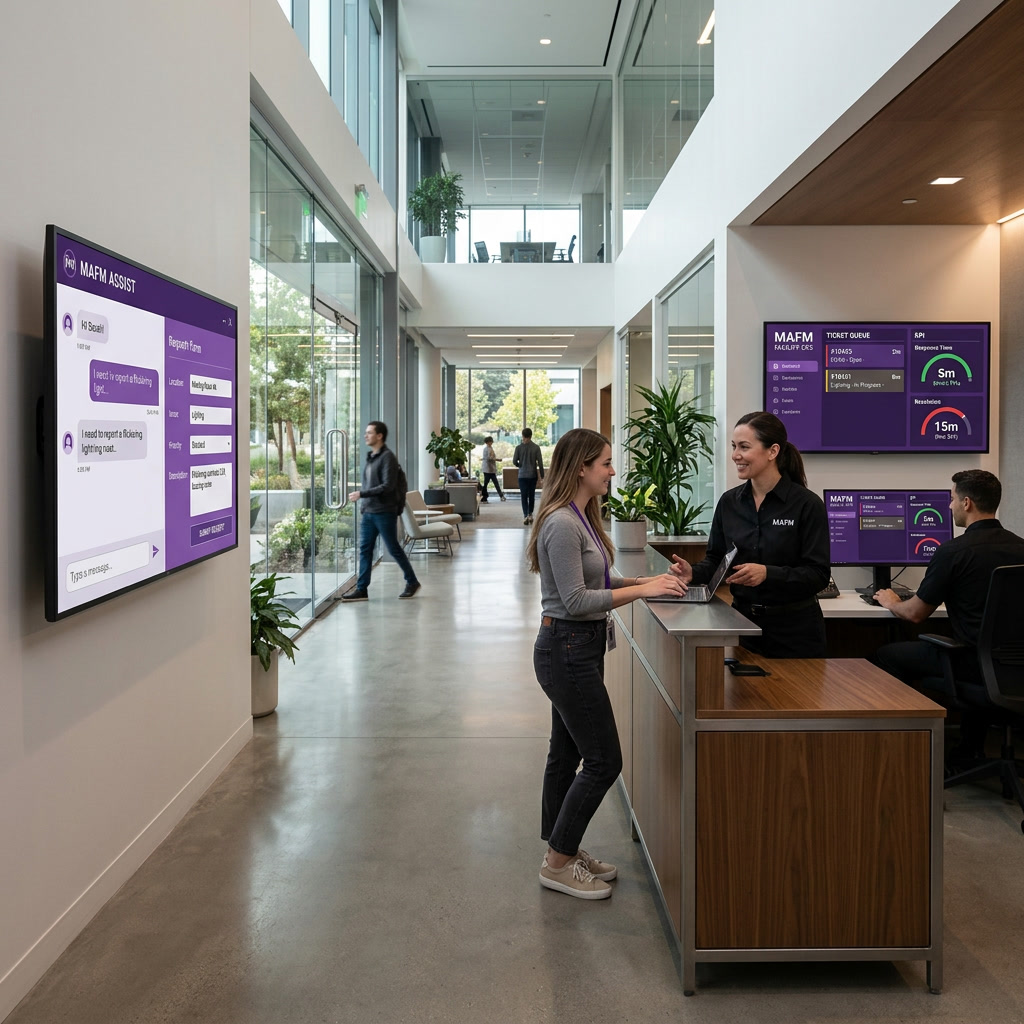
An AI tenant service chatbot works best as a front door, not a replacement for your building team. It takes the request, asks the follow-up questions, opens a ticket and tells the tenant what happens next, at any hour. A person still decides anything urgent, unusual or upsetting.
That split is where most deployments succeed or fail. The technology can speed up intake. It cannot repair a thermostat, and it can say wrong things with confidence, so the design question is where the bot stops and your people start.
It handles intake: collecting the location, the problem and the tenant's contact details, then creating a work order. For routine requests that is the whole job. A burned-out hallway light, a request for more recycling bins or a question about building hours follows a predictable path and does not need a person to read it first.
The same tool can sort requests by urgency. "My office runs a little warm" becomes a standard work order. "Water is coming through the lobby ceiling" pages whoever is on call. Vendors advertise this triage as a headline feature, so test it before you trust it (more on that below).
Comfort complaints are the volume you are trying to absorb. In a January 2026 Building Engines survey of more than 350 commercial real estate professionals, conducted with BOMA, tenant comfort issues made up 62% of all service requests. More than half of property teams reported spending over five hours a week going back and forth with tenants about requests. Building Engines sells property management software, so read the report as an industry survey from a vendor, not a neutral audit.
Not much. In that same Building Engines and BOMA survey, 28% of property managers said they had put AI to work in their buildings and 62% had not. When respondents were asked which communication method works best with tenants, email led at 66.40%, tenant app notifications followed at 14.63%, and text message or chatbot came in at 2.71%.
Read that as a sign that the tools are early, not that they fail. It also means you will have few peers to copy, so a small, well-measured pilot beats a building-wide launch.
The main risks are wrong answers, dead ends and lost trust. Two federal sources describe them well, even though neither is about office buildings.
None of this means skip the technology. It means build the exit to a human before you build anything else.
Anywhere safety, security or liability is involved. Reports of injury, water intrusion, smoke, a suspicious person, a stuck elevator or a structural concern should reach a person immediately, whatever the bot's own triage says. A missed escalation costs far more than the minutes you saved.
Add the cases that are about the tenant rather than the building:
Make the way out visible at every step. If a tenant has to find a hidden command to reach a person, the design is working against them.
Start narrow, route generously to humans, and loosen only when the data supports it. BOMA's guidance on making commercial real estate technology work quotes a San Francisco asset manager: "Technology is just a tool to achieve something. You can't just place a new piece of tech in your building and expect it to solve all your problems; you need to properly evaluate it and create an implementation plan as you would for any other new initiative." The same article advises defining the problem first: "What is the tenant service you want to enhance?"
A workable rollout looks like this:
If your team already has a predictive maintenance program, the two fit together: sensors catch what equipment can announce, and the chatbot catches what only an occupant notices. See how predictive maintenance and AI catch equipment failures for the other half.
Measure speed, resolution and sentiment together. A fast acknowledgment followed by a poor repair is not an improvement.
A BOMA article on technology and tenant satisfaction from 2023 quotes an asset manager asking whether work orders can also reflect tenant satisfaction, and answering that they can "by tracking how fast an issue was resolved and how well." Our guide to measuring tenant satisfaction covers the survey side, and the post on AI and facility response times covers the speed side.
Review a sample of real conversations every week at first. Vendor default settings were not tuned for your tenants, your building or your vocabulary.
Can a chatbot replace the property or facility management office?
No. A chatbot handles intake and routine answers, but repairs, judgment calls and upset tenants still need people. The CFPB's research on chatbots found that effectiveness drops as problems get more complex, which is why a human handoff belongs in the design from day one.
Does the tenant have to be told they are talking to a bot?
As a matter of trust, yes: say it in the first message and offer a way to reach a person. Disclosure rules vary by state and by use, so ask your counsel what applies to your buildings and your vendor's tool.
What should an after-hours chatbot do with an emergency?
It should stop troubleshooting and alert a named on-call person immediately, then tell the tenant that a person has been notified. Write the keywords and situations that trigger this, such as water, smoke, injury or a security concern, and test them with real examples before launch.
How much does a tenant service chatbot cost?
It varies too much by vendor, building size and integrations for a single honest figure, and no independent source we found publishes one. Ask vendors for pricing that includes the work order integration, the setup and the ongoing review time on your side.
MAFM is a facility management company, not a software vendor. We plan and coordinate the people and vendors behind tenant service: who answers a request, how work orders are scheduled and tracked, and how janitorial and building teams respond. To set up a request and escalation process that a chatbot can sit in front of, talk to us about facility management.
MAFM offers comprehensive facility management solutions tailored to your business needs.
Get in Touch