Strategy / Planning
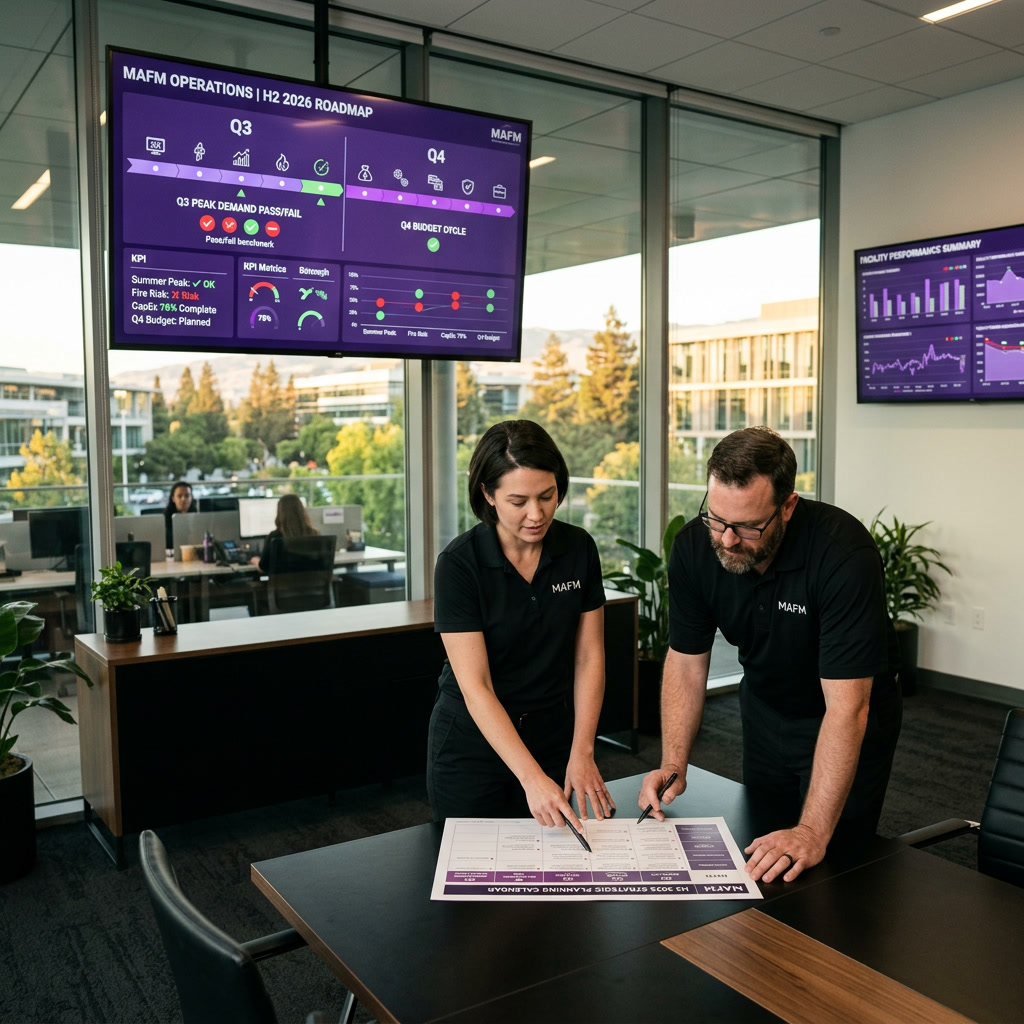
H2 2026 Strategic Planning: Setting Your Facility Program Up for a Strong Finish to the Year
June 26, 2026
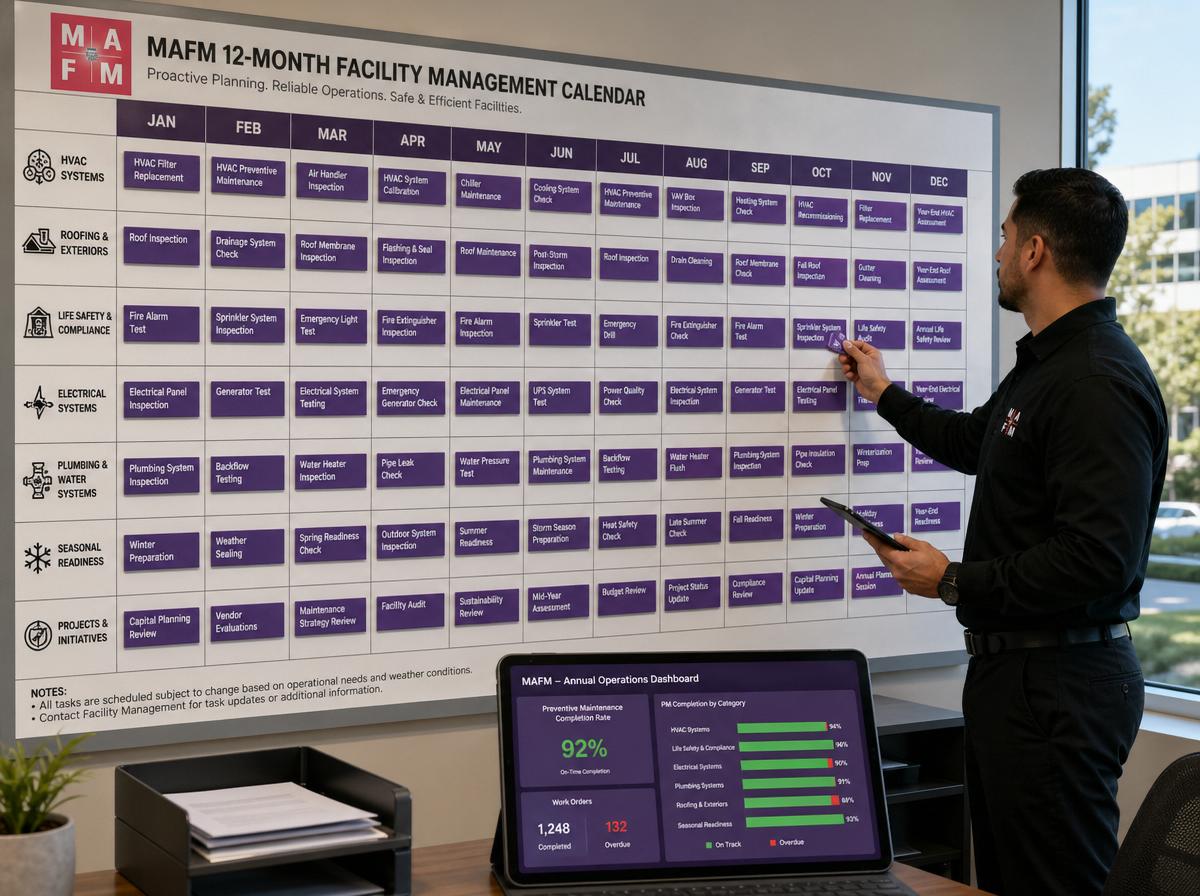
The difference between facility managers who spend their year fighting fires and those who coast through each quarter with confidence comes down to one thing: an annual operations calendar that positions every major activity in the right month. When preventive maintenance happens on schedule, seasonal preparations occur before conditions demand them, and budget activities align with ownership decision cycles, the entire operation runs with a rhythm that eliminates surprises.
Most Silicon Valley facility managers carry this calendar in their heads, a mental list of things that need to happen at certain times of year. The problem with mental calendars is that they are incomplete, inconsistent, and vulnerable to the daily emergencies that push planned activities into next month, then the month after, then never.
Here is the complete annual operations calendar that captures every major facility management activity, positioned in the optimal month for Silicon Valley commercial properties.
January is your planning and procurement month. The annual budget is fresh, vendor contracts are either newly signed or freshly renewed, and the entire year stretches ahead with maximum flexibility.
Finalize your annual preventive maintenance schedule with every task, frequency, and responsible party documented. Distribute the schedule to all vendors and internal staff so everyone begins the year aligned on expectations.
Complete annual chemical inventory and procurement. Lock in pricing agreements with supply vendors for the calendar year. Verify that all cleaning products meet current California regulatory requirements and update any non-compliant products.
Schedule all annual inspections required by code: fire alarm, sprinkler, elevator, backflow prevention, generator, and any jurisdiction-specific requirements. Getting these on the calendar in January prevents the scheduling scramble that occurs when inspections are remembered mid-year.
Review and update your emergency response plan. Verify that contact lists, evacuation routes, and emergency procedures reflect current building conditions and tenant rosters.
February is your deep-dive assessment month. Use the data from the prior year to evaluate every major building system and vendor relationship while the year is still young enough for corrections.
Conduct your annual Facility Condition Assessment. Walk every system, rate every component, calculate your Facility Condition Index, and prioritize your capital needs for the coming year.
Execute annual vendor performance reviews using your scorecard framework. Meet with each major vendor to review prior-year performance, establish current-year expectations, and negotiate any contract adjustments.
Review your insurance coverage against current building conditions and replacement values. Verify that coverage limits, deductible levels, and policy provisions still match your building's risk profile. Coordinate with your insurance broker on any changes needed before renewal.
Begin planning your spring deep cleaning program. Schedule crews, order supplies, and coordinate with tenants for the spring execution window.
March is your transition month. Winter operations wind down and spring preparation activities ramp up.
Execute your spring deep cleaning program. Deploy the four-zone approach across every building: air and climate systems, hard surfaces and flooring, restrooms and break areas, building envelope and common areas.
Complete spring HVAC preparation. Change all filters, clean coils, test economizers, calibrate thermostats, inspect ductwork, and clear condensate drains before cooling season begins.
Activate and test irrigation systems. Calibrate smart controllers for spring weather patterns. Address any winterization damage to irrigation components.
Begin your Q2 budget adjustment process using Q1 actuals. Identify variances, categorize by type, and develop your adjusted forecast for Q2–Q4.
April is your exterior work month. Bay Area spring weather provides ideal conditions for outdoor maintenance projects.
Pressure wash building facades, parking structures, sidewalks, loading docks, and exterior common areas. Schedule exterior painting and sealant work while spring temperatures optimize application conditions.
Conduct your spring roof inspection. Document conditions, photograph any deterioration, and schedule preventive maintenance for identified issues.
Execute parking structure maintenance: crack sealing, joint sealant inspection, traffic coating touch-ups, and drainage system clearing.
Plant spring landscape installations. Complete any landscape renovation projects. Apply pre-emergent weed treatment. Begin regular mowing and trimming schedules.
Review and renegotiate facility service contracts that align with spring leverage timing. Run competitive bid processes for any contracts requiring replacement.
May is your final preparation window before summer demands begin.
Verify cooling system performance under load. Conduct a full-building comfort assessment on the first warm day sequence and address any zones that are not maintaining temperature setpoints.
Complete your annual fire and life safety system inspections if not yet scheduled. Verify that all test documentation is current and filed properly.
Execute annual window cleaning for the building exterior. Schedule interior glass cleaning for common areas.
Launch your mid-year tenant satisfaction survey. Collect feedback while spring improvements are fresh in tenant awareness.
Confirm that your emergency preparedness protocols are updated for wildfire season. Verify HVAC recirculation capability, stock replacement air filters, and position portable HEPA units.
Summer is your highest-demand operating period. With preparation complete, focus shifts to execution and monitoring.
June marks the beginning of peak cooling season. Monitor energy consumption weekly against your budget projections. Track HVAC performance metrics and address any efficiency degradation before it compounds through the summer months.
July typically brings the highest utility costs and most intense occupant comfort management. Implement your pre-cooling strategy using off-peak electricity to condition the building before peak rate hours. Monitor air quality index levels during early wildfire season and activate smoke response protocols when thresholds are reached.
August is your planning month for fall. Begin developing the next fiscal year's budget using current-year trending data. Schedule your fall roof inspection. Plan Q4 deep cleaning and year-end maintenance activities.
Execute summer-specific landscape maintenance: increased irrigation monitoring, heat stress management, fire-season vegetation management for properties in wildland-urban interface areas.
September begins the transition from summer operations to winter preparation.
Conduct your fall roof inspection. Address any deterioration from summer UV and thermal cycling before winter weather arrives. Complete any roofing repairs or coating work while dry conditions allow.
Schedule and execute fall HVAC transition: test heating systems, clean and inspect furnaces and boilers, calibrate changeover controls, and verify that heating elements function before the first cold morning catches you unprepared.
October is your budget finalization month for most calendar-year properties. Present your annual capital plan, operating budget, and reserve fund recommendations to ownership with supporting documentation from your facility condition assessment and operational data.
Execute fall landscape maintenance: aeration, overseeding if applicable, irrigation winterization planning, and leaf management.
Conduct your annual emergency preparedness drill. Test evacuation procedures, generator systems, and emergency communication protocols.
The final two months focus on closing out the current year strong and positioning the building for January.
November is your vendor contract renewal window. Finalize negotiations for the coming year based on annual performance reviews. Execute competitive bid processes for any services requiring new providers.
Complete any deferred maintenance that can be accomplished before year-end. Properties with use-it-or-lose-it maintenance budgets should execute planned spending before the fiscal year closes.
December brings holiday-specific facility management: enhanced cleaning for tenant holiday events, seasonal decorations in common areas, end-of-year deep cleaning programs, and equipment winterization.
Compile your annual facility performance report. Document the year's achievements, challenges, expenditures, and recommendations for the coming year. Present this report to ownership as evidence of professional management and the foundation for next year's planning.
The monthly calendar outlined above is a framework, not a rigid schedule. Your specific building's age, condition, tenant profile, and climate zone may shift some activities earlier or later. The value is in the systematic approach, ensuring that nothing gets forgotten, nothing gets deferred indefinitely, and every major activity occurs in the optimal window.
Build this calendar into your CMMS as recurring annual tasks. Set reminders 30 days before each major activity to allow procurement, scheduling, and coordination time. Review the calendar quarterly to verify that planned activities are executing on schedule and adjust for any emerging priorities.
Share the calendar with your vendors, your team, and your property management colleagues. When everyone operates from the same annual roadmap, coordination improves, conflicts decrease, and the building operates with the predictable rhythm that prevents emergencies and delivers consistent quality.
An annual operations calendar is the simplest and most effective management tool in facility management. It costs nothing to create, requires minimal time to maintain, and prevents the costly, stressful reactive management that consumes facility managers who operate without a plan.
Build yours this week using the month-by-month framework outlined here. Customize it for your specific property. Enter it into your management system. And then follow it, not perfectly, because no year goes exactly as planned, but consistently enough that your building moves through each season prepared rather than surprised.
MAFM PRO operates every property on a comprehensive annual operations calendar that ensures nothing is missed and every building system receives attention at the optimal time. Contact us to see how systematic facility management delivers year-round performance.
Schedule your consultation: Contact MAFM.PRO
MAFM offers comprehensive facility management solutions tailored to your business needs.
Get in Touch