
Sustainability & Energy
De-Icing Solutions for California Facilities: What Works
January 28, 2026
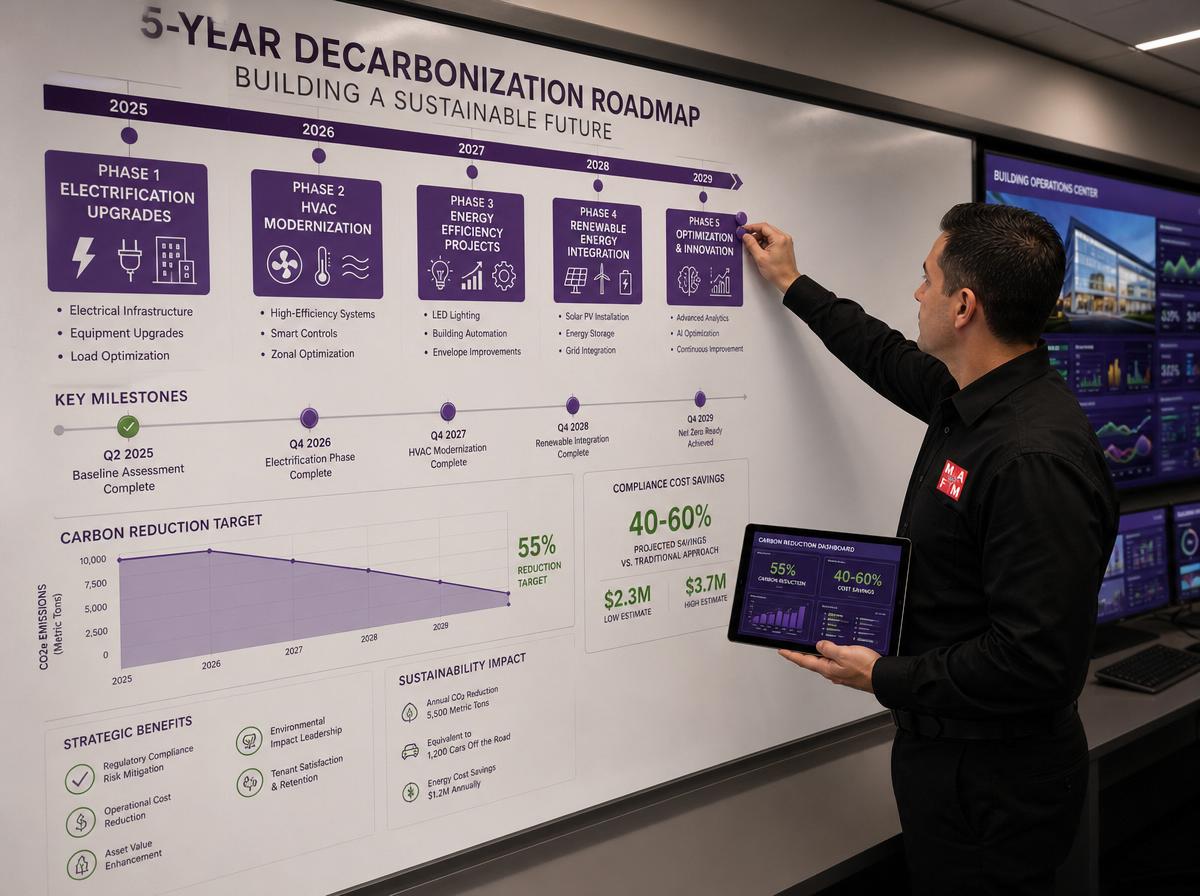
A building decarbonization roadmap for a Silicon Valley property is a phased plan with four moves in a fixed order: measure your emissions, cut the energy the building uses, replace gas equipment with electric equipment as it wears out, and then buy or generate clean electricity. Do them in that order and each step makes the next one smaller and cheaper to size.
Nothing here needs a five-year commitment on day one. The roadmap is a sequence you revisit each year, tied to equipment age, lease dates and the rules that apply to your building. The phases below are a planning frame, not a mandate, and the timing will move with your equipment.
Start with a baseline: a year of utility data in ENERGY STAR Portfolio Manager, the free EPA tool. It calculates a building's emissions from on-site fuel combustion and purchased electricity, and tracks avoided emissions from green power purchases. EPA notes the method is consistent with the Greenhouse Gas Protocol.
Know what the baseline will and will not tell you. Emissions "have no bearing" on a building's 1 to 100 ENERGY STAR score, so a building can score well and still burn a lot of gas.
Then ask where the carbon comes from. In most Bay Area offices it is one of two things:
If your building is over 50,000 square feet, you may already be collecting this data. The California Energy Commission's benchmarking program requires owners of commercial buildings over 50,000 square feet to report energy use each year by June 1, and it points owners to Portfolio Manager. The baseline you build for the roadmap can serve that filing too.
Build the equipment list at the same time. For every boiler, furnace, water heater, rooftop unit and chiller, record the age, the fuel, the service contract and who maintains it. A roadmap without that list is a wish.
Because every unit of energy you stop using is a unit you do not have to replace with new electric capacity. A building that has been tightened and tuned needs a smaller heat pump, a smaller electrical service upgrade and a smaller solar array than the same building left as it is.
Year 1 to 2 work is mostly operations and controls, and much of it is what a facility team already owns:
We are deliberately not putting payback numbers on envelope or controls work. They swing too widely by building, and a walkthrough with your mechanical vendor gives you a real number where a blog post cannot.
At the end of its life, unless a specific incentive or rule changes the math. Replacing a working boiler early is a capital decision that needs its own justification. Replacing one that has failed, with a heat pump, is the cheapest time to change fuel, because you are buying new equipment either way.
That is why the equipment list matters. Mark each gas unit with its likely replacement window and decide in advance what it will be replaced with, so a failure on a Friday does not become a like-for-like gas purchase by Monday.
The Bay Area has a rule that makes this planning timely. The Bay Area Air Quality Management District's Rules 9-4 and 9-6 govern nitrogen oxide emissions from residential and commercial furnaces and water heaters. The Air District's implementation page says the March 2023 amendments introduced a zero-NOx requirement for newly installed furnaces and water heaters, with compliance dates beginning in 2027, 2029 and 2031 depending on size and equipment type, applying only when current equipment burns out.
Those dates are moving. On November 4, 2026, the Air District board adopted amendments to Rule 9-6 that delay the zero-NOx date for residential water heaters to January 1, 2028. The Air District states that the rule applies only when a water heater is replaced and does not require replacing a working unit. Confirm the current date for your equipment size before you order, and note that the page describes the delay for residential water heaters, so check how it applies to commercial units.
Water heating is the usual first candidate, since it is smaller than a space conditioning system and is easy to isolate. Space heating follows, ideally as a combined heat pump system where the building's cooling load is larger than its heating load.
A facility management partner earns its keep here. MAFM does not install mechanical equipment, but planning the work is part of facility management: keeping the equipment inventory, scheduling vendor walkthroughs, getting comparable bids and sequencing shutdowns around tenant hours. For more on the equipment itself, see our post on heat pump technology for Silicon Valley commercial buildings.
Start with the supplier, because it is the cheapest step in terms of capital. If your building is in Silicon Valley Clean Energy's service area, SVCE offers GreenPrime as an optional 100% renewable generation service. Commercial enrollment opens January 1 and closes April 1 each year, and total residential and commercial GreenPrime enrollment is capped at 200 GWh. Missing the window can cost a year, so put it on the calendar.
On-site solar and storage come next, and they depend on tariff rules that have changed. The California Public Utilities Commission adopted the Net Billing Tariff in December 2022 as the successor to the older net metering program, and it applies to customers who submitted an interconnection application on or after April 15, 2023. A solar project today is sized and valued under that tariff, so ask any solar vendor to show their numbers under net billing, not under the old rules.
If you do not own the roof, or the lease is short, a third-party ownership arrangement can change who pays up front. The terms are contract-specific, so read them with your counsel. Our post on solar and battery storage for Silicon Valley commercial buildings covers the decision in more depth.
Fewer than many older guides assume, and some have deadlines. Federal money is the clearest example. The Department of Energy says the One Big Beautiful Bill Act added a termination provision to the Section 179D energy efficient commercial buildings deduction: it does not apply to property the construction of which begins after June 30, 2026. That date has passed, so projects that did not begin construction by then should not count on it. Ask your tax advisor how it applies to anything already in progress.
State and utility programs change often. Before committing capital to any piece of equipment, ask the vendor and your utility which rebates apply this year, and get the answer in writing. Do not build a roadmap on an incentive you have not confirmed.
Re-run the Portfolio Manager baseline every year and compare it with the first year. It shows whether the work delivered what the vendor promised, and it is the data a tenant will ask for.
Tenants may ask because of their own reporting. California's Climate Corporate Data Accountability Act (SB 253) applies to business entities with annual revenue over one billion dollars that do business in California. They must disclose scope 1, 2 and 3 emissions, and CARB's page lists November 10, 2026 as the deadline for the first scope 1 and scope 2 reports. A building's energy data feeds a tenant's numbers, so having it ready is a service to them. Our post on scope 1, 2 and 3 emissions reporting explains how those categories apply to buildings.
How long does a building decarbonization roadmap take?
A typical roadmap is staged over several years because it follows equipment replacement, not a calendar. The first phase, the baseline and operational efficiency work, can start immediately. Electrification happens as each gas unit reaches the end of its life, and clean electricity can be bought sooner through your supplier.
Do Bay Area rules require me to replace my gas boiler or water heater now?
Not based on what the Air District has published. Its zero-NOx rules apply to newly installed furnaces and water heaters, and the Air District says they apply only when equipment is replaced. Dates and scope have been amended, so check the current rule before you buy replacement equipment.
What is the cheapest first step?
Building the baseline in Portfolio Manager and the equipment inventory costs staff time, not capital. After that, schedule and controls fixes are usually next, because they require no new equipment. Switching to a fully renewable electricity supply is also low capital, but enrollment windows apply.
Can MAFM carry out decarbonization projects?
MAFM is a facilities management company, so it does not install boilers, heat pumps or solar. It plans and coordinates the work: the equipment inventory, vendor walkthroughs, bid comparison, scheduling and access around tenant hours, and the ongoing building care afterward.
If you want help turning the equipment list and the first-year efficiency work into a schedule your vendors can follow, talk to us about facility management for your Silicon Valley building.
MAFM offers comprehensive facility management solutions tailored to your business needs.
Get in Touch