Sustainability & Energy
De-Icing Solutions for California Facilities: What Works
January 28, 2026
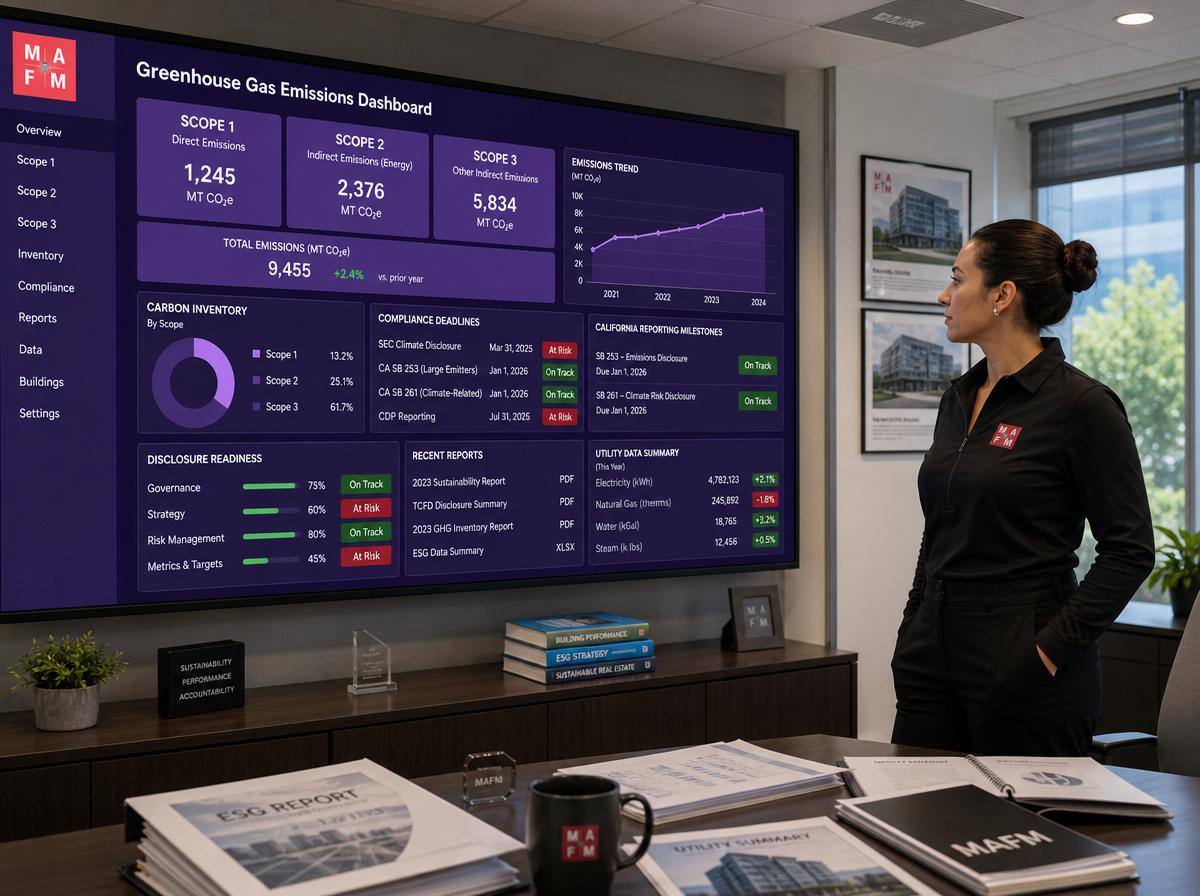
Scope 1, 2 and 3 emissions reporting is a legal requirement for a narrow group of very large companies in California, not for most commercial buildings. If you own or run a building in Silicon Valley, the real question is whether you or one of your tenants is on that list, and what building data they will ask you for.
As of November 2026, California's SB 253 requires Scope 1 and 2 reports from covered companies, a federal appeals court has put its Scope 3 piece in doubt, and the SEC's climate rule is on its way out. The sections below sort out what applies, what each scope means for a building, and how a facilities team can get the data ready.
SB 253 applies to companies, not to buildings. CARB says the program will require entities "with total annual revenues in excess of one billion dollars ($1,000,000,000) that do business in California" to annually disclose their Scope 1, 2 and 3 greenhouse gas emissions for the prior fiscal year.
That means a property owner is covered only if the owning entity crosses the revenue threshold and does business in California. Many tenants in Silicon Valley office buildings are large enough to be covered, and that is how the law reaches your building.
The first reports were due on November 10, 2026, and only for Scope 1 and 2. CARB's 2026 guidance says it will use enforcement discretion for that first report, so entities that were not collecting emissions data when its December 2024 enforcement notice was issued are not expected to submit data this cycle. CARB is writing a separate regulation for 2027 and later years.
The Ninth Circuit left Scope 1 and 2 in place and ruled against the Scope 3 requirement at the preliminary stage. In its November 9, 2026 opinion in Chamber of Commerce v. Sanchez, the panel affirmed the denial of a preliminary injunction for Scope 1 and 2, reversed it for Scope 3 and for SB 261, and sent the question of whether Scope 3 can be separated from the rest of SB 253 back to the district court.
The opinion did not itself block anything. A law firm summary of the ruling notes that it is up to the district court to enter any injunction, and that CARB had not yet said how it will respond.
SB 261, the climate-related financial risk report law, is a separate requirement for companies with $500 million in revenue. CARB's December 2025 enforcement advisory says it will not enforce the January 1, 2026 deadline while the appeal is pending. Treat all of this as a moving target and check CARB's page before you plan around a date.
No. The SEC adopted climate disclosure rules in March 2024 and stayed them in April 2024. On March 27, 2025 it voted to end its defense of the rules in the Eighth Circuit.
On May 29, 2026 the SEC proposed rescinding them entirely. Check sec.gov for whether that proposal has been finalized. The practical point for a building team: do not plan around a federal requirement to report emissions to the SEC, and do not tell tenants one exists.
The scopes sort emissions by who controls the source. The Ninth Circuit's description is a handy summary: Scope 1 covers emissions from sources a company directly owns or controls, Scope 2 covers emissions from purchased energy, and Scope 3 covers indirect emissions across the value chain.
In a building that translates to:
Which scope a given meter lands in depends on lease type and how the reporting company draws its boundary, which is the part owners most often get wrong.
It depends on the lease and the boundary approach, and the two sides must not both count the same electricity. The GHG Protocol's Appendix F on leased assets says its guidance "has been designed to ensure that the categorization of emissions from leased assets by lessors and lessees does not lead to any double-counting of emissions in scopes 1 and 2."
For an operating lease, which covers most office leases, the outcome depends on the approach each party picks. If the tenant uses the operational control approach, its fuel combustion is Scope 1 and its purchased electricity is Scope 2. A landlord using operational control then counts the same emissions as Scope 3.
The reverse also happens. Under an equity share or financial control approach, the lessor counts them as Scope 1 and 2, and the tenant counts them as Scope 3. The GHG Protocol's Scope 3 Standard points tenants to Category 8 (upstream leased assets) and landlords to Category 13 (downstream leased assets).
Your building's accountants and your tenants' sustainability teams may land on different answers, so agree on the boundary in writing.
Start with the records a facilities team already touches. Portfolio Manager's technical reference says that emissions "are calculated by multiplying the site energy for each fuel by the emissions factor for that specific fuel type," so the quality of the inventory is the quality of your energy data.
A workable data set for one building looks like this:
Since 2015 the GHG Protocol requires Scope 2 to be reported two ways. As the Portfolio Manager reference puts it: "a location-based method relying on grid-average emissions factors, and a market-based method using energy supplier-specific emissions factors." Portfolio Manager added market-based calculation in 2024. CARB's guidance notes that reporters commonly use EPA's eGRID emission factors for Scope 2 and may use alternative credible sources if they identify them.
If you do not have 15-minute interval data, monthly bills still support a valid inventory. The meter map and the paperwork matter more than the data resolution.
Build the data pull into the monthly routine instead of a year-end scramble. Log bills as they arrive, check them against the prior month, and flag any meter that jumps.
This is where facilities management earns its place. The people who walk the building know which meters serve which spaces, which equipment burns fuel, and when a generator was run. They also schedule the vendors, such as mechanical contractors and energy consultants, who hold the rest of the data.
MAFM does not calculate or verify emissions inventories, and it is not an assurance provider. What a facility management partner can do is keep the equipment list and meter map current, collect and organize the bills and run logs, and coordinate the specialists who prepare and verify the inventory. See the related guides on energy management in Silicon Valley and a building decarbonization roadmap.
Does SB 253 require my building to report emissions?
Only if the owning company has more than $1 billion in annual revenue and does business in California, per CARB. If it does not, you are still likely to be asked for building data by a covered tenant, since a tenant's reporting can include the space it occupies.
Do companies have to report Scope 3 emissions in 2026?
CARB's 2026 report was limited to Scope 1 and 2. Scope 3 was set for 2027, but the Ninth Circuit's November 2026 ruling reversed the denial of a preliminary injunction against the Scope 3 requirement and sent it back to the district court, so its future is uncertain.
What is the difference between location-based and market-based Scope 2?
Location-based uses average emission factors for the electricity grid in your region. Market-based uses factors specific to the electricity you bought, such as a particular supply product. The GHG Protocol asks for both.
Is ENERGY STAR Portfolio Manager enough for a building inventory?
It is a sound starting point. Its method follows the GHG Protocol and it calculates direct and indirect emissions from your energy data, but it does not cover fugitive refrigerant leaks or on-site vehicle use, so those need to be tracked separately.
If your building team needs a clear equipment list, meter map and monthly data routine before tenants start asking, talk to MAFM about facility management. We serve San Jose and the surrounding Silicon Valley market, and we coordinate the specialists who handle the inventory itself.
MAFM offers comprehensive facility management solutions tailored to your business needs.
Get in Touch