Sustainability & Energy
De-Icing Solutions for California Facilities: What Works
January 28, 2026
A zero waste program for a commercial building starts with the state's organic waste rules, then goes further by measuring what your tenants actually throw away and making the right bin the easy bin. California's SB 1383 sets the floor for businesses in Silicon Valley. What sets a good building apart is how clean its streams are and how well the program survives day to day.
This guide covers what the law asks of a business, how to learn your building's waste profile, how to design stations that work, how to handle batteries and electronics, and how to report progress honestly.
SB 1383 requires every business to take part in organic waste collection, and it puts duties on the people who run the building. CalRecycle says businesses must either join their jurisdiction's organics collection service or self-haul organic waste to an approved facility or program. It also lists these duties:
Organic waste here is wider than food. CalRecycle's definition includes food, green material, lumber, wood, paper products, and printing and writing paper. That is why clean office paper and cardboard sit in the same conversation as the break room.
Rules vary by city, so check your local ordinance for the pickup service and enforcement details. Our San Jose page covers the market we serve in the South Bay.
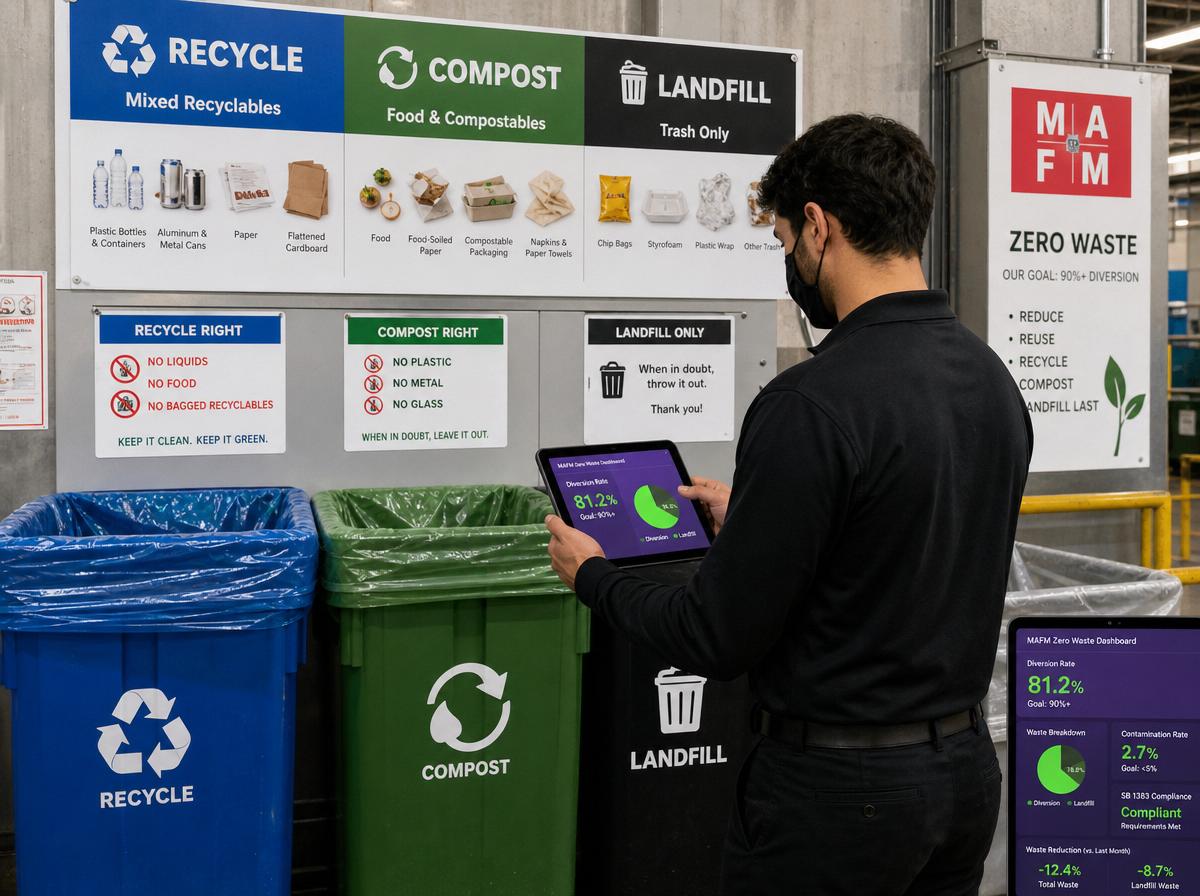
Jurisdictions may run a three-container, two-container or single-container service, and the colors are set by the state. CalRecycle's collection systems page describes the standard:
The same page says new containers need labels showing which materials are allowed and prohibited, using text, images or both, and that the color rules apply to the outside of the container. Containers bought before 2022 do not have to be replaced until the end of their functional life or January 1, 2036, whichever comes first. If your hauler runs a different arrangement, such as two containers or a single gray container sent to a high-diversion processing facility, the sorting rules change with it, so confirm which service you have before you buy a single bin.
Measure first, because you cannot cut what you have not weighed. A basic waste audit means pulling a sample from each stream, sorting it by hand into the categories you care about, and recording what was in it. Do it a few times a year, and repeat it after any change to stations or tenant mix.
Three things are worth tracking:
Do not set a diversion target before you have a baseline. A target taken from another building tells you nothing about yours.
Make the correct choice the easiest one. People sort right when the bins are together, labeled with pictures, and placed where the waste is created.
Janitorial crews matter here. They are the people who see every bin every night, so a short feedback loop works: crews note bins with obvious contamination, the facility team passes the information to tenants, and the building updates its signs or station layout.
Batteries, electronics and surplus furniture each need a separate path, and for the first two the law is specific. California's Department of Toxic Substances Control classifies batteries and electronic devices as universal wastes, along with lamps and some other items, and says no person or business, regardless of exemption status, may put any universal waste in the trash in California. DTSC lists most alkaline batteries among the universal waste batteries.
Set up the following:
Keep the paperwork for these streams. A receipt from the recycler is the proof if anyone asks.
Report what you measured, in the same way every period. A simple monthly record works: pounds or cubic yards picked up for each stream, contamination notes from the hauler, and any change made to the stations.
Share a short summary with tenants once a year. Tell them what the building did, what improved, and what you need from them next. State only the figures you have records for, and say which period they cover.
Avoid setting a "zero waste" claim in marketing before you have evidence. A targeted goal for one stream, such as keeping batteries out of the trash, is easier to prove and easier to keep. For a wider look at buying and operating sustainably, see our guide to sustainable facility supplies.
Does SB 1383 apply to office buildings?
Yes. CalRecycle says businesses must either participate in their jurisdiction's organics collection service or self-haul organic waste, and must provide containers, education and contamination checks. Property managers usually carry these duties for shared areas, so confirm the split with your lease and your tenants.
What goes in the green, blue and gray bins?
In the standard three-container system, green holds food and other organic waste, blue holds recyclables plus clean paper and cardboard, and gray holds everything else. Your hauler's guide controls the details if it runs a two-container or single-container service.
Can we put used batteries in the trash?
No. DTSC says no person or business may dispose of any type of universal waste, including batteries, in the trash in California. Set up a collection point and send them to a battery recycler.
Who handles waste at our building?
A licensed hauler collects the waste under your jurisdiction's service. MAFM does not haul waste. We coordinate the building side: janitorial crews who service the bins, station layout, tenant communication and vendor schedules.
If your bins, signs and tenant communications need a refresh, talk to us about janitorial services and facility management, or contact MAFM to start with a walkthrough of your current stations.
MAFM offers comprehensive facility management solutions tailored to your business needs.
Get in Touch