Sustainability & Energy
De-Icing Solutions for California Facilities: What Works
January 28, 2026
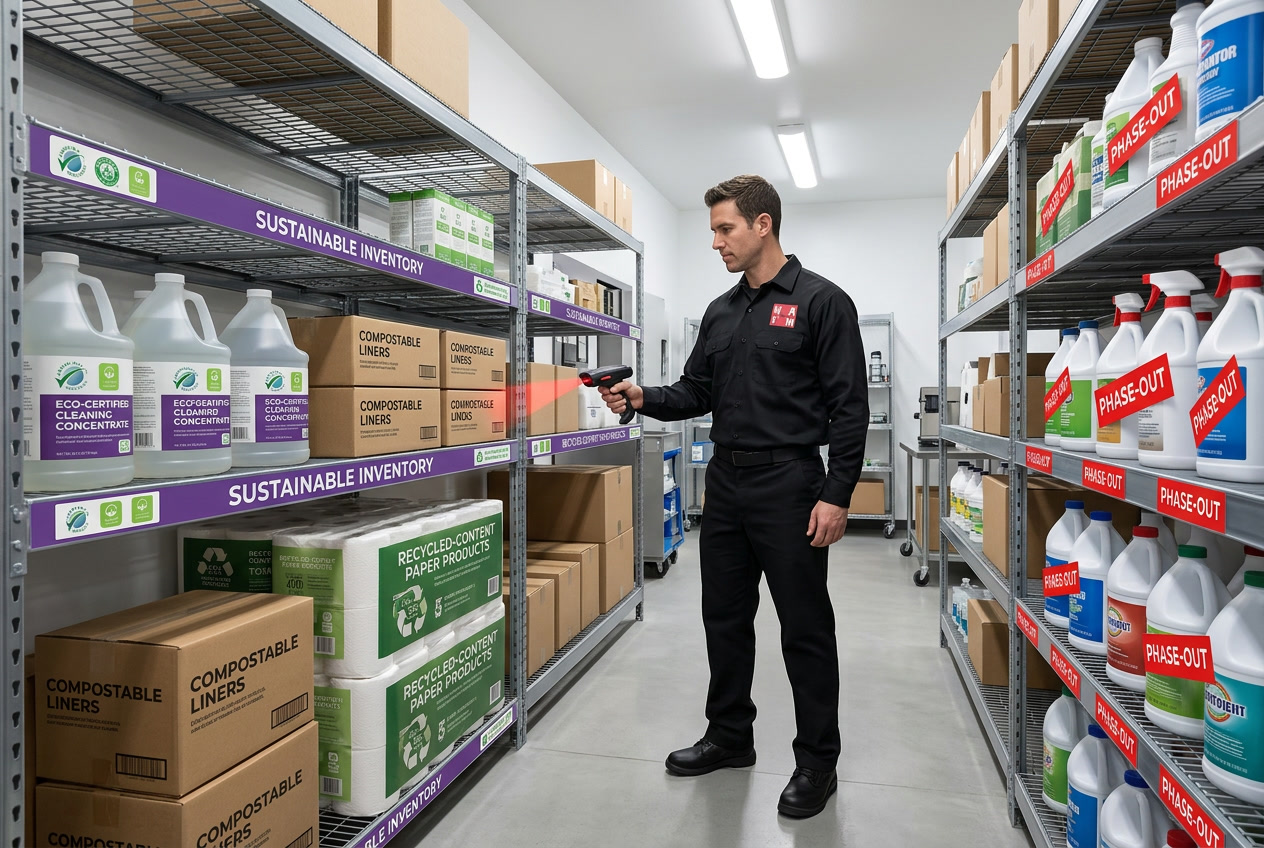
A sustainable supply chain for facility products starts with buying third-party certified cleaning chemicals, paper and supplies, and judging them on cost per use and performance in your own building, not on the claim printed on the label. Green Seal, UL ECOLOGO and EPA Safer Choice are the three certifications worth looking for in commercial cleaning products, and California adds an ingredient disclosure law that makes vendor questions easier to ask.
This guide explains what those labels mean, what California requires of cleaning product makers, how to switch categories in phases, and where concentrates, microfiber and recycled paper do and do not pay off. We do not quote price-parity or savings percentages, because no source supports a number that holds for every building. Compare your own invoices instead.
A sustainable supply chain buys products whose environmental claims have been verified by someone other than the seller. The Federal Trade Commission's Green Guides summary says broad claims such as "green" or "eco-friendly" are difficult to substantiate, if not impossible, and that a third-party seal still requires the marketer to substantiate all express and implied claims. In practice, a bottle that says "natural" or "eco" with no named standard tells you nothing.
The supply chain also includes how products get to your building and what happens to the packaging, which is why the buying decision is bigger than the product itself. Three questions cover most of it:
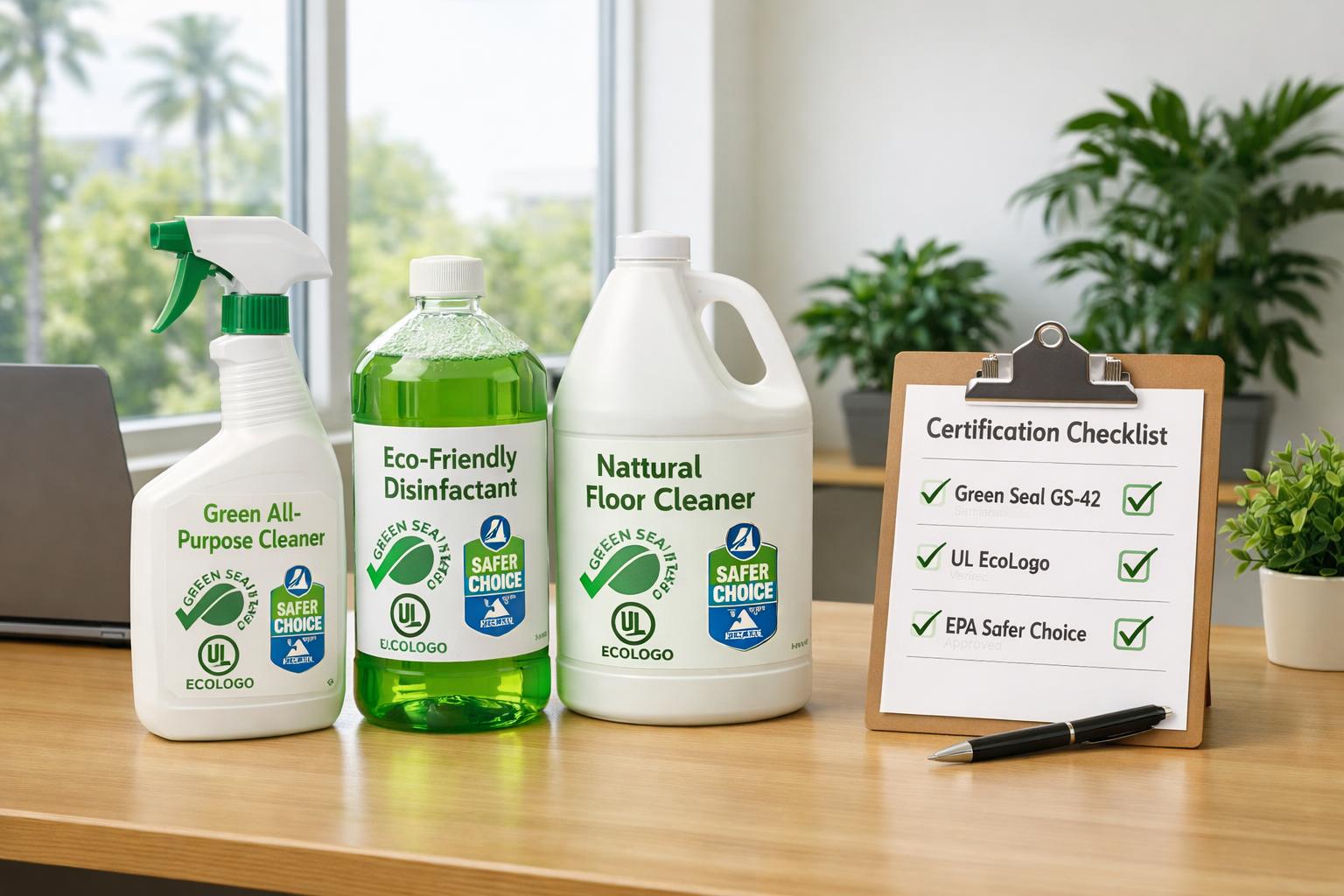
For commercial cleaning chemicals, look for Green Seal GS-37, UL ECOLOGO or EPA Safer Choice, and treat everything else as unverified until the vendor shows a standard. Each works differently.
A certification covers a specific product, not a whole brand. When a vendor says a line is certified, ask which products in the line, and check the certifier's own directory. Our post on green cleaning certifications that matter in California goes deeper on the labels.
California requires ingredient disclosure on cleaning products, which gives a facility manager a simple, enforceable question to ask any supplier. The Cleaning Product Right to Know Act covers a "designated product", defined as an air care product, automotive product, general cleaning product, or a polish or floor maintenance product used primarily for janitorial, domestic or institutional cleaning.
Under Health and Safety Code section 108954, the label has to show the manufacturer's toll-free telephone number and website address, and either list the ingredients or say "For more ingredient information visit" with a web address. The label points to a website that must carry the fuller ingredient information the Act requires. Pesticides as defined in the Food and Agricultural Code are excluded.
You can use this in procurement. Ask each vendor where the ingredient list for a product is published, and keep that web address with the safety data sheet. If a product sold into California has neither a label list nor a working website, treat it as a problem before it reaches the supply closet.
Switch one product category at a time, test each product in your building first, and keep the old one available until the new one has passed. A phased approach finds problems on a single floor instead of the whole property.
Because the switch touches chemicals, the paperwork has to keep up. Update the chemical list, the safety data sheets and the crew's training records with each change.
They can, and the evidence is clearest for dilution control, microfiber for floors and certified recycled-content paper. None of them pays off automatically, so measure cost per use.
Concentrates reduce packaging and shipping weight, and a metered dispenser removes guesswork about dilution. The catch is that concentrates only work when the crew uses the dispensing system. Green Seal's rule against packaging concentrated products in spray bottles exists for that reason: a concentrate poured by eye is a way to overuse product.
Microfiber has real research behind it for floors, though from a hospital setting. A 2007 study in the American Journal of Infection Control evaluated 24 rooms per test condition and found a microfiber system with a detergent cleaner removed 95% of microbes, against 68% for cotton string mops with the same detergent. Adding a disinfectant raised the cotton mops to 95% and did not change the microfiber result. It is one study of floors, not proof for every surface, but it supports trialing microfiber before assuming you need more chemistry.
Recycled-content paper is a mature category. EPA's Comprehensive Procurement Guideline for paper lists commercial and industrial bathroom tissue at 20 to 60 percent postconsumer fiber and paper towels at 40 to 60 percent postconsumer fiber, with total recovered fiber of at least 20 and 40 percent respectively. Those ranges are written for government buyers but give a useful benchmark for a specification. Test a sample in your dispensers before committing, because sheet strength and dispenser fit vary by product.
Choose a distributor that can document what it sells, and write that into the agreement. Ask for:
Local and regional suppliers can shorten delivery times and make it easier to fix a problem quickly, but proximity is not a substitute for certification. Hold a local supplier to the same standard as a national one.
A facility management partner turns a purchasing policy into daily practice. It writes the product specification into the janitorial scope, runs the trials, keeps chemical lists and safety data sheets current, trains the crew and checks that what arrives is what you approved. If your building is in the Bay Area, our San Jose team can help set this up for your property.
Do sustainable cleaning products cost more? It depends on the product and how you measure. Compare cost per use, including dilution, dispensers and waste, on your own invoices rather than relying on a general claim of price parity. Run a trial before you commit.
Is a "green" or "eco-friendly" label enough? No. The FTC's Green Guides call broad unqualified claims like these difficult to substantiate. Ask for a named standard, such as Green Seal, UL ECOLOGO or EPA Safer Choice.
What does California's Cleaning Product Right to Know Act mean for my supplies? Cleaning products covered by the Act must carry a toll-free number and website on the label, and either list ingredients or point to where they are listed. Ask suppliers for the ingredient web address and keep it with each product's safety data sheet.
Where should we start? Start with an inventory of every chemical and paper product in use, and switch hand soap and paper products first. They carry the least risk to surfaces, so they make good first trials.
If you want help turning this into a written product list, a trial plan and crew training, MAFM can build it into your cleaning and facility scope. Talk to us about janitorial services.
MAFM offers comprehensive facility management solutions tailored to your business needs.
Get in Touch