
Sustainability & Energy
De-Icing Solutions for California Facilities: What Works
January 28, 2026
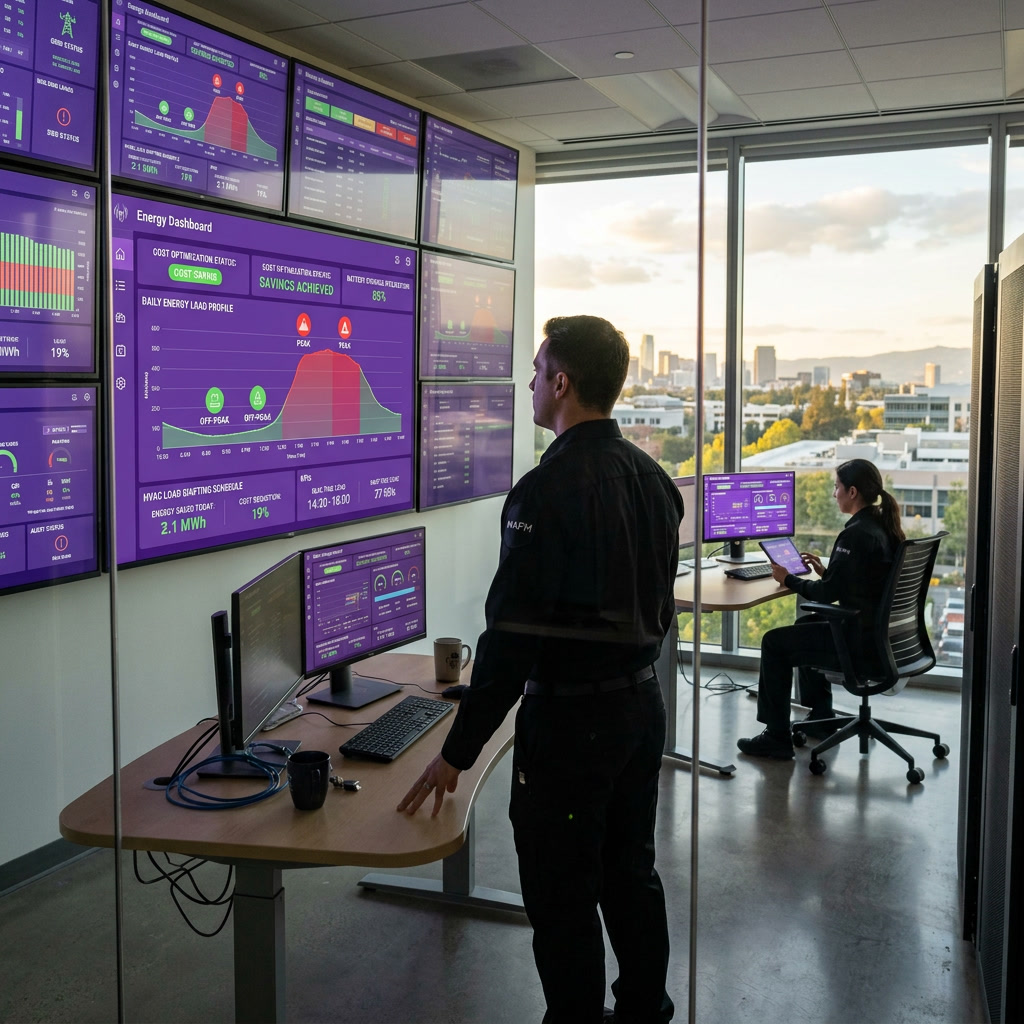
Time-of-use load shifting means moving flexible electrical load out of the hours when your utility charges the most and into hours when it charges less, without using less energy overall. For a PG&E business customer in Silicon Valley, the expensive window is the late afternoon and evening, and the equipment that can move out of it is usually already in the building.
PG&E's business time-of-use plans set the peak at 4 to 9 p.m. every day. The exact prices depend on your rate plan, so the first job is not a retrofit. It is reading your rate schedule next to your equipment schedule and finding what runs inside that window without needing to.
It is a scheduling strategy: the same work gets done, at a cheaper hour. The U.S. Department of Energy's Federal Energy Management Program explains that customers on time-of-use rates have charges that vary "based on when their electricity is consumed, not just the total amount," and can lower costs by reducing use during on-peak hours or shifting it to off-peak hours.
It helps to separate three ideas that often get blurred together:
This post is about the first one. The other two have their own posts: demand response programs for Silicon Valley offices covers event-based programs, and peak demand charge management covers the monthly demand line on the bill.
On PG&E's commercial time-of-use plans the peak is 4 to 9 p.m. every day. Summer rates, when peak prices are highest, run for four months, June through September. Partial-peak periods apply in summer only, and the lowest prices fall in off-peak periods and in a super off-peak period during the spring months.
PG&E also offers a Business Low Use Alternative plan for businesses with some flexibility in when they use energy, and that plan has no partial-peak period. Which plan fits depends on the building's size and load pattern. PG&E's business rate plan overview groups plans by demand: under 75 kilowatts, 75 to 499, 500 to 999 and 1,000 or more.
Two cautions. Rate schedules change, so check the current one for your account rather than relying on a blog post, including this one. And if a community choice provider supplies your generation, ask them how their charges are structured too.
The loads worth looking at are the ones where timing does not change the result. FEMP's guidance says that non-essential equipment can be scheduled to run during off-peak hours to take advantage of lower rates, and it lists thermal energy storage as another way to move load.
On a typical office walkthrough, the candidates look like this:
Loads that should not move are the ones tied to people and safety: life safety systems, elevators, server rooms and anything a tenant depends on while they are in the space. Shifting is for flexible load only.
It can, and it works best in buildings with heavy construction. A Lawrence Berkeley National Laboratory paper on thermal mass found that pre-cooling "has the potential to improve the demand responsiveness of commercial buildings while maintaining acceptable comfort conditions," and that it can be very effective when the building mass is relatively heavy.
The same paper is candid about limits: because pre-cooling takes time, it suits events known a day ahead, and further work was needed to confirm how well it performs in different climates. It dates from 2009, so treat it as a principle, not a promise.
In practice that means testing, not assuming. Change one zone's schedule, watch the space temperature and any complaints, and keep the change only if tenants do not notice it.
Start with the schedule, not the equipment. A building's controls usually hold the run times, and the rate schedule gives the peak window, so the comparison is a short exercise. FEMP's guide to grid-interactive buildings says a first step is to understand the utility program offerings at the site, including time-of-use rates, demand charges and demand response, along with how the load varies by day, month and season.
A workable sequence:
The last step matters. Without a log, a changed schedule and a changed bill are two unrelated facts.
A crew arriving at 6 p.m. is working inside the peak window, with lights on and air handlers running for them. Janitorial timing is a building operations decision, and it is worth counting in the same exercise as HVAC and charging.
A cleaning crew will also need lighting and conditioned air whenever it works, so the practical question is when the building is least expensive to run with people in it, and when tenants are out of the way. MAFM plans service hours around the tenant's operating day, and a time-of-use schedule is one more input to that conversation.
The main risk is comfort and trust, not equipment. Tenants who find the space warm at 4 p.m. do not care how the rate schedule works. Make each change small, tell the people who answer complaints, and be ready to reverse it.
Two others are worth naming. First, a shift that raises load in the off-peak window can create a new spike, which matters if your plan has a demand charge. Second, shifted loads still use energy, so a time-of-use strategy cuts the price of a kilowatt-hour, not the number of them.
Does load shifting reduce how much energy my building uses?
No. Load shifting moves when energy is used, so the building uses about the same total. The saving comes from paying a lower price per kilowatt-hour, not from consuming fewer of them.
Do I need to enroll in anything to shift load?
Not for time-of-use savings. PG&E says most business customers have been on time-of-use plans for several years, and the benefit comes from changing when your equipment runs. Demand response is different: it is a separate program with its own enrollment.
How do I know which PG&E rate plan I should be on?
PG&E provides an online rate comparison tool for business customers that uses your own usage. Plans differ by size and by whether they carry a demand charge, so use your account data, not a general rule.
Can a facility management company handle this for me?
A facility management partner can schedule the work, coordinate your controls contractor and keep the log of changes. MAFM does not design energy programs or program control systems itself, but it plans and coordinates the building operations that make shifting work.
If your building's equipment, cleaning and maintenance schedules were set years ago and nobody has compared them to the rate plan, that comparison is a good place to start. Talk to MAFM about facility management for your building, or read about office service in San Jose.
MAFM offers comprehensive facility management solutions tailored to your business needs.
Get in Touch