Sustainability & Energy
De-Icing Solutions for California Facilities: What Works
January 28, 2026
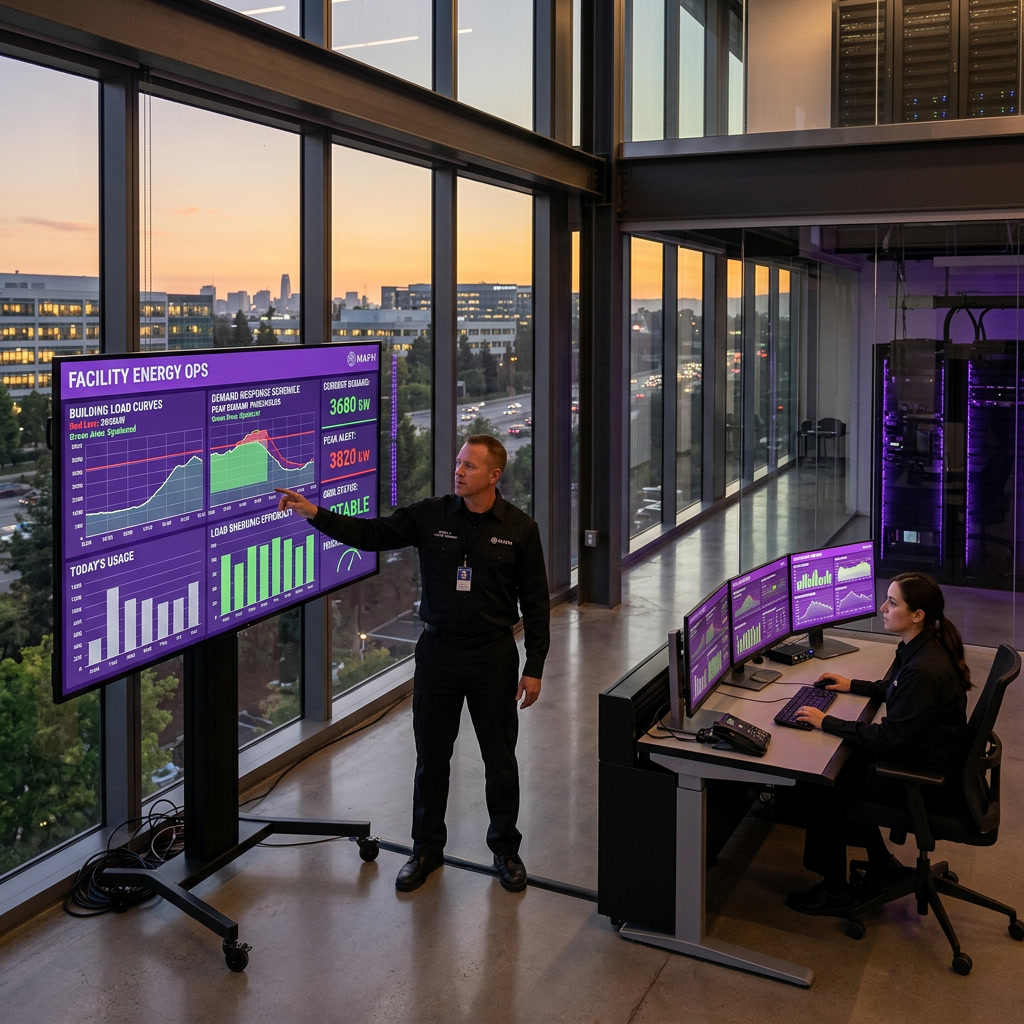
Demand response programs pay a commercial building for using less electricity when the grid is tight, and in PG&E territory the choice comes down to a handful of programs with different rules, notice times and risks. For most Silicon Valley offices, the realistic path is a voluntary program or an aggregator, a written curtailment plan, and a building that can actually shed load without upsetting tenants.
The money is real but modest and depends on your load, so treat it as an offset to energy cost rather than a profit center. This guide covers how the PG&E programs differ, what your building can shed, how performance is measured and who needs to do what before the first event.
Demand response is a customer reducing, increasing or shifting electricity use in response to a price or a grid-reliability signal, in exchange for a bill credit or payment. The California Public Utilities Commission defines it as "reductions, increases, or shifts in electricity consumption by customers in response to economic or reliability signals," and notes that participation is at the customer's discretion.
Programs are run by the investor-owned utilities, community choice aggregators and third-party providers called aggregators. Under PG&E's Rule 24, a customer can enroll with a third-party provider, who bids the reduction into the wholesale market run by the California Independent System Operator (CAISO). One catch: you cannot be in a conflicting PG&E program and a third-party program at the same time, so pick one path before you sign anything.
Five business options matter, and they trade payment for obligation. The details below come from PG&E's business demand response program guide and its business programs page. Check both before enrolling, because tariffs and incentives change.
For a first-time participant, ELRP carries the least risk because nothing is penalized. BIP pays more for availability but punishes a missed reduction, so it suits buildings with a proven, tested shed plan.
It depends on the reduction you can deliver, and published figures for an average office do not exist. What you can do is multiply the rate by your own numbers.
As a hypothetical, an office that reliably sheds 100 kW for a 4 hour ELRP event reduces 400 kWh, which at PG&E's stated $2 per kWh would be $800 for that event, before any aggregator share. The same office in a program with fewer events earns less, and in a mild summer there may be few or no events at all. ELRP events depend on grid conditions, so a payment forecast built on a fixed number of events is a guess.
For that reason, keep the business case honest: count revenue only from what the program sheet says, ignore any "typical annual payment" a vendor quotes unless they will put it in the contract, and compare the figure against what you would spend on controls and staff time. If the number is small, the real value may be in the controls you install anyway.
Cooling is usually the largest flexible load in an office, followed by lighting and a few discretionary systems. The question is how much you can move before comfort complaints start.
Berkeley Lab research on Bay Area buildings concluded that pre-cooling can improve the demand responsiveness of commercial buildings while keeping comfort acceptable. The same study found that it increases the depth and duration of the shed, works best in buildings with heavier mass, and only suits day-ahead programs because pre-cooling takes time. The authors also noted that more work was needed to quantify results in other climates, so test your own building rather than assume.
A practical shed list, in the order most building engineers try it:
If your equipment cannot be adjusted without a vendor visit, that is the first project, not the program enrollment.
A one page plan, with a named owner for each step, beats a sophisticated strategy nobody remembers on a hot Thursday. It should say who receives the event notice, what changes at each setpoint and zone, who confirms it happened, and how to restore normal operation when the event ends.
Include these items:
This is where a facility management partner helps. MAFM does not install or tune building controls or serve as an energy provider, but as the facility management company coordinating your vendors it can keep the plan current, schedule the controls contractor's testing, make sure the crew knows what to expect on an event day and keep the tenant communication consistent. See Building Automation and Load Shedding for the controls side.
You are paid on the difference between what the building actually used and an estimate of what it would have used without the event, called a baseline. In wholesale markets, CAISO's long-standing approach is a "10-in-10" day-matching baseline that looks at each hour of the past 10 similar days. CAISO's own 2017 board memo adds that research found this baseline accurate for many medium and large commercial customers but possibly not for smaller ones, and that it approved additional methods using control groups and weather matching.
What that means for you is simple: a building that already runs lean on the days before an event has a lower baseline, and therefore less to show as reduction. Ask the program or aggregator which baseline applies to your account, what meter data it uses and whether baselines are adjusted for weather. Then compare their statement against your own interval data after the first event, and keep a record of the differences.
It works best as the last layer, after you have fixed rate plans, controls and equipment problems. A building on the wrong rate schedule or with sticking dampers will find demand response disappointing. Start with the PG&E rate and bill review in Utility Cost Benchmarking and PG&E Rate Plans for Offices, then add demand response once the building is running predictably.
Properties in San Jose and the surrounding PG&E territory should also remember that program rules and incentive levels are authorized for set periods. PG&E's program guide states the ELRP incentive of $2 per kWh applies through 2027, and the CPUC opened a new demand response rulemaking in September 2025, so expect changes and re-verify before each season.
Is demand response mandatory for commercial buildings in California?
No for most programs. The CPUC describes participation as voluntary, and PG&E states that ELRP participation is voluntary with no penalty for not taking part. BIP, by contrast, charges $6.00 per kWh for use above your prescribed level, so read the terms before enrolling.
Should I enroll directly with PG&E or use an aggregator?
Direct enrollment is simplest for ELRP and BIP. An aggregator makes sense when you want someone to manage events, notification and reporting, as in the Capacity Bidding Program, but ask what share of the incentive they keep and what the contract commits you to.
Can I be in more than one program?
Sometimes. PG&E's guide says ELRP participants cannot be in another CAISO supply-side program except BIP and CBP, and that Peak Day Pricing can be paired with ELRP. A third-party Rule 24 program cannot overlap with a PG&E program, so confirm eligibility before changing anything.
Will tenants notice a demand response event?
They may notice a slightly warmer space if the shed is deep or the event is long. Stepped setpoints, light pre-cooling on day-ahead events and a short advance notice to tenants keep complaints low.
If you want a coordinated plan for event-day operations, vendor testing and tenant communication, talk to MAFM about facility management. We plan the work and coordinate the specialists, so your building is ready before the first call.
MAFM offers comprehensive facility management solutions tailored to your business needs.
Get in Touch