Budgets & Contracts
Reduce Facility Operating Costs in Silicon Valley, 2026
January 12, 2026
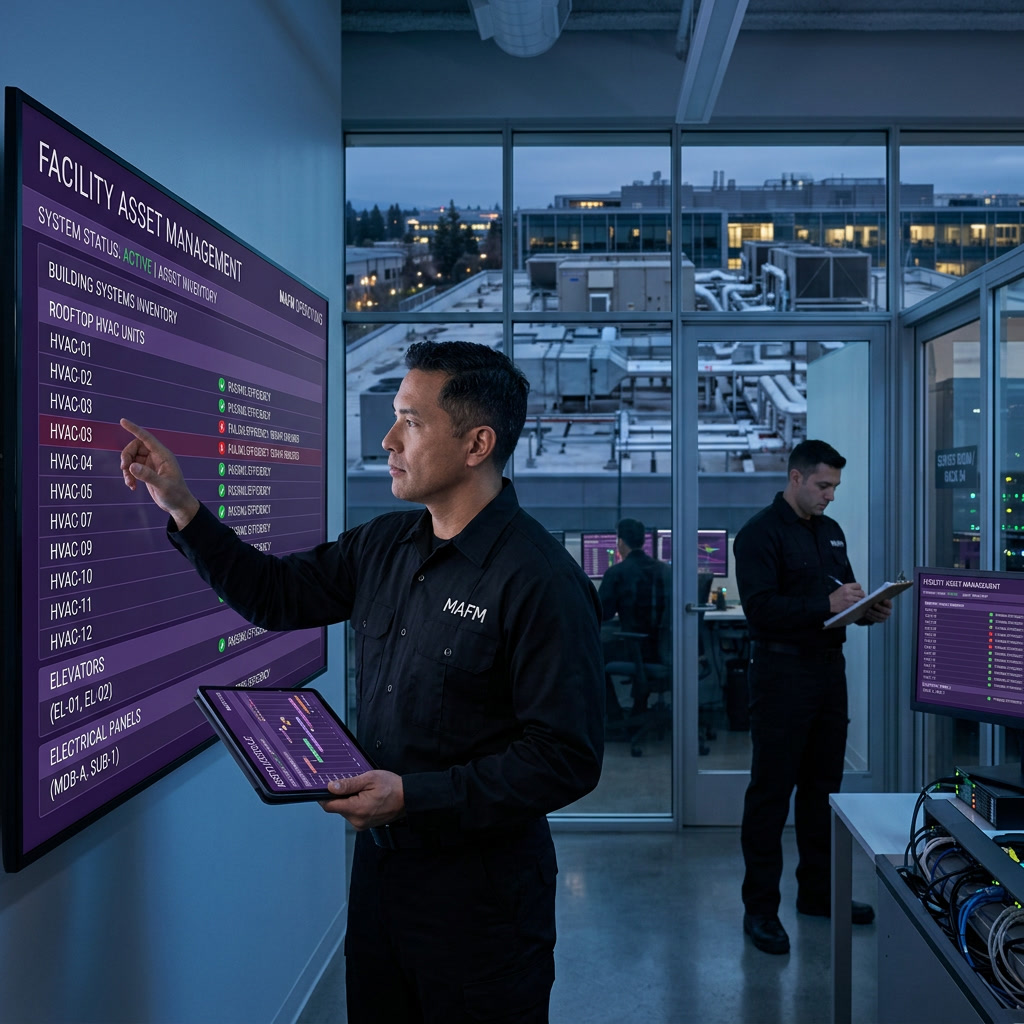
A facility asset lifecycle assessment is an equipment-by-equipment inventory that scores each asset on its condition, its remaining life and what happens if it fails. It turns "the building needs work" into a ranked list a CFO can approve against, and it should be finished before anyone writes a dollar figure into a 2027 capital request.
The order matters. Capital requests stall when the number comes first and the asset list comes second, because the first follow-up question ("which units, specifically?") has no answer. Build the register, score it on two axes, price it as ranges, then stage it across budget years.
A complete register for each building, built from records and nameplates instead of memory. Pull install dates and model data from nameplates, warranty files, building automation logs and past service tickets, then walk the building to confirm what is actually there.
IFMA's guide to the facility condition index describes the same exercise at larger scale: a team inspects each system in a building, and "the condition is based on any deficiencies and the remaining useful life of the system." It adds that a building can have upwards of 80 systems. Start with the systems that carry capital-sized costs:
For each asset, capture four facts: install date, expected life, current condition from a visual check or vendor report, and repair history over roughly the last two years. The repair pattern often says more than the age. A unit that has needed repeated compressor calls is telling you something a straight-line age calculation will not.
Expect gaps, such as a unit with no service records or a generator with no documented load test. Label those "unknown condition, assess first" and budget a third-party assessment. A committee respects that more than a padded number covering uncertainty.
Use published service-life data as a starting range, then adjust for the unit's own history. The most cited source is the ASHRAE owning and operating cost database. Its Handbook chapter, reproduced in an ASHRAE supplement, was built from a sample of 163 commercial office buildings across the United States.
The medians it reports are lower bounds, not expiry dates. ASHRAE lists centrifugal chillers at more than 25 years, metal cooling towers at more than 22 years, steel gas-fired hot-water boilers at more than 22 years and DX air distribution equipment at more than 24 years. The ">" is there because the sample thins out past those ages. ASHRAE explains that "the median service life of centrifugal chillers can only be stated with confidence as >25 years."
Two cautions keep you honest. First, many rows, rooftop units among them, show "N/A" in the 2005 study, with the older 1978 estimates listed beside them and a note that those older figures "may be outdated and not statistically relevant." If a vendor quotes you a tidy life for a rooftop unit, ask where it comes from. Second, these are medians across many buildings. Your climate, run hours and maintenance history move the answer either way.
For equipment without data, ASHRAE says estimates "may be obtained from manufacturers, associations, consortia, or governmental agencies."
Rank on two axes: how much life is left, and how bad a failure would be. Ranking by age alone puts the oldest equipment first no matter what it serves.
Remaining life comes from the section above. Criticality is a judgment about consequences, so define it in writing before you score. A simple 1 to 5 scale works if each point is tied to the same four questions:
A rooftop unit over a rarely used conference room is low criticality even at end of life. The same unit over a server room or a tenant's controlled environment is not. In San Jose and the rest of the Bay Area, where one building can mix older office stock with lab or process space, two units of the same age can land in opposite corners of the grid.
The Government Accountability Office lists conducting "condition assessments as a basis for establishing appropriate levels of funding" among leading practices for managing a maintenance backlog. Condition data first, funding second.
Plot condition or remaining life on one axis and criticality on the other. The quadrant with little life left and high criticality is your near-term priority. That one grid is the exhibit that makes the request legible to people who have never walked a mechanical room.
A facility condition index (FCI) is a useful portfolio comparison, but not a substitute for the asset grid. IFMA defines it as maintenance, repair and replacement deficiencies divided by the facility's current replacement value, and says it lets you compare buildings in a portfolio or the same building over time.
The same guide points out the limits. The FCI is "not an absolute statement of the size of the backlog," because a large, complex building needs a bigger backlog to raise the ratio than a small one does. It also notes the standard formula "does not include a weighting system" for how important each system is, which is the gap the criticality axis fills.
If you report an FCI, state what is in the numerator. IFMA notes the original formula counted only deficiencies, while some organizations now add future lifecycle renewal costs.
Price each priority item as a range with a stated basis and a date, from at least two budgetary quotes, not a single internal guess. Equipment prices, labor rates and lead times shift, so a rough quote from a contractor who would actually do the work is worth more than any published cost table. The old habit of pasting a per-unit price from a blog is the weakest link in most capital requests.
Each line item should show the vendor quotes and dates, what is in scope (equipment only, or rigging, controls and permits), lead times for equipment and permit review, and a contingency with its reason.
Choose the contingency by risk, not habit. A like-for-like swap carries less uncertainty than a project that touches structure, electrical service or a long plan-check queue. Write the method down in the proposal. Ownership groups trust a stated method more than a rounded lump sum.
Keep the avoided-cost argument modest. The U.S. Department of Energy's FEMP operations and maintenance guide (Release 3.0, 2010) estimates "12% to 18% cost savings over reactive maintenance program" for preventive maintenance. That is an older federal estimate, not a forecast for your building, so cite it as context. Our post on moving from reactive to preventive maintenance covers how to apply it.
Sort the priced list into three tiers and ask for the first tier only. The tiers are:
Staging keeps the year-one ask sized to what ownership can approve, and shows that deferred items are sequenced, not ignored.
Document the monitor tier as carefully as the first. For each item, write the trigger that promotes it, such as repeated refrigerant top-offs on a chiller or a failed inspection on a parking structure sealant. That turns the assessment into a living document. It also protects you, because the backlog is a real thing: GAO found that estimated deferred maintenance and repair at four selected federal agencies rose about $22 billion, or 83 percent, between fiscal years 2017 and 2022, with agency officials pointing to funding constraints and rising labor and material costs.
MAFM does not perform engineering assessments or mechanical replacements. As a facilities management company, we help plan, schedule and coordinate the work around them: keeping the register current, running the walkthroughs that feed condition scores, tracking service records from your HVAC, elevator and roofing vendors, and sequencing vendor access so a replacement does not collide with tenant hours. Our facility assessment template is a good place to start the register, and the commercial roof lifecycle plan shows how one asset class is tracked over time.
How often should a facility asset lifecycle assessment be updated? Update condition and repair history on a regular schedule, with a full review before each capital planning cycle. Triggers such as a major failure or a change in tenant use should prompt an early update.
Is remaining useful life the same as the manufacturer's rated life? No. Rated life is a design expectation, while remaining life is your estimate after accounting for maintenance, run hours and repair history. ASHRAE's published medians are drawn from real buildings and are lower bounds for several equipment types, so treat them as a starting range rather than a deadline.
What should go in the asset register first? Start with equipment whose failure would stop tenants from working or carry a safety or code consequence, then add the rest. Capture install date, expected life, condition and repair history for each. Mark anything without records as unknown condition and schedule an assessment.
Do we need a third-party facility condition assessment? Not for every asset. An internal register covers most items, but equipment with no records, high criticality or a large replacement cost justifies an independent assessment before you size the request. IFMA describes a facility condition assessment as work done by an experienced consulting team, which gives the number more weight with ownership.
If your asset list lives in several spreadsheets and a few people's heads, we can help you consolidate it, run the walkthroughs and coordinate the vendors who assess and replace equipment. Talk to MAFM about facility management before your next budget cycle closes. For buildings in the South Bay, see our San Jose page.
MAFM offers comprehensive facility management solutions tailored to your business needs.
Get in Touch