Commercial Roof Maintenance: The Lifecycle Management Strategy That Prevents Six-Figure Emergency Replacements
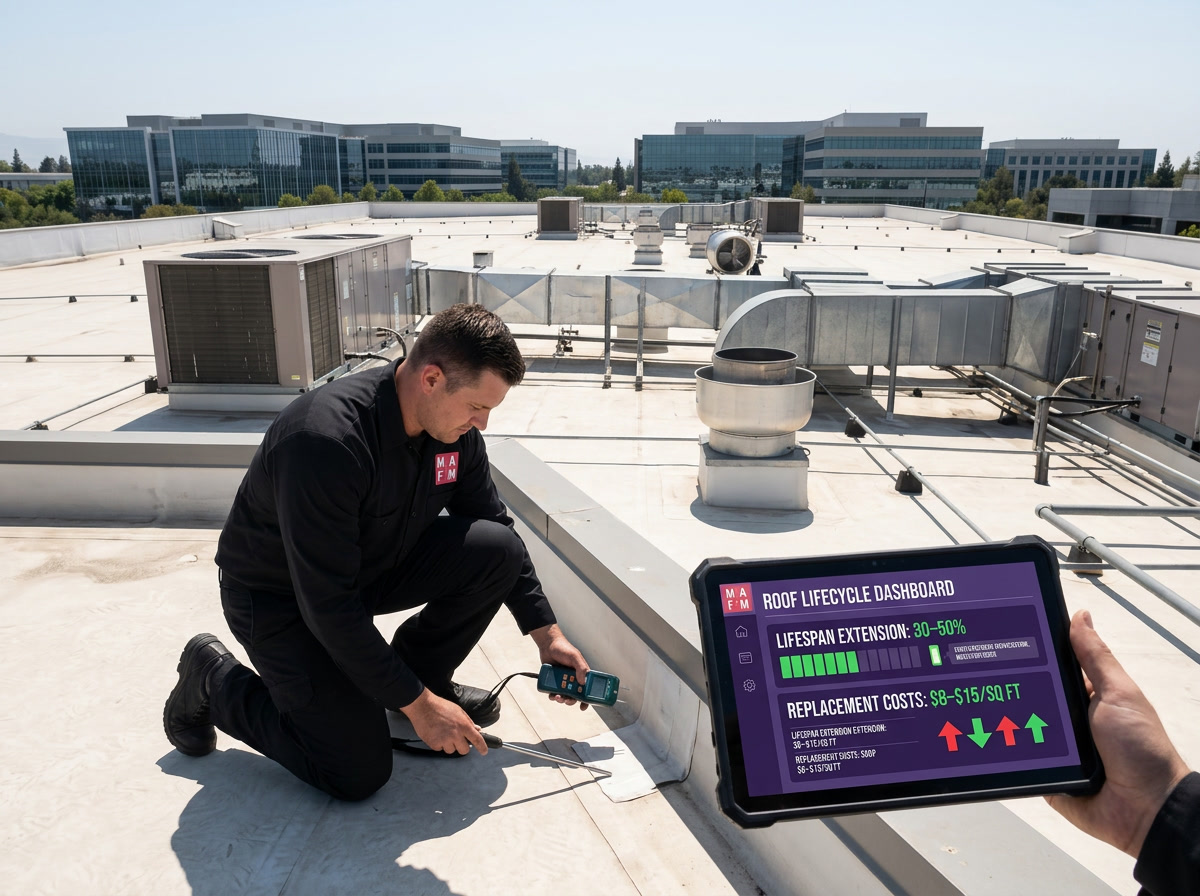
Commercial Roof Maintenance: The Lifecycle Management Strategy That Prevents Six-Figure Emergency Replacements
The commercial roof is simultaneously the most expensive building component to replace and the easiest to ignore. It sits above the ceiling tiles, out of sight and out of mind, quietly performing its primary function until the day it does not. When that day arrives (typically announced by a ceiling stain, a dripping light fixture, or a puddle on a tenant's desk) the damage extends far beyond the roof membrane itself.
A roof failure in a Silicon Valley commercial building triggers a cascade of costs: emergency leak repair, interior damage remediation, tenant disruption, potential business interruption claims, and accelerated roof replacement that could have been deferred years with proper maintenance. The total exposure from a single significant roof failure routinely exceeds $100,000 when all direct and indirect costs are tallied.
Proactive roof maintenance is the least glamorous and highest-ROI investment in your facility budget. Here is the lifecycle management strategy that keeps your roof performing and your budget intact.
Understanding Commercial Roof Systems
Different roof systems require different maintenance approaches, and understanding what sits on top of your building is the essential first step in lifecycle management.
Built-up roofing systems consist of multiple layers of bitumen and reinforcing fabrics. These systems are durable and well-understood but degrade through UV exposure, thermal cycling, and moisture infiltration at seams and penetrations. Maintenance focuses on preserving the surface coating, maintaining flashing integrity, and detecting subsurface moisture before it reaches the structural deck.
Single-ply membrane systems (TPO, PVC, and EPDM) have become the dominant roofing choice for Silicon Valley commercial buildings constructed or re-roofed in the past 20 years. Each membrane type has different maintenance requirements. TPO and PVC seams are heat-welded and vulnerable to seam separation over time. EPDM seams are adhesive-bonded and susceptible to adhesive failure and shrinkage. Maintenance for all single-ply systems focuses on seam integrity, membrane puncture detection, and flashing condition at penetrations and perimeter edges.
Modified bitumen systems combine the layered approach of built-up roofing with modern polymer-modified materials. Maintenance priorities include granule surface preservation, seam inspection, and flashing condition monitoring.
Metal roofing systems are less common on Silicon Valley office buildings but appear frequently on industrial and flex-space properties. Maintenance focuses on fastener integrity, panel seam condition, coating preservation, and expansion joint performance.
The Semi-Annual Inspection Protocol
Effective roof maintenance begins with regular, systematic inspections. Two comprehensive inspections annually, spring and fall, catch developing issues at the earliest possible stage when intervention costs are lowest.
The spring inspection, ideally conducted in April or early May, assesses any damage from winter weather exposure and prepares the roof for the dry season ahead. The fall inspection, conducted in September or October, prepares the roof for winter weather and addresses any deterioration from summer UV exposure and thermal cycling.
Each inspection should follow a documented protocol covering specific elements in a consistent sequence. Start at the perimeter and work inward, examining edge metal and coping condition, perimeter flashing adhesion and sealant integrity, drainage path verification at each roof drain, membrane condition across the entire field of the roof, all penetration flashings including HVAC curbs, plumbing vents, electrical conduits, and exhaust fans, and the condition of any rooftop equipment supports and platforms.
Document every inspection with written notes, photographs, and a scored condition assessment. Photography is essential, roof conditions change gradually enough that visual comparison between inspections reveals deterioration patterns that single-point observation misses.
Pay particular attention to areas around mechanical equipment. HVAC technicians, plumbers, and electricians who access rooftop equipment are the most common source of accidental membrane damage. Traffic paths to and from rooftop equipment should be protected with walkway pads, and any new damage should be repaired immediately rather than deferred.
Preventive Maintenance Priorities
Inspection identifies issues. Preventive maintenance addresses them before they escalate into failures.
Drain maintenance is the single most important preventive activity. Clogged or slow-draining roof drains create ponding water that accelerates membrane deterioration, increases structural loading, and provides mosquito breeding habitat. Clean all roof drains quarterly at minimum and after every significant debris event, wind storms, leaf fall, and construction activity all deposit material that obstructs drainage.
Sealant maintenance at penetrations and flashing terminations should be performed annually. Roof sealants have finite lifespans, typically five to eight years depending on product type and UV exposure, and require systematic replacement on a scheduled cycle rather than reactive replacement after failure.
Debris removal prevents organic material from retaining moisture against the membrane surface, which accelerates deterioration and creates conditions for biological growth. Remove accumulated leaves, dirt, and debris during every inspection visit and after major weather events.
Minor repair execution during inspection visits prevents small issues from becoming large ones. A membrane puncture that costs $50 to patch during an inspection visit costs $5,000 to remediate after water has migrated through the roof assembly and saturated the insulation below.
Coating and surface treatment renewal extends roof life significantly. Reflective roof coatings reduce thermal stress by lowering surface temperatures 50-70 degrees during summer, slow UV degradation, and can add 8-12 years of useful life to aging roof systems at 15-25% of replacement cost.
Moisture Detection and Early Warning
The most destructive roof damage occurs invisibly. Water that penetrates a membrane defect migrates laterally through the insulation layer, saturating large areas while the visible entry point remains small. By the time interior water staining appears, the subsurface damage typically extends far beyond the visible leak location.
Infrared thermographic surveys detect subsurface moisture by identifying temperature differences between wet and dry insulation. Wet insulation retains heat longer than dry insulation, creating thermal signatures that infrared cameras can map across the entire roof surface.
Schedule an infrared survey every two to three years as a supplement to visual inspections. The survey should be conducted during evening hours after a warm, sunny day when temperature differential between wet and dry areas is most pronounced.
For high-value properties where roof failure creates significant business interruption exposure, electronic leak detection systems provide continuous monitoring through sensors embedded in the roof assembly. These systems detect moisture penetration within hours of occurrence and pinpoint the location with precision that eliminates exploratory demolition during repair.
Nuclear moisture meters provide point-specific moisture readings during inspections and are useful for evaluating suspect areas identified during visual inspection. However, they only measure the specific points tested and cannot identify moisture in untested locations.
Lifecycle Cost Planning
Commercial roof systems have defined lifespans that vary by material type, installation quality, maintenance history, and climate exposure.
Single-ply membranes in Silicon Valley's moderate climate typically deliver 20-30 years of service with proper maintenance. Without maintenance, these systems may fail in 12-18 years. The difference in replacement timing represents hundreds of thousands of dollars in avoided capital expenditure for a typical commercial building.
Built-up and modified bitumen systems often exceed 25-30 years with proper maintenance and periodic coating renewal. Metal roofing systems can last 40-50 years with appropriate maintenance.
Build your roof lifecycle into your capital reserve planning. A 50,000 square foot commercial roof replacement at current Silicon Valley pricing runs $400,000-$750,000 depending on system type and access complexity. Funding this expenditure through annual reserve contributions of $15,000-$30,000 prevents the budget shock of emergency replacement financing.
Track your roof's condition trend through annual FCI scoring. A roof that maintains Condition 2 rating year after year confirms that your maintenance investment is preserving the asset effectively. A roof that declines from Condition 2 to Condition 3 over two to three years signals that maintenance efforts are not keeping pace with deterioration and additional investment or accelerated replacement planning is warranted.
Contractor Selection and Oversight
Roof maintenance requires specialized expertise that general facility maintenance contractors cannot provide. Select roofing contractors based on demonstrated experience with your specific roof system type, appropriate California roofing contractor licensing, manufacturer certifications that preserve your warranty coverage, and verifiable references from Silicon Valley commercial properties.
Maintain a relationship with a single qualified roofing contractor rather than soliciting competitive bids for every minor repair. A contractor who knows your roof's history, condition, and problem areas provides more effective service than one encountering your roof for the first time during each visit.
Protect Your Most Expensive Asset
Your commercial roof is a depreciating asset that requires systematic investment to reach its designed service life. Every dollar spent on inspection, preventive maintenance, and timely repair returns multiples in extended roof life, avoided emergency costs, and protected interior spaces.
Schedule your spring roof inspection this month if you have not already. Confirm that your maintenance contractor has a current understanding of your roof's condition. Verify that your capital reserve plan adequately funds eventual replacement. These straightforward management actions protect one of your building's most expensive and most vulnerable systems.
MAFM PRO coordinates comprehensive roof maintenance programs as part of our total facility management approach. Contact us for a roof condition assessment and lifecycle plan.
Schedule your consultation: Contact MAFM.PRO
Ready to Optimize Your Facilities?
MAFM offers comprehensive facility management solutions tailored to your business needs.
Get in Touch