Technology & Operations
AI Facility Management: What It Can Do for Response Times
January 21, 2026
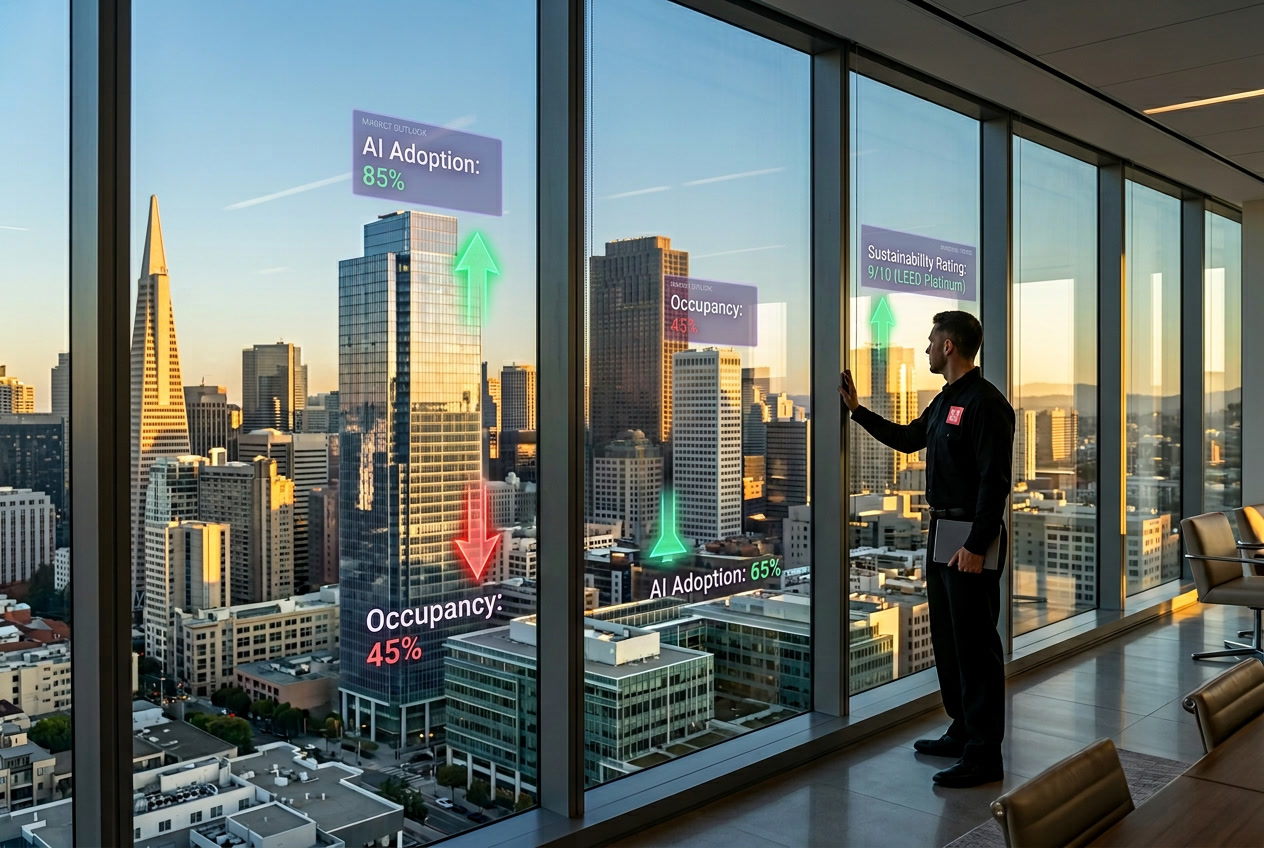
The facility management trends that matter most for Silicon Valley buildings in 2026 are uneven office attendance, higher cleaning labor costs, tightening energy and air rules, and a push toward data-driven maintenance. None of them is new. What has changed is that each one now shows up in a budget line or a compliance deadline.
This post sticks to what can be measured or read in the rule text. Where a trend has no solid number behind it, it says so rather than guessing. Use it as a planning checklist for the rest of the year, not as a forecast.
Buildings are busy in the middle of the week and much quieter at the edges, and the average sits well below pre-2020 levels. Kastle Systems tracks badge entries in the office buildings it secures and compares each week with a February 2020 baseline of 100%. In its Back to Work Barometer, San Jose averaged 46.0% for the week ending October 21, 2026, with a Wednesday peak of 54.0%. Nationally, Tuesday was the peak day that week.
Kastle's data covers only its own customer buildings, so it is a signal and not a census. Still, the pattern is consistent: a midweek peak and a lighter Monday and Friday.
For facility teams, the practical effects are about timing and quality, not just cost:
Any change to a cleaning schedule should be written into the scope of work, so the crew and the client agree on which days get which tasks.
They are higher in the Bay Area than almost anywhere else in the country. The Bureau of Labor Statistics reported for May 2025 that the San Jose-Sunnyvale-Santa Clara area had 15,780 janitors and cleaners, with a mean wage of $22.55 an hour, or $46,900 a year. The national mean annual wage for the same occupation was $38,760.
Those are averages across every employer, so a given contract can sit above or below them. The point for budgeting is the gap, and that it is structural. A cleaning contract priced as if labor costs matched the national picture will be underfunded in this market.
An underfunded contract usually fails in one of three ways:
Ask for the labor assumptions behind a bid: hours per visit, supervision and who covers absences. A price that cannot be explained in hours is hard to trust. Stable crews also make routine inspections possible, which is the foundation of any preventive maintenance program.
Two programs deserve a place on the calendar: state energy reporting and the Bay Area's rules for gas appliances.
Benchmarking. The California Energy Commission's Building Energy Benchmarking Program covers commercial buildings of more than 50,000 square feet of gross floor area. Reporting is due every year by June 1, entered through ENERGY STAR Portfolio Manager. Owners need clean utility data and a person responsible for filing it. If that person left last year, nobody may be doing it.
Gas appliances. The Bay Area Air Quality Management District's Rules 9-4 and 9-6 set zero-NOx emission standards for certain water heating and space heating equipment, with implementation dates beginning in 2027, 2029 and 2031. The District says the requirements apply only when existing equipment burns out, and the water heater rule does not require replacing a functioning unit. The page also notes a proposed delay to January 1, 2028 for residential water heaters, so check the current status before you plan around a date.
The takeaway is to know your equipment before it fails. A list of every gas-fired unit, its age and its replacement cost lets you choose a replacement on your schedule, not in the middle of a January failure. Our post on heat pump technology for commercial buildings covers the replacement side.
MAFM does not repair or replace HVAC equipment. As a facility management partner, we keep the asset list current, schedule the licensed vendors who do that work and make sure the right people are in the building when they arrive.
Mostly in the boring layers underneath: clean equipment records, consistent work orders and sensor data someone looks at. Predictive maintenance and automated optimization are real, but they depend on that groundwork, and many mid-size buildings do not have it yet.
An older reference point makes the same argument. The U.S. Department of Energy's Operations and Maintenance Best Practices guide, published in 2010, estimates that O&M programs can save 5% to 20% on energy bills without a significant capital investment, and it defers to manufacturer recommendations on how equipment should be run and maintained. Software can help you see what is drifting. It does not replace the basics.
Before buying any platform, check four things:
If the answers are no, fix those first. Conversational work order tools and shared dashboards are also useful at the front end, because requests arrive with a location and a description instead of a vague phone message.
Tenants ask about ventilation and filtration more often than they used to, and a facility team that can answer plainly has an edge. The CDC's ventilation guidance says ventilation system upgrades or improvements can increase the delivery of clean air and dilute potential contaminants, and that many buildings can add clean air without major renovation. It also states that air cleaning is not a substitute for the minimum outdoor air requirements in building codes.
That gives a facility manager a simple way to talk about air quality:
Filter changes and air handler servicing are done by licensed HVAC vendors. Scheduling them, escorting them and recording the work is the part a facility partner handles.
Start with the facts you already have and work outward. A practical plan has five items:
Each item is small. Together they turn a vague outlook into a calendar with names on it. If you manage a property in the South Bay, our San Jose facility management page describes how we work in the area.
Is hybrid work still reducing office demand in Silicon Valley? Occupancy is still well under pre-2020 levels. In Kastle's barometer, San Jose averaged 46.0% of its February 2020 baseline in the week ending October 21, 2026. Attendance is also uneven across the week, so schedules built for five equal days tend to miss.
Do the Bay Area gas appliance rules force me to replace working equipment? Not according to the Air District. It says the requirements for Rules 9-4 and 9-6 apply upon burn out of current equipment, and the water heater rule does not require replacing a functioning unit. The practical consequence is that when a unit fails, the replacement may need to meet the zero-NOx standard once the relevant date arrives.
Does my building have to report its energy use to the state? If it has more than 50,000 square feet of gross floor area, it is a disclosable building under the California Energy Commission's benchmarking program, and the report is due each year by June 1. Reporting goes through ENERGY STAR Portfolio Manager. Check the Commission's page for the current requirements.
Should a mid-size building buy predictive maintenance software? Only after the basics are in place. The software relies on accurate equipment records and consistent work orders, and someone has to act on what it finds. If those are missing, building them first usually delivers more than the platform would.
If you want a second opinion on your cleaning schedule, equipment list or vendor calendar, MAFM can walk the building with you and turn it into a written plan. Talk to us about facility management.
MAFM offers comprehensive facility management solutions tailored to your business needs.
Get in Touch