Compliance & Regulations
California 2026 Environmental Regulations for Facilities
March 4, 2026
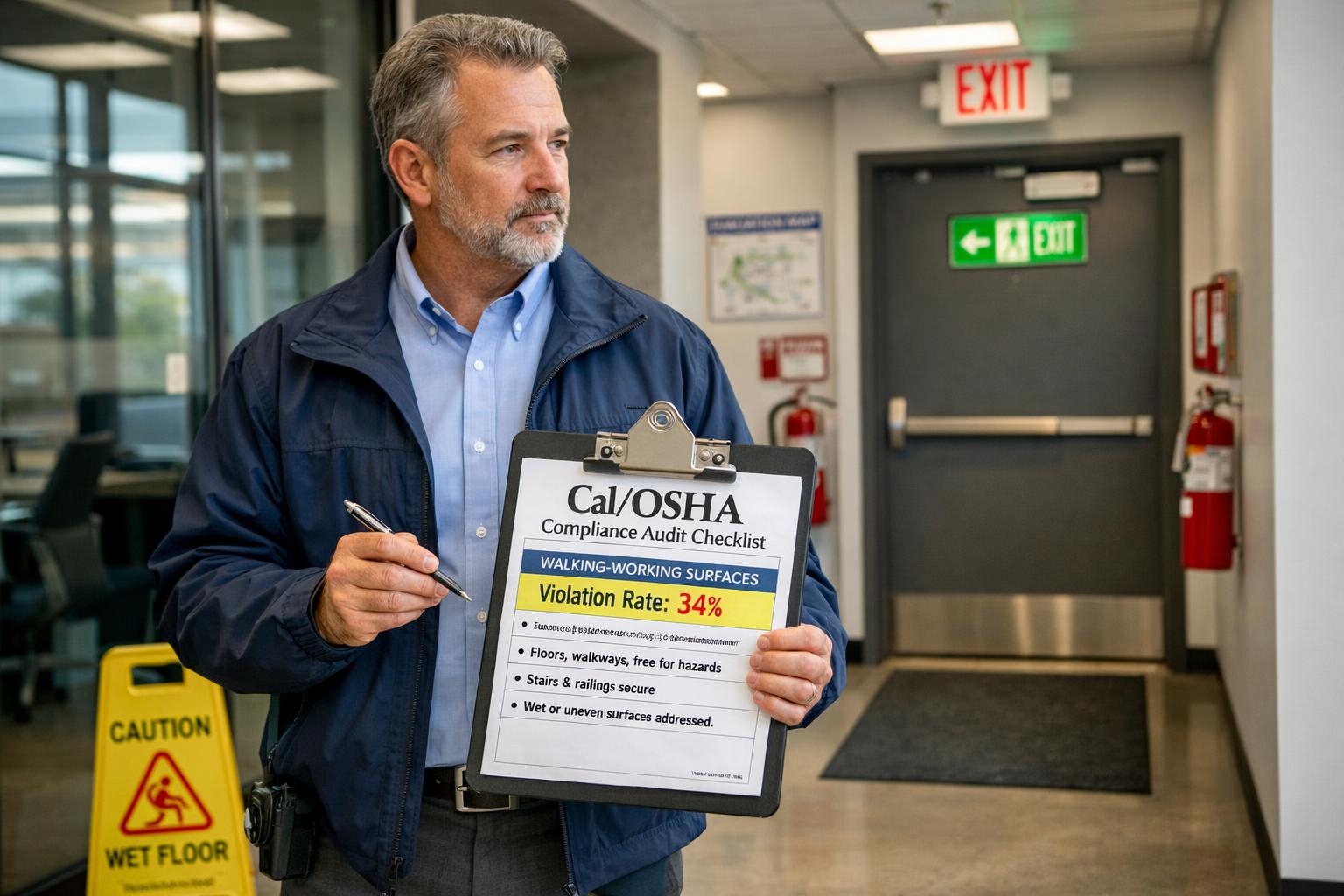
An OSHA compliance checklist for a Silicon Valley commercial building comes down to seven areas: a written injury and illness prevention program, safe walking surfaces, hazard communication for cleaning and maintenance chemicals, emergency and fire planning, personal protective equipment, bloodborne pathogen controls where they apply, and records you can produce on request. In California the rules that count are Cal/OSHA's Title 8, and many of them mirror federal OSHA's.
Most citations in an office building trace back to paperwork never written, training never given, or a hazard someone saw and did not fix. This checklist walks through each area, names the regulation it rests on, and ends with a calendar.
Cal/OSHA applies. California runs an OSHA-approved State Plan that covers most private sector workers, and State Plans must be at least as effective as federal OSHA in protecting workers. Where Title 8 asks for more than the federal standards, California wins.
The duty sits with each employer for its own employees. A property manager, a tenant company and a cleaning contractor each owe their own people a safe workplace and their own paperwork. A building with several employers on site needs one person who knows who owns what.
Start with the umbrella requirement. Under Title 8 section 3203, California employers need a written Injury and Illness Prevention Program. It must name the person with authority and responsibility for running it, include a system for making sure employees follow safe work practices, communicate with employees in a form they understand, schedule periodic inspections, and train new hires, people given new assignments and supervisors.
California's penalty ceilings are set in regulation and are high enough to matter. Under Title 8 section 336, as amended effective January 1, 2025, a general violation can draw a civil penalty of up to $16,285, a serious violation up to $25,000, and a willful violation a minimum of $11,632 and up to $162,851. Federal OSHA publishes its own annually adjusted maximums on its penalties page.
The practical lesson: a hazard that was reported and left alone looks very different to an inspector than one found and fixed the same day. A dated inspection record is your best evidence.
Keep floors clean and dry, fix hazards before anyone uses the surface again, and guard what you cannot fix immediately. Federal 29 CFR 1910.22 requires walking-working surfaces to be kept clean, orderly and sanitary, floors kept clean and "to the extent feasible" dry, surfaces inspected regularly and as necessary, and hazards corrected before use or guarded if repair cannot be immediate. California's Title 8 section 3273 adds that permanent floors must be reasonably free of oil, grease or water, with mats, grates or cleats where slippery conditions cannot be avoided.
A walkthrough for this area looks for:
Stairs and ladders have their own rules. 29 CFR 1910.25 requires stairs to have uniform riser heights and tread depths between landings, with handrails and guardrails provided as 1910.28 specifies. For portable ladders, 29 CFR 1910.23 requires an inspection before initial use in each work shift, tagging and removal from service for defective ladders, use only on stable and level surfaces unless secured, and side rails that extend at least 3 feet above an upper landing.
For the slip hazards specific to wet weather, see our guide to slip and fall prevention in Bay Area buildings.
A written program, a safety data sheet for every hazardous product, labeled containers and trained employees. Cleaning chemicals, floor products, pest control materials and maintenance supplies all count.
The federal rule, 29 CFR 1910.1200, requires employers to develop, implement and maintain a written hazard communication program at each workplace, to keep safety data sheets readily accessible during each work shift, and to give employees effective information and training on hazardous chemicals. California's equivalent is Title 8 section 5194, with the same core duties.
Labels are where buildings slip. Each workplace container must carry either the full shipped-container label elements or the product identifier plus words, pictures or symbols giving general hazard information. The exception is a portable container filled from a labeled one and used only by the person who filled it, for their immediate use. A spray bottle that sits on a cart overnight is no longer immediate use.
Steps for a facility team:
The plan covers how people report an emergency, how they evacuate, who stays behind for critical operations, how everyone is accounted for, and who handles rescue or medical duties. That list comes from 29 CFR 1910.38, which also requires the plan to be written, kept in the workplace and available for review, with a small-employer exception: an employer with 10 or fewer employees may communicate it orally. Employees must be briefed when the plan is developed, when their duties change and when the plan changes, and some must be trained to help others evacuate.
California's Title 8 section 3220 is built the same way: a written plan with minimum elements, trained evacuation assistants, and a review with each employee on initial assignment. Our emergency response planning guide covers building the plan.
Fire safety checks that belong on your calendar:
Anyone who handles chemicals, cleans restrooms or responds to a bodily fluid spill is covered. For protective equipment, 29 CFR 1910.132 requires the employer to assess the workplace for hazards, certify the assessment in writing, provide required PPE at no cost to employees, pay for replacements unless an employee lost or deliberately damaged the item, and train each employee who must use it. Each affected employee has to demonstrate understanding before doing work that requires PPE.
For bloodborne pathogens, 29 CFR 1910.1030 requires a written exposure control plan reviewed at least annually, hepatitis B vaccination offered within 10 working days of initial assignment, and training at initial assignment and at least annually after. Contaminated sharps go in closable, puncture resistant, leakproof, labeled containers that are replaced before they overfill. California's version, Title 8 section 5193, requires a written plan updated at least annually and annual training.
Keep inspection and training records for at least a year, and keep injury and illness logs for five years. Under Title 8 section 3203, inspection records must show who inspected, the unsafe conditions found and the corrective action taken, and both inspection and training records must be kept for at least one year.
Federal recordkeeping rules cover the injury log. 29 CFR 1904.33 requires the OSHA 300 Log, the annual summary and the 301 incident reports to be kept for five years following the end of the calendar year they cover. 29 CFR 1904.32 requires the annual summary to be posted by February 1 of the following year and kept in place until April 30. Employers in industries listed in Appendix A of 29 CFR 1904.2 do not need to keep these records unless asked, so confirm whether your employer type is covered.
California's workplace violence law adds a written prevention plan, which can be a section of your injury and illness program, plus training and a violent incident log. Cal/OSHA's general industry page says it took effect July 1, 2024, with incident logs kept at least five years.
A simple annual rhythm keeps all of this current:
Is Cal/OSHA stricter than federal OSHA?
State Plans must be at least as effective as federal OSHA, and California adds duties such as a written injury and illness prevention program and workplace violence prevention. Following Title 8 will normally satisfy the federal equivalent too.
Do small offices need a written emergency action plan?
Yes, with one exception. Federal and California rules both require a written plan, but an employer with 10 or fewer employees may communicate it orally. A one-page written plan is still easier to train from.
How long should we keep safety records?
Inspection and training records for at least one year under Title 8 section 3203, and OSHA 300 logs, summaries and 301 reports for five years under 29 CFR 1904.33. Violent incident logs are kept at least five years.
Who is responsible for compliance when a cleaning contractor works in our building?
Each employer is responsible for its own employees, so a contractor owes its crew training, data sheets and protective equipment. You still coordinate by sharing hazards and emergency procedures and asking for their program documents.
MAFM is a facilities management company based in San Jose. We coordinate the recurring work that keeps a building inspection-ready: walkthrough schedules, janitorial scopes, vendor coordination and the records that prove it was done. Talk to us about facility management, or read how we work across San Jose.
MAFM offers comprehensive facility management solutions tailored to your business needs.
Get in Touch