Compliance & Regulations
OSHA Compliance Checklist for Silicon Valley Buildings
February 4, 2026
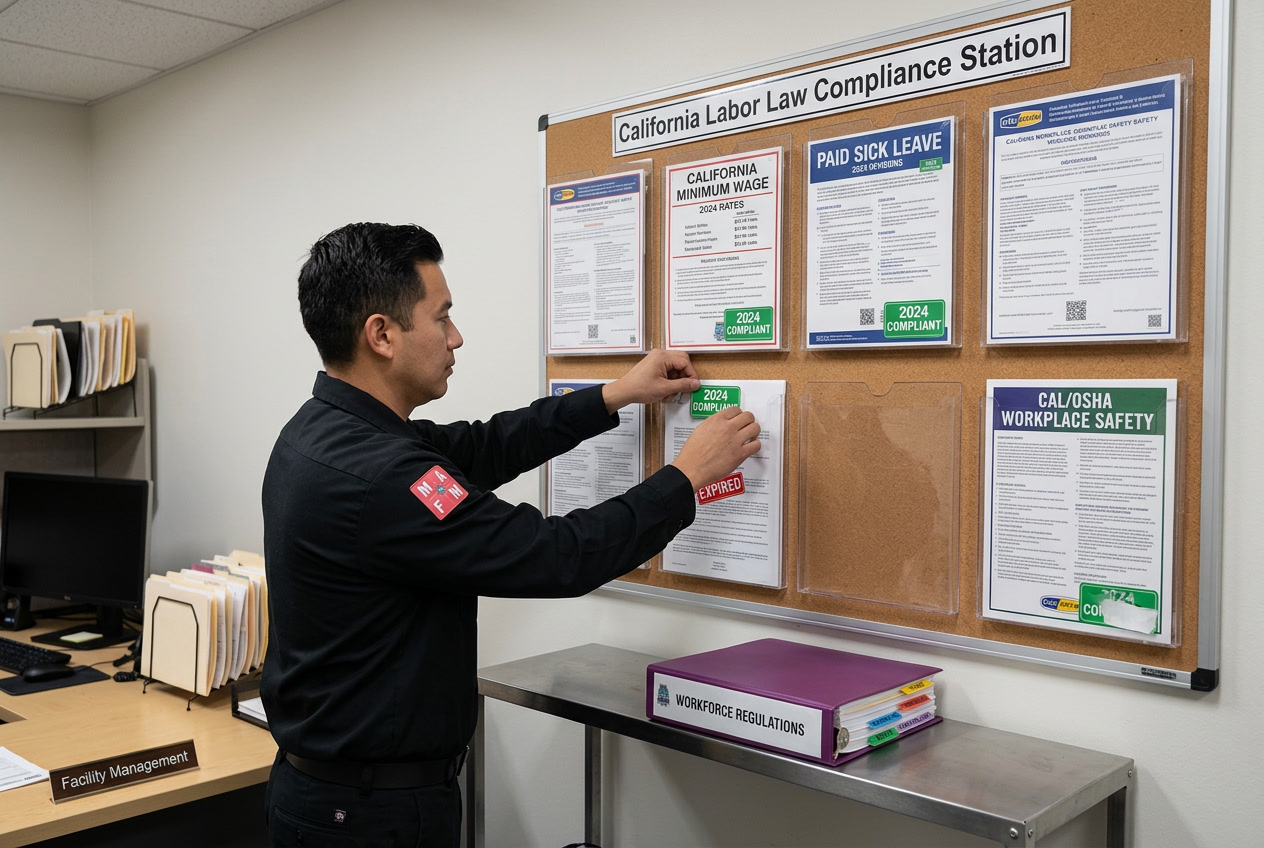
California labor law compliance for cleaning and maintenance teams comes down to six areas: wages and overtime, meal and rest breaks, the state's janitorial registration and training rules, paid sick leave, Cal/OSHA safety programs, and whether each worker is really an employee. A facility manager does not need to run payroll, but does need to know which of these a vendor or an in-house crew must get right, because some of the penalties land on the company that hires the cleaner.
This is general information, not legal advice. Confirm contract and payroll decisions with employment counsel.
California counts overtime by the day, not just the week, and the minimum wage you must meet depends on the city where the work is done. Under the Labor Commissioner's overtime guidance, hours beyond eight in a workday are paid at one and one-half times the regular rate, up to 12 hours. Hours beyond 12 in a workday are paid at double the regular rate. On the seventh consecutive day of work in a workweek, the first eight hours are paid at one and one-half times the rate and anything beyond eight at double.
The state minimum wage is $16.90 per hour in 2026, but where a local rate is higher, the employer must follow the stricter standard. Many South Bay cities set their own. The UC Berkeley Labor Center's inventory of local minimum wages lists these rates, effective January 1, 2026:
These rates change each January, so check the current figure before you sign or renew. A crew working buildings in more than one city may be owed a different minimum in each.
For scheduling, a ten-hour deep-clean shift carries two overtime hours however few hours the person worked earlier in the week. Split big projects across shifts or add a second person, and price the overtime in when a long shift cannot be avoided.
A cleaning shift that runs more than five hours needs a meal period, and every shift needs rest periods, with real money attached if they are missed. The Labor Commissioner's meal period guidance says an employer may not employ a person for more than five hours in a day without a meal period of not less than 30 minutes, with a second one required past ten hours. The first meal period can be waived by mutual consent only when the total work period is six hours or less.
Rest periods are separate. Employers must authorize and permit a net 10-minute paid rest period for every four hours worked or major fraction thereof. A short four-hour cleaning window may skip the meal period, but it does not skip the rest period.
If a required meal or rest period is not provided, the employer owes one additional hour of pay at the regular rate for each workday it happens. One hour per workday is the rule, not one hour per missed break, which is a correction to a common misstatement.
On a night route in an empty building, breaks slide because nobody is watching a clock. Write the break windows into the route and have supervisors confirm them.
California has a state registration program and a training mandate that apply to janitorial employers, and the penalty for hiring an unregistered one falls on the hiring company. The Labor Commissioner's janitorial registration FAQ covers the main points:
The Labor Commissioner's janitorial providers page links a registration search tool. Check it before you award or renew a contract, and put a registration clause in the agreement so the vendor must stay registered for the term. If you employ janitorial staff directly, ask your counsel whether the registration duty applies to you, because the FAQ says it covers businesses that employ covered workers.
The same FAQ describes the training mandate. Janitorial employers must provide at least two hours of in-person sexual violence and harassment prevention training at least once every two years, new workers must be trained within six months of starting, and training records must be kept for three years. Ask for the sign-in sheets and certificates.
Employers must generally provide five days or 40 hours of paid sick leave a year, and local ordinances can require more. The Labor Commissioner's paid sick leave FAQ says employees must satisfy a 90-day employment period before taking leave, that accrual plans must earn at least one hour for each 30 hours worked, and that an employer cannot deny the right to use accrued sick days. Where a local ordinance applies, the employer must provide whichever provision is most generous to the employee.
Some cities have their own ordinances, so confirm the current local terms rather than relying on a vendor's summary. Leave that people can actually use means someone else covers the shift. A one-person night route with no backup quietly pressures that person to come in sick. Ask a vendor how absences are covered, whether by a floating crew member or cross-trained supervisors. Our post on warning signs of an underperforming janitorial service lists coverage gaps among the first things to check.
Three Cal/OSHA programs touch almost every cleaning and maintenance crew, each with a written element and a training element.
If a vendor's program covers your building, ask to see the chemical list and the sheets for what is actually stocked in your supply room. Our OSHA compliance checklist for Silicon Valley commercial buildings goes further on the building side.
In California, a worker is presumed to be an employee, and a hiring entity must prove all three parts of the ABC test to treat someone as a contractor. The Labor Commissioner's independent contractor FAQ states the parts:
Some occupations are evaluated under a different test, so this is a starting point. But a person who cleans your building on your schedule, with your supplies, and has no business of their own is hard to defend as a contractor. For a janitorial company, cleaning is its usual course of business, so its cleaners will not pass the second part. The same FAQ notes that willful misclassification carries civil penalties of $5,000 to $25,000 per violation under Labor Code section 226.8.
The straightforward path is to hire an established company that employs its crew on payroll. Put a clause in the agreement that the vendor classifies all workers in compliance with California law and carries workers' compensation coverage.
Ask for documents, not assurances. A vendor that runs a clean operation can produce these quickly:
Review these yearly and at renewal. Our guide to building a vendor performance scorecard shows one way to track them.
Does a company that hires a janitorial contractor have any legal exposure? Yes, in one specific way. California fines a business that contracts for janitorial services with an employer that is not registered with the Labor Commissioner when the contract is executed, extended, renewed or modified, starting at $2,000 to $10,000 for a first violation. Checking registration before you sign or renew is the safeguard.
Is overtime owed after eight hours in a single day? Yes. California pays one and one-half times the regular rate for hours beyond eight in a workday and double time beyond 12, whatever the weekly total. Long project shifts therefore trigger overtime on their own.
How many sick days must a cleaner receive in California? Employers must generally provide five days or 40 hours of paid sick leave a year, and where a city ordinance is more generous, the more generous rule applies. Employees can use it after a 90-day employment period.
Can we hire one cleaner directly as an independent contractor? It is risky. California presumes a worker is an employee unless the hiring entity can prove all three parts of the ABC test, and a regular cleaner working your schedule rarely satisfies them. Working with a company that employs its crew on payroll avoids the problem.
A short document review at renewal is cheaper than finding a gap during a labor audit. MAFM is a facilities management company that plans and supervises building services, and we will walk through these documents with you for San Jose and Bay Area buildings. Talk to us about janitorial services.
February 4, 2026

March 4, 2026

May 15, 2026
MAFM offers comprehensive facility management solutions tailored to your business needs.
Get in Touch