
Compliance
The Impact of California's 2026 Environmental Regulations on Facility Operations
March 4, 2026
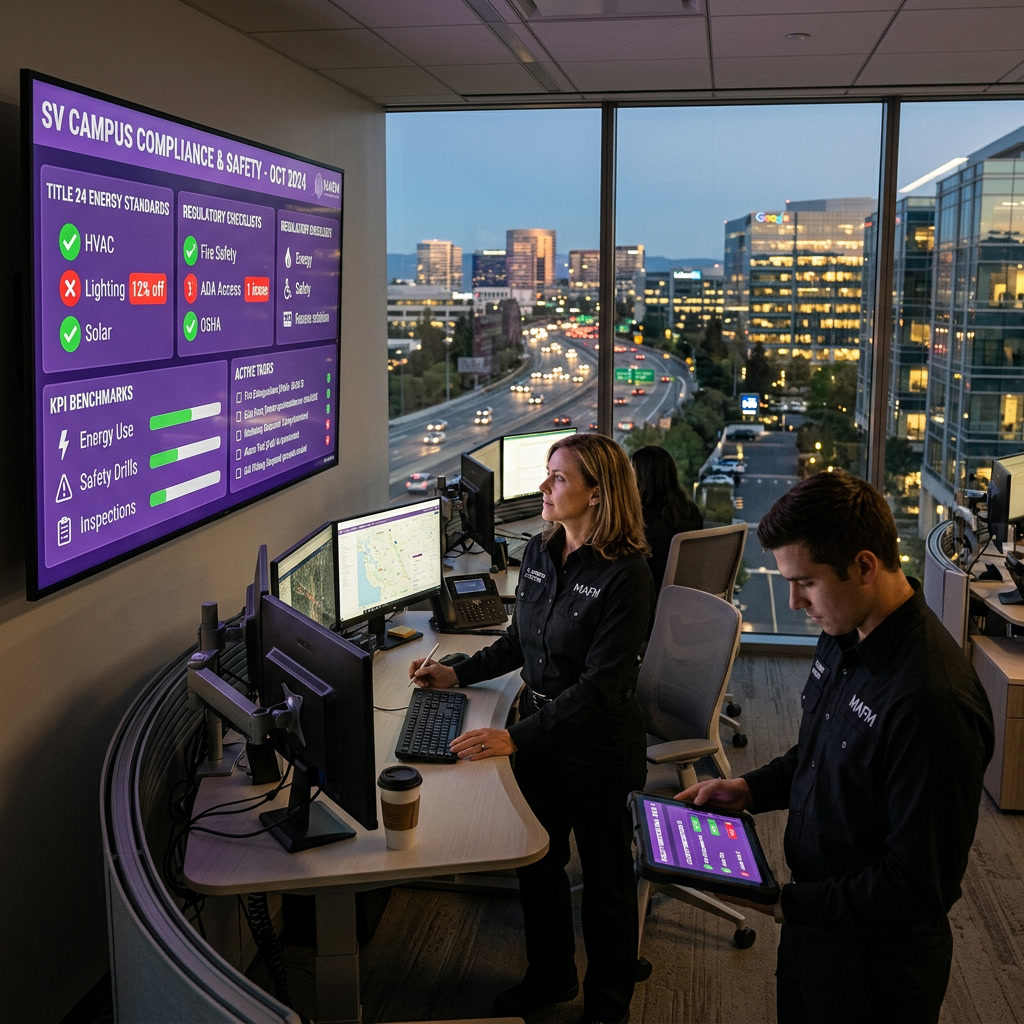
If you manage a commercial property in Santa Clara County, San Mateo County, or anywhere along the 101 corridor, you've probably noticed the compliance landscape doesn't sit still. Between updated Title 24 energy standards, evolving Cal/OSHA indoor heat and injury prevention rules, municipal reach codes that vary by city, and federal accessibility enforcement that's gotten more aggressive, the regulatory floor keeps shifting under buildings that were "fully compliant" just two or three years ago. For a facility director juggling forty other priorities, that's a real problem, not an abstract one.
This week on the MAFM blog, we're running a five-part deep dive into the compliance issues we see most often in our work across Silicon Valley's office parks, biotech campuses, data centers, and mixed-use retail properties. Each post this week will take on a specific facet: energy code and Title 24 updates, Cal/OSHA indoor environmental requirements, ADA and accessibility remediation, and stormwater/wastewater discharge permitting for properties with industrial tenants. We'll close out the week Friday with a synthesis post that pulls everything into a practical roadmap.
Today, we're setting the stage, walking through why 2026 is a particularly active year for compliance in this region, and giving you a framework for thinking about regulatory risk before we get into the weeds on specific rules later this week.
Every few years, multiple regulatory cycles converge, and 2026 is one of those years for Silicon Valley commercial real estate. The California Energy Commission's Title 24 Part 6 update cycle has pushed new requirements for lighting controls, HVAC economizer verification, and electrical vehicle charging infrastructure into force for buildings undergoing renovation or tenant improvement work. If your property has pulled permits for any TI work in the last 18 months, there's a good chance you've already run into the updated compliance forms, CF1R and CF2R documentation that's more granular than what building departments accepted even three years ago.
At the same time, Cal/OSHA's indoor heat illness prevention standard, which went into effect for indoor workplaces in 2025, is now in its first full enforcement year. Facilities with warehouse space, server rooms, loading docks, or any area where mechanical cooling doesn't reliably keep ambient temperatures below 87 degrees need documented heat illness prevention plans, not just a policy binder nobody's read, but training records, monitoring logs, and acclimatization protocols that inspectors will actually ask to see.
Layer on top of that the fact that several South Bay municipalities (including Palo Alto, Mountain View, and San Jose) have their own local amendments to the California Building Code and their own reach codes around electrification and stormwater management. A property manager overseeing buildings in three different cities is effectively managing three different compliance regimes, even though the buildings might look nearly identical from the street.
We've walked into more properties than we can count where compliance was handled reactively, a fire alarm inspection here, an elevator certificate renewal there, all done just in time to avoid a fine, with no coordinated system tracking what's due when. That approach works fine until it doesn't, and when it fails, it tends to fail expensively.
Consider a scenario we see regularly: a 120,000 square foot office campus in Sunnyvale gets a tenant improvement permit application flagged because the building's existing lighting controls don't meet current Title 24 acceptance testing requirements. Now the TI project is stalled, the tenant's move-in date slips by six to eight weeks, and the building owner is negotiating rent abatement while paying an electrical contractor to retrofit controls that should have been addressed during the last capital improvement cycle. The retrofit itself might cost $40,000 to $80,000 depending on square footage, but the real cost is the tenant relationship and the lost leasing momentum.
Or consider Cal/OSHA penalties for indoor heat compliance gaps: initial citations for willful or repeat violations can run into the tens of thousands of dollars per violation, and that's before you factor in the operational disruption of an inspector shutting down work in a non-compliant space. Compliance debt behaves like technical debt, it accrues quietly until a permit application, a tenant complaint, or a random inspection forces the reckoning all at once.
The properties that handle this well share a common trait: they treat compliance as an ongoing operational function, not a periodic scramble. That means a live compliance calendar, assigned ownership for each regulatory category, and documentation that's audit-ready at any given moment rather than reconstructed under deadline pressure.
Tomorrow's post takes on Title 24 Part 6 in detail, specifically what's changed for lighting controls, HVAC economizers, and EV charging mandates, and what triggers compliance obligations even if you're not planning major construction. If your property has any tenant turnover planned in the next 12 months, that post is worth blocking time for, because tenant improvement scope is one of the most common triggers for full compliance review.
Wednesday, we're covering Cal/OSHA's indoor environmental requirements in depth, including the heat illness prevention standard, workplace violence prevention plans (mandatory since 2024 but still poorly implemented at many properties), and injury and illness prevention program documentation standards that inspectors are now enforcing more strictly.
Thursday's post addresses ADA and California accessibility compliance, a topic that never really goes away in this region given the volume of demand letters and lawsuits filed against Bay Area commercial properties each year. We'll look at what's changed in recent CASp (Certified Access Specialist) inspection guidance and where we most often find properties exposed.
Friday, we bring it together. Rather than treating these as four separate compliance silos, we'll show you how a single coordinated compliance calendar and documentation system handles all four categories at once, because in practice, that's how a well-run facilities team actually operates, not with four disconnected checklists, but with one integrated view of regulatory risk across the property.
Before we get into the specifics later this week, it's worth naming what actually separates a defensible compliance posture from a fragile one. First is documentation discipline, not just having a policy, but having dated, signed records showing the policy was implemented: training sign-in sheets, inspection logs, maintenance records for life safety systems, and testing certificates that are filed somewhere more reliable than an individual employee's inbox.
Second is assigned accountability. Every compliance obligation needs a named owner, whether that's an internal facility manager or an outsourced FM partner, and that owner needs visibility into deadlines far enough in advance to act, 90 days out for annual certifications, not nine days. Third is local knowledge. Because so much of California's compliance framework layers state law, county health orders, and municipal amendments, a generic national compliance checklist will miss things that matter specifically in Santa Clara, San Mateo, or Alameda County jurisdictions.
Finally, and this is the piece most properties underinvest in: a standing relationship with contractors and specialists who can execute corrective work quickly. Identifying a compliance gap is only half the job. If your fire alarm testing turns up a deficiency, or your accessibility survey flags a non-compliant restroom configuration, how fast can you actually get it fixed? Properties with pre-vetted vendor relationships close these gaps in weeks. Properties without them can sit exposed for months while they source and vet a contractor from scratch.
Compliance in Silicon Valley commercial real estate isn't a once-a-year audit exercise anymore, it's a continuous operational discipline that touches energy systems, safety programs, accessibility standards, and increasingly, environmental permitting. The properties that handle 2026's regulatory changes smoothly are the ones that already built the infrastructure (documentation, ownership, vendor relationships) to absorb new requirements without a fire drill.
Over the next four days, we'll get specific about each of these areas so you can walk away from this week with an actual action list, not just a general sense of unease. Stay with us.
If you're not confident your property could pass a surprise compliance audit tomorrow, let's talk, MAFM builds and manages compliance calendars, documentation systems, and vendor networks for Silicon Valley properties so nothing falls through the cracks.
Reference this week's upcoming posts on Title 24 energy code updates (Tuesday), Cal/OSHA indoor environmental standards (Wednesday), ADA and accessibility compliance (Thursday), and Friday's synthesis roadmap post tying all four areas together.
California Energy Commission's Title 24 Building Energy Efficiency Standards page (energy.ca.gov/title24); Cal/OSHA's Indoor Heat Illness Prevention standard guidance (dir.ca.gov/dosh).
March 4, 2026
July 28, 2026

July 29, 2026
MAFM offers comprehensive facility management solutions tailored to your business needs.
Get in Touch