
Compliance
The Impact of California's 2026 Environmental Regulations on Facility Operations
March 4, 2026
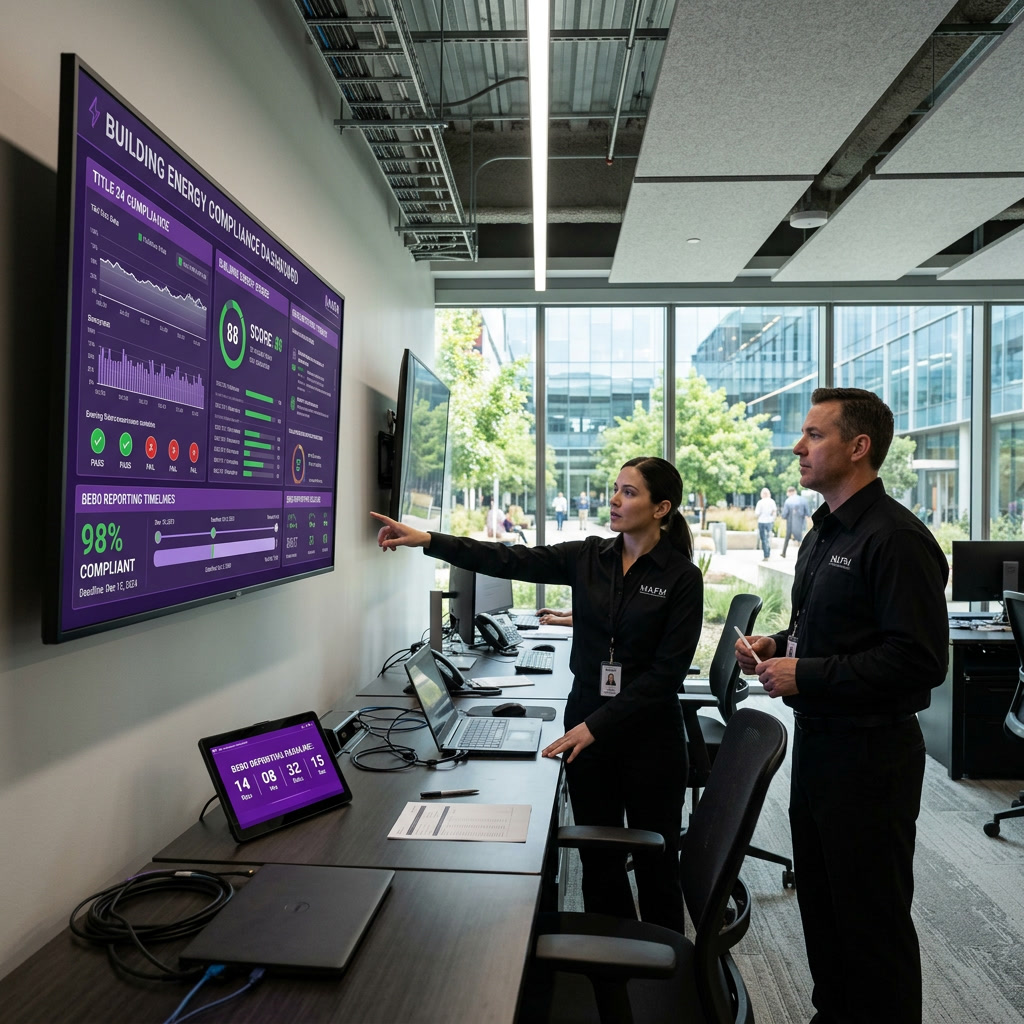
Every facility manager we work with in Santa Clara and San Mateo counties knows the phrase "Title 24" the way homeowners know "property tax", a background hum of obligation that occasionally spikes into an emergency. This week we're doing a deep dive into the regulatory pressures shaping Silicon Valley commercial buildings, and today's focus is the one that trips up more building owners than any fire code or ADA requirement: energy compliance, specifically the overlapping demands of California's Title 24 Building Energy Efficiency Standards and the state's Building Energy Benchmarking Program (BEBO), formerly AB 802.
The confusion isn't really about the regulations themselves. It's about timing and ownership. Title 24 governs what happens when you build, renovate, or replace major equipment. BEBO governs what happens every single year, whether you touch the building or not. Most compliance failures we see at MAFM-managed properties happen at the seam between these two, an owner assumes their energy consultant handled the annual benchmarking because they handled the last retrofit, or a property management company assumes the building's utility is submitting data automatically when the responsibility legally sits with the owner.
With California pushing harder on decarbonization ahead of 2030 targets, and with local jurisdictions like San Jose and Mountain View layering their own reach codes on top of state requirements, the compliance floor is rising every year. This post breaks down where the actual risk sits for commercial and mixed-use buildings in our market, and what a defensible compliance file looks like heading into the next reporting cycle.
Title 24, Part 6, sets the energy efficiency standards for new construction, additions, and alterations, insulation values, HVAC efficiency, lighting power density, and increasingly, electrification requirements for water heating and space conditioning. If you're replacing a rooftop package unit, re-lamping a floor, or doing a tenant improvement build-out, Title 24 compliance documentation (typically CF1R and CF2R forms) has to be filed and approved before the permit closes. This is project-based. It happens when you do work.
BEBO is different. Under California Energy Commission rules, buildings over 50,000 square feet (with the threshold dropping to 20,000 square feet in recent phase-ins) must report whole-building energy use annually through ENERGY STAR Portfolio Manager, regardless of whether any construction happened that year. The building owner is the responsible party, not the tenant, not the management company, unless that responsibility is explicitly delegated in a signed agreement.
We've seen this distinction cause real problems. A 68,000-square-foot office campus in Santa Clara had a spotless Title 24 file, every HVAC swap and lighting retrofit properly permitted and closed out, but had never submitted a single annual benchmarking report because the previous facilities coordinator assumed the utility company handled it. That's not how it works. Utilities like PG&E and Silicon Valley Power will release aggregated data upon request, but the owner still has to pull it into Portfolio Manager and submit it to CEC on schedule. The gap had gone unnoticed for four years before we caught it during a lease renewal energy audit.
Two things are changing the risk calculus this year. First, the CEC has continued lowering the square footage threshold for mandatory benchmarking, which means buildings that were exempt three years ago are now in scope, a lot of smaller flex/R&D buildings common in Sunnyvale and Mountain View business parks are crossing that line for the first time and don't have benchmarking histories at all.
Second, local reach codes are getting stricter about electrification at the point of major equipment replacement. San Jose's reach code and similar ordinances in unincorporated Santa Clara County now require all-electric replacement for water heaters and, in many cases, HVAC equipment when the existing unit fails or reaches end of life, not just for new construction. This changes maintenance strategy fundamentally. A facility manager who used to treat an aging gas water heater as a like-for-like swap now has to budget for electrical panel capacity upgrades, potentially new circuits, and in older buildings, a full electrical service reassessment, all triggered by what used to be a routine repair.
We're advising every client with buildings built before 2010 to get a proactive electrical capacity assessment now, before a failure forces a rushed, non-compliant fix or an expensive change order under deadline pressure. The buildings that get caught flat-footed are almost always the ones where nobody mapped which pieces of aging equipment will trigger a reach code event when they fail.
In our experience managing compliance documentation across dozens of Silicon Valley commercial properties, failures cluster around three specific gaps.
The first is ownership transfer. When a building sells, benchmarking history and Title 24 compliance records frequently don't transfer cleanly. The new owner inherits the legal obligation but not the documentation trail, and CEC penalties don't care that you just closed escrow. We recommend building compliance documentation transfer into the due diligence checklist for every acquisition, not as a legal afterthought but as an operational handoff with the same rigor as a Phase I environmental assessment.
The second is tenant-triggered work that never gets reported back to ownership. A tenant does their own build-out with their own contractor, pulls permits under a TI permit process, and the Title 24 forms get filed and closed at the city, but nobody sends a copy back to the building owner's central compliance file. Two years later, during a benchmarking cycle or an insurance audit, the owner can't produce records for equipment installed in their own building. This is entirely preventable with a lease clause requiring tenants to forward closed permit documentation, but almost no standard California commercial lease template includes it by default.
The third is the annual benchmarking deadline itself getting buried in someone's inbox. Portfolio Manager submissions are due by June 1 each year covering the prior calendar year's data, and there's no forgiving grace period once the CEC compliance division starts sending violation notices, penalties can run into thousands of dollars per building per year of non-compliance, and they compound. Buildings that missed reporting for multiple years face escalating exposure, and "we didn't know we were in scope" is not a defense the CEC accepts once a violation notice arrives.
The fix for all three of these gaps is the same: a single, centralized compliance file per building that survives staff turnover, ownership changes, and tenant transitions. At minimum, that file should contain closed Title 24 forms for every piece of equipment currently in service, the building's Portfolio Manager account credentials and submission history, copies of any reach code determinations tied to specific equipment, and a forward-looking equipment replacement schedule flagging which units will trigger electrification requirements at end of life.
We build this file as part of our standard facilities management onboarding for every new property, specifically because we've seen too many buildings inherit years of silent non-compliance from a prior management company that simply didn't track it. It typically takes us two to three weeks to reconstruct a compliance history from scratch on a building that's never had one, pulling utility data, reviewing permit records with the city, and reconciling equipment inventories against what's actually installed. That's meaningfully cheaper and faster than doing it under the pressure of a violation notice or a buyer's due diligence deadline.
We also recommend an annual internal compliance review, separate from the CEC's June 1 submission deadline, scheduled for early spring. This gives enough lead time to catch missing data, chase down tenant permit records, and correct utility meter mapping errors in Portfolio Manager before the deadline, rather than discovering a gap in late May with no runway to fix it.
Title 24 and BEBO compliance aren't going to get simpler. The trend line in California and specifically in Silicon Valley's more aggressive municipalities is toward lower thresholds, faster electrification timelines, and less patience for buildings that fall behind. The facility managers who stay ahead of this aren't necessarily doing more work, they're doing the same work earlier and keeping better records of it.
If your building's compliance history has gaps, uncertain ownership of the benchmarking obligation, or aging equipment that's one failure away from triggering a reach code event, the time to find out is now, not during next spring's reporting deadline.
MAFM offers a comprehensive Title 24 and BEBO compliance audit for Silicon Valley commercial properties, contact us to get your building's compliance file assessed and centralized before the next reporting cycle.
Reference Monday's post introducing this week's Compliance Deep Dives series, and point ahead to later posts in the week covering ADA facility compliance and OSHA workplace safety updates for commercial buildings.
California Energy Commission's Building Energy Benchmarking Program page; ENERGY STAR Portfolio Manager technical reference guide.
March 4, 2026
July 27, 2026

July 29, 2026
MAFM offers comprehensive facility management solutions tailored to your business needs.
Get in Touch