Health & Safety
Slip and Fall Prevention for Bay Area Commercial Buildings
January 24, 2026
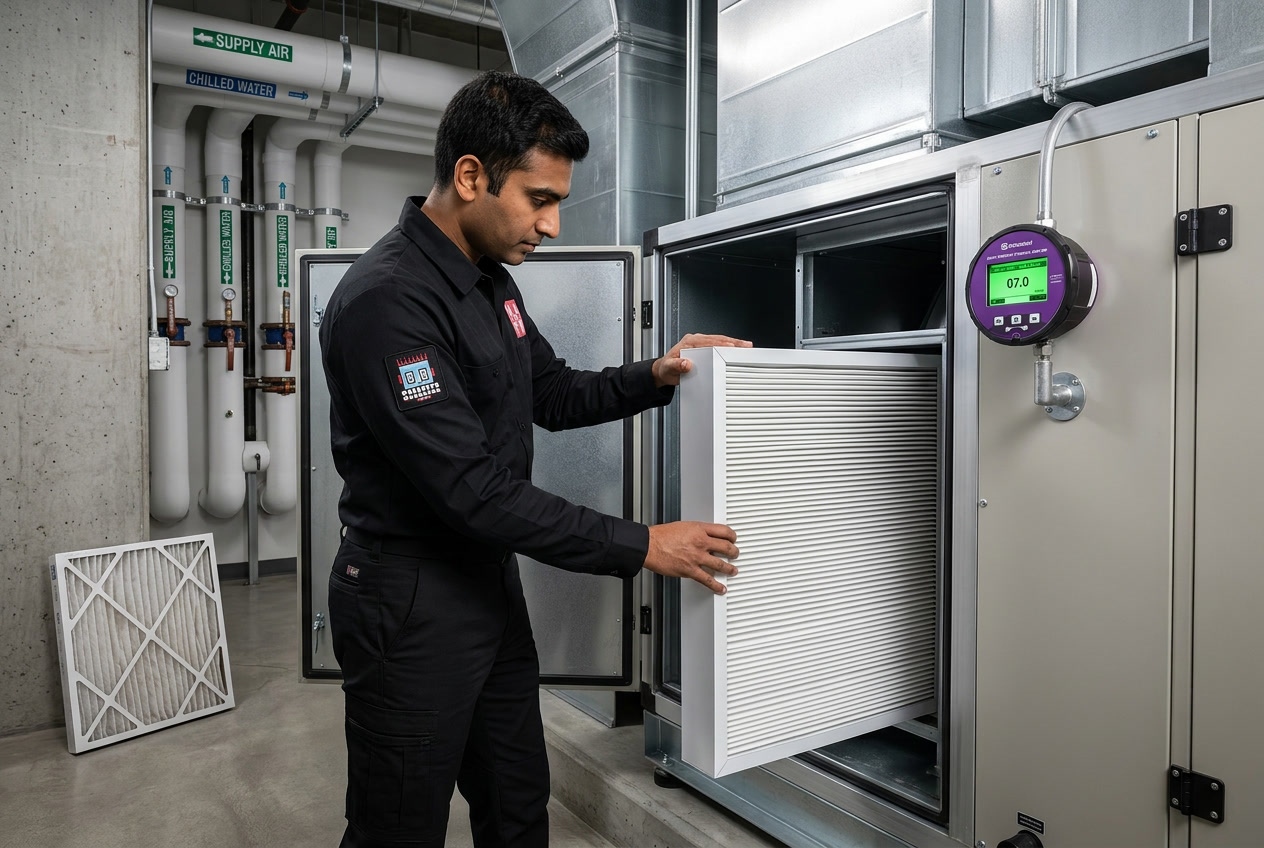
Most office buildings do not need true HEPA filtration in the central air handlers. The practical upgrade is a MERV 13 filter, or the highest rating your fans and filter racks can handle, with portable HEPA air cleaners for the few rooms that need more. Commercial HEPA filtration earns its cost in specialized spaces, not in a typical office floor.
The reasoning comes down to what each rating actually captures and what it costs your HVAC system to push air through it. This guide covers the difference between MERV and HEPA, how to decide, and how to upgrade without creating new problems.
MERV is a rating scale for HVAC filters, and HEPA is a separate, stricter test for a specific class of filter. The Minimum Efficiency Reporting Value scale is defined in ANSI/ASHRAE Standard 52.2 and runs from 1 to 16, with higher numbers meaning higher efficiency. A HEPA filter is one tested to capture at least 99.97% of particles 0.3 micrometers in size (ASHRAE position on infectious aerosols).
That means "MERV 17" and above, which some vendors and older articles use as shorthand for HEPA, are not part of the current MERV scale. EPA's own table notes that HEPA efficiency figures "are not based on the MERV rating system" (EPA, What is a MERV rating?).
Here is how the common ratings compare:
ASHRAE says MERV 8 filters have low effectiveness at reducing exposure to infectious aerosols, and it recommends upgrading to MERV 13 where possible. Its filtration guidance calls for MERV 13 with MERV 14 or better preferred, within what the HVAC system can handle (ASHRAE filtration and disinfection FAQ). That guidance dates from 2020, so check ASHRAE for current updates before putting it in a specification.
Usually not for the whole building. Match the filtration level to the space and its risk.
Central HEPA in a conventional office air handler is an engineering project, not a filter swap, because the system has to move air through much more resistance than it was designed for, and that needs a mechanical engineer's review. Targeted portable units are the more practical way to reach HEPA-level cleaning in an executive suite, a wellness room or a sensitive tenant space.
It raises the resistance the fan works against, and the effect grows with each step up. ASHRAE puts it plainly: increasing filter efficiency generally leads to increased pressure drop, which can reduce airflow through the system, increase fan energy to compensate, or both (ASHRAE FAQ).
The exact penalty depends on the filter model, the face area and the fan. We have not cited a percentage here because published figures vary widely by product, and your own measurements are more reliable. Ask your HVAC contractor to measure pressure drop across the current filters at design airflow and compare it to the air handler's rated capacity.
If the system is already near its limit, a denser filter can cut airflow and make comfort worse. In that case:
For a broader walk through the ratings, see our guide to choosing a MERV filter grade.
Choosing the filter is half the job. The rest is making sure all the air actually goes through it.
Facility staff and the HVAC contractor should do this together. A facility management partner can schedule the walk-through, track the results by unit and keep the filter inventory current.
Filtration is the core of a smoke plan, but it works alongside the building envelope and operating mode. Wildfire smoke is mostly fine particulate matter (PM2.5), meaning particles less than 2.5 micrometers across, along with gases.
A planning framework summarized in ASHRAE Journal by authors from EPA, NIST and universities describes a "Smoke Readiness Plan" that includes the following (ASHRAE Journal, March 2021):
Cal/OSHA's wildfire smoke rule applies when the current PM2.5 Air Quality Index is 151 or greater, and it exempts enclosed buildings where air is filtered by a mechanical ventilation system with windows and doors closed (Title 8 section 5141.1). Your filtration status therefore matters for compliance as well as comfort. We cover the operations side in our wildfire smoke guide for building operations.
One caution on portable units: California requires indoor air cleaners sold or shipped into the state to meet ozone emission and electrical safety standards, with an ozone limit of 0.05 parts per million (California Air Resources Board). Confirm any unit you buy carries CARB certification before it goes into a tenant space.
Keep the message short, factual and specific. Say what filter was installed, where, and what that means for smoke days. Avoid promising a level of protection you have not measured.
If you add a low-cost PM2.5 monitor, which the ASHRAE authors suggest, share what it shows in plain terms and note that such monitors are less accurate than regulatory ones but useful for seeing whether your steps are working. Update tenants after major smoke events with what the building did.
Is MERV 13 the same as HEPA? No. MERV is a rating scale that tops out at 16, while HEPA is a separate test requiring at least 99.97% capture of 0.3 micrometer particles (ASHRAE). MERV 13 captures far more fine particles than MERV 8 but does not meet the HEPA definition.
Can I put a MERV 13 filter in any commercial HVAC system? Not always. Higher-efficiency filters resist airflow more, so the system fan and filter housing must be able to handle them. EPA advises using MERV 13 "or as high a rating" as the system can accommodate, and a technician can confirm what yours supports (EPA).
Do portable HEPA air cleaners work for an office? They can clean the air in a single room when sized for the space. ASHRAE recommends a portable cleaner with a HEPA filter, appropriately sized, where the HVAC system cannot sufficiently reduce PM2.5, and notes that larger rooms may need several (ASHRAE Journal). Choose a CARB-certified model.
How often should filters be changed after an upgrade? Base it on measured pressure drop and visible loading, not only a fixed calendar. During heavy smoke, ASHRAE notes that filters may need changing as often as daily. Keep spares on site so you are not waiting on a supplier.
The right filtration plan starts with an honest audit of what each air handler can support. MAFM works as a facilities management partner that plans and coordinates HVAC contractors, schedules filter work and keeps records of each upgrade. Talk to us about facility management to get an air handler walk-through scheduled.
MAFM offers comprehensive facility management solutions tailored to your business needs.
Get in Touch