Health & Safety
Slip and Fall Prevention for Bay Area Commercial Buildings
January 24, 2026
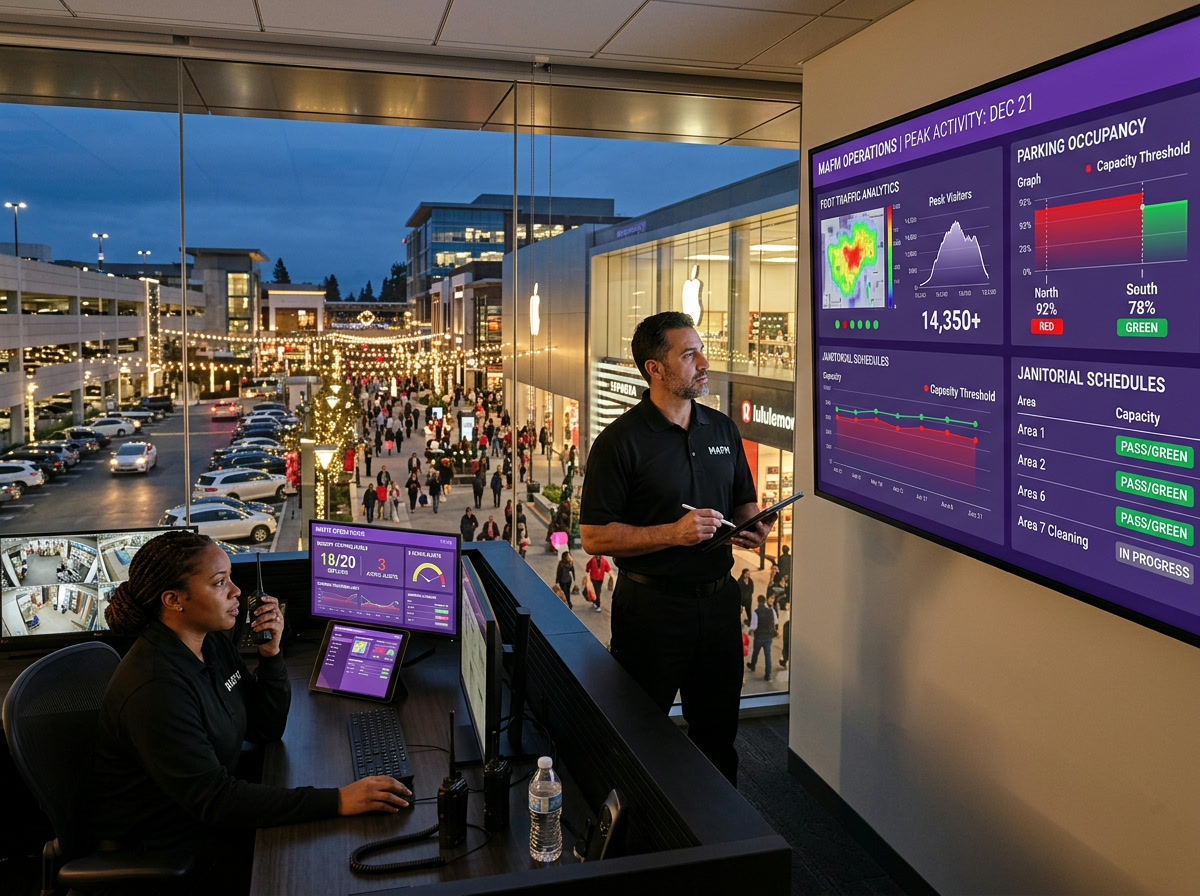
A Black Friday facility management plan comes down to four jobs done before the crowds arrive: confirm infrastructure capacity, staff to the real traffic curve, keep exits and crowd limits clear, and tell tenants what is changing. Do them in that order, well ahead of the day, and the rest of the Q4 shopping season becomes repetition instead of emergency.
This applies beyond shopping centers. Mixed-use buildings with ground-floor retail under offices, shared parking structures and public-facing cafeterias all inherit the same pressure near Santana Row, Valley Fair or the El Camino Real corridor. The roadmap below works for any Silicon Valley property that mixes visitors and tenants, and it assumes a facility manager coordinating several vendors rather than one in-house crew.
Verify capacity at least a couple of weeks out, not the week of. Overflow parking, pop-up vendors and temporary signage all change what the building has to carry, and the surprises come from systems nobody tested under the new load.
MAFM coordinates vendors like these as part of facility management, and the vendor backup principles in emergency vendor networks for Silicon Valley facility managers apply to Q4 as well.
Staff to the hours when people actually arrive, not to an average day. Visitor volume on a big shopping day is rarely flat: it comes in waves, and restroom demand, spills and security calls follow the waves. A flat shift is overstaffed in the lulls and thin when the crowd peaks.
The practical approach is to split coverage. A lean opening crew, a reinforced midday team and full coverage through close and the post-close reset usually beats one uniform shift. Your own gate counts, parking data or tenant sales reports from last year will tell you where your waves fall; use those rather than a national average.
Overtime rules shape the choice. In California, overtime at one and a half times applies beyond eight hours in a workday or 40 in a workweek, and double time beyond 12 hours in a workday. Stretching a few people through very long shifts can cost more than adding a second, shorter shift, and it tires the crew. Price both options against your actual wage rates before you build the schedule.
OSHA's crowd guidance backs the same idea. Its crowd management fact sheet for retailers says to create a detailed staffing plan that designates a location for each worker and to hire additional staff where large crowds are expected.
Exits and occupancy limits. They do not relax on a sales day, and the common mistakes are small: a kiosk in a corridor, a display against an exit door, a stack of boxes at a loading dock.
OSHA's exit route rule is direct: exit routes must be free and unobstructed, and no materials or equipment may be placed, either permanently or temporarily, within the exit route. It also requires exit route doors to be free of decorations or signs that obscure them, and sprinklers, alarms and exit lighting to be in working order at all times.
The same OSHA fact sheet adds practical crowd points: do not restrict egress or block or lock exit doors, and when a store reaches maximum occupancy, do not allow additional customers to enter until the occupancy level drops. It also advises that waiting lines should not start right at the entrance.
A short walkthrough checklist covers most of it:
Local fire and police agencies should know about big events. The OSHA sheet recommends contacting them in advance, so make that call part of the plan. For the wider framework, see emergency response planning for commercial buildings.
Treat the season as a shared operation and put changes in writing early. Tenants cooperate when they know what is different, and complain when they find out by surprise.
Send a short operations notice well ahead of the day. Cover trash and recycling pickup changes, after-hours access for restocking, who to call for urgent issues and what to expect from building systems.
Tenant communication plan for fall has a fuller template for this kind of notice.
Restrooms and entrances take the heaviest load, and a clean reset after close matters as much as coverage during the day. Plan more frequent restroom checks at peak hours, a team on hand for spills and entrance mats and floors, and a deeper reset overnight. Janitorial scheduling is a core part of what MAFM does through its janitorial services, and the surge version is simply the normal checklist at higher frequency.
How early should Black Friday facility planning start?
Start in October, so vendor availability, tenant notices and staffing are settled before the busiest weekend. Capacity checks like backup power and fire access are best done a couple of weeks before.
Who is responsible for crowd safety in shared common areas?
It depends on your lease and operating agreements, and a lawyer or your property insurer can tell you where the line sits. Either way, OSHA's guidance expects employers to plan for crowds and keep exits clear, so the practical answer is to coordinate with your tenants and write the plan down.
Does this apply to an office building with no retail?
Often yes in part. Shared parking, public cafeterias and ground-floor visitors bring some of the same load. Scale the plan to what your building actually sees.
What if my staffing plan is already in place?
Check it against the real arrival pattern, the overtime rules and your exit routes. Gaps usually show up in the details: a blocked corridor, an untested generator circuit or a vendor with no holiday coverage.
MAFM is a facilities management company serving the San Jose area. If your Q4 plan lives in separate spreadsheets for security, janitorial and leasing, talk to us about facility management and we will help coordinate it into one operating plan before the next peak.
MAFM offers comprehensive facility management solutions tailored to your business needs.
Get in Touch