Technology & Operations
AI Facility Management: What It Can Do for Response Times
January 21, 2026
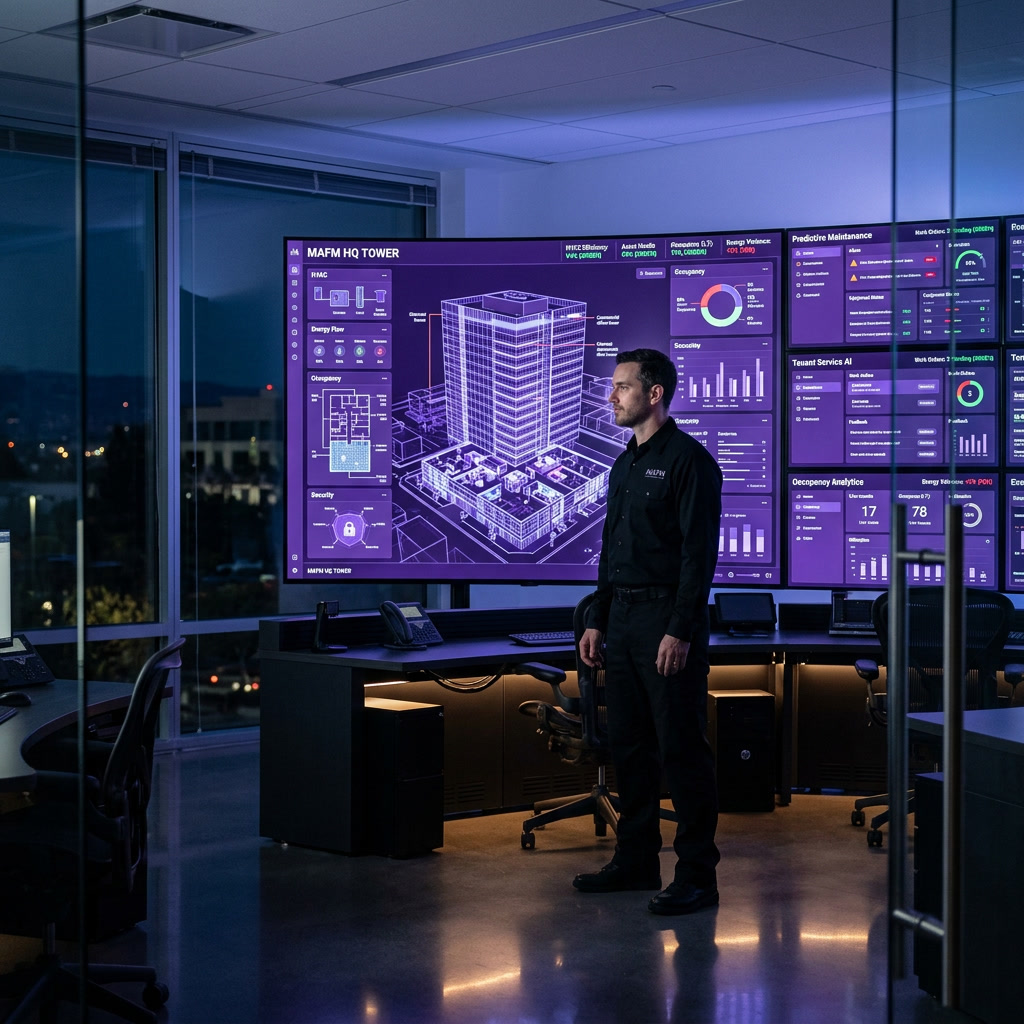
A digital twin for facility management is a virtual model of your building that stays tied to live data from your equipment, your work order system and your spaces. If the model is not kept in sync, it is just a 3D drawing. If it is, a technician can click a rooftop unit and see its alarms, history and open work orders in one place.
Most buildings do not need one yet. The ones that benefit are complex, already well instrumented, and run by a team with a specific question the model will answer. This post covers what a twin needs to be useful, what to build first, and where these projects go wrong.
A digital twin is a computer model of a physical system, such as a building, that is kept current with data from that system. NIST describes it as "a particular type of computer model of a physical system, such as a machine or building," and notes that twins "primarily function to make predictions or as a status indicator" for the system being modeled.
The Digital Twin Consortium's wording, quoted in NIST Internal Report 8356, is "a virtual representation of real-world entities and processes synchronized at a specified frequency and fidelity." The word to notice is "synchronized." A model drawn at construction and never updated does not meet it.
Be careful with vendor definitions. The same NIST report says there is "no agreed-upon definition for or consensus on the full potential of digital twins," and notes that commercial vendors make their own claims about what counts. Ask any vendor what live data feeds their twin, how often it refreshes, and who fixes it when a feed breaks.
A BIM model describes the building. A twin adds the building's current condition. They are related: the BIM model is often the geometry and asset list a twin is built on.
Two standards are worth knowing, because they are how you keep your data from being locked into one vendor:
If your building has a BIM model from construction or a major renovation, ask for it in an open format and find out whether it was updated as built. If it was not, the first job is correcting it, and that cost belongs in any twin budget.
A twin is only as good as its feeds. In a typical commercial building, four sources do most of the work:
NIST notes that Internet of Things sensors are now small and low cost, and that "modern buildings may have thousands of sensors" (NIST IR 8356). That is a reason to be selective. More feeds mean more that can drift, disconnect or mislabel, so connect the ones your team already trusts.
Complex buildings with many interacting systems and a team that struggles to see them together. Think a large campus, a high-rise with dense mechanical plant, or a lab building. Buildings that already have a good as-built model and a working BAS and CMMS start ahead, because the expensive groundwork exists.
A portfolio with a small central team can also benefit, because one interface across properties beats learning each building separately.
A small, single-tenant office with simple systems usually should not. If your engineer can hold the whole building in their head, the overhead of keeping a twin accurate will outweigh the benefit.
Published cost and savings figures for twins come mostly from manufacturing. NIST's economics work, for example, focuses on the manufacturing industry and says cost effectiveness is likely affected by the complexity of the system being modeled. We found no sound source for a typical return on a commercial office twin, so treat any payback figure you are quoted as a vendor claim to test.
Start with one use case, prove it, then add. A comprehensive all-systems build is where these projects tend to stall, because integration effort grows faster than anyone plans for.
On that last point, a buildingSMART awards entry from a general contractor describes a Polish government office complex where IFC models and COBie files fed a facility management platform that the contractor says ties facility data to specific model elements. It is the contractor's own submission, so read it as one team's account. Its lessons are still useful: the contractor says subcontractor documentation "was often not properly coded," and that COBie is "commonly being misinterpreted or not properly understood." Data discipline at handover decides what you can do later.
The usual failures are about people and data, not software. Four are worth planning for:
MAFM does not build or sell digital twin software. What a facility management company can do is the unglamorous work that decides whether a twin holds up: keeping asset records accurate, scheduling and documenting the maintenance the model displays, walking the building so the model matches the floor, and coordinating the controls, software and engineering vendors a project like this involves.
It also ties into other technology decisions. If you are weighing predictive maintenance or smart building technology, a twin is where that data would eventually be viewed together, so sequence the projects rather than buying them all at once.
What is the difference between a digital twin and a 3D model of a building?
A 3D model shows what the building looks like. A digital twin is kept synchronized with live data such as equipment status and maintenance records, so it shows what the building is doing now. Without a live data connection, it is a model, not a twin.
Do I need BIM to build a digital twin?
Not always, but an accurate as-built model saves a great deal of work, since it supplies the geometry and asset information. Without one, expect to survey the building and build the model, which is often the largest cost. Ask for it in an open format such as IFC so you are not tied to one vendor.
Is a digital twin worth it for a small office building?
Usually not yet. A twin has to be kept accurate, and in a simple building with a short systems list that effort tends to exceed the benefit. A well-kept CMMS and a clean asset register give most of the value for far less work.
Are digital twins secure?
They can be, but they add risk because they gather building data in one place and may connect to controls. NIST recommends cybersecurity controls on both the twin and its instrumentation, and a zero-trust approach. Involve IT before any integration goes live.
If you are weighing a twin, start with the groundwork: accurate asset records, a maintained work order system and a clear first question. Talk to MAFM about facility management that keeps that groundwork current and coordinates your technology vendors.
MAFM offers comprehensive facility management solutions tailored to your business needs.
Get in Touch