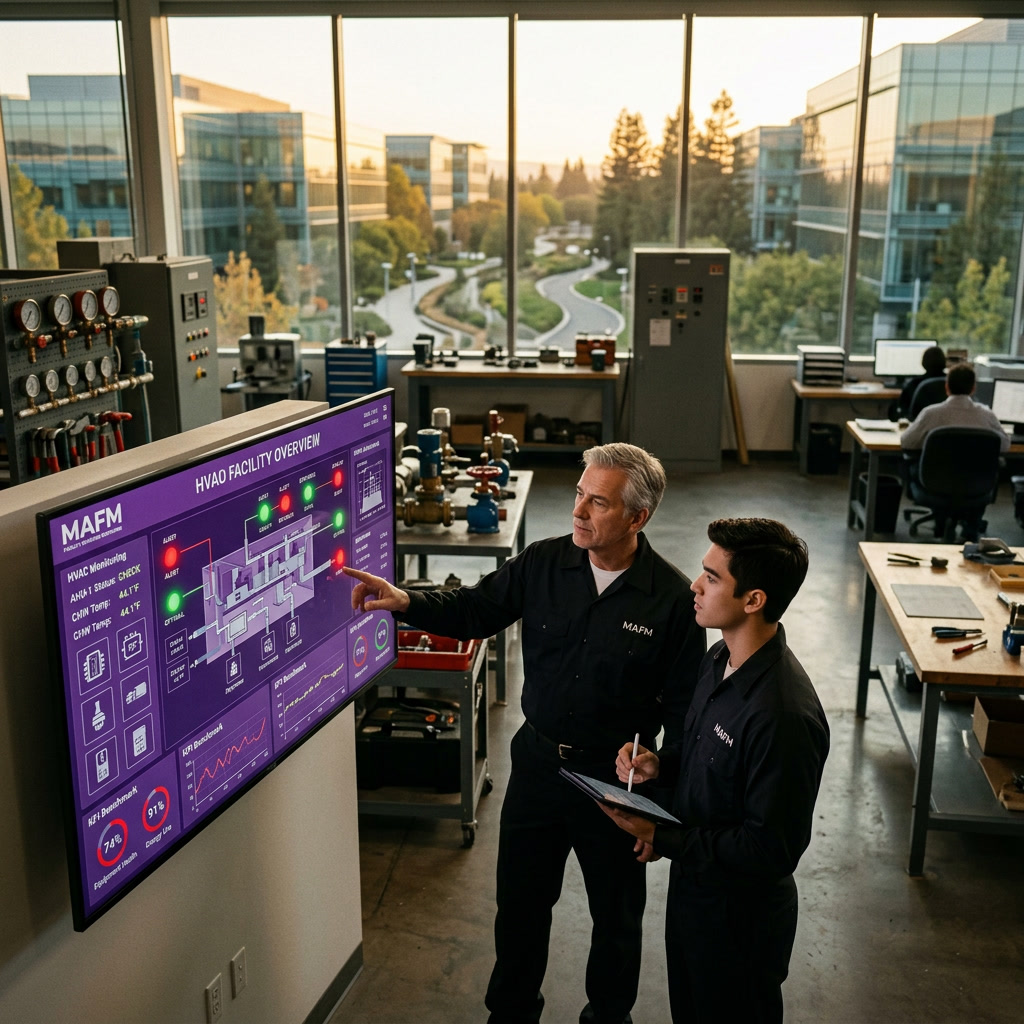
Staffing / Workforce
The Vanishing Building Engineer: Why Silicon Valley Facilities Teams Need a Career Ladder, Not Just a Job Posting
July 14, 2026
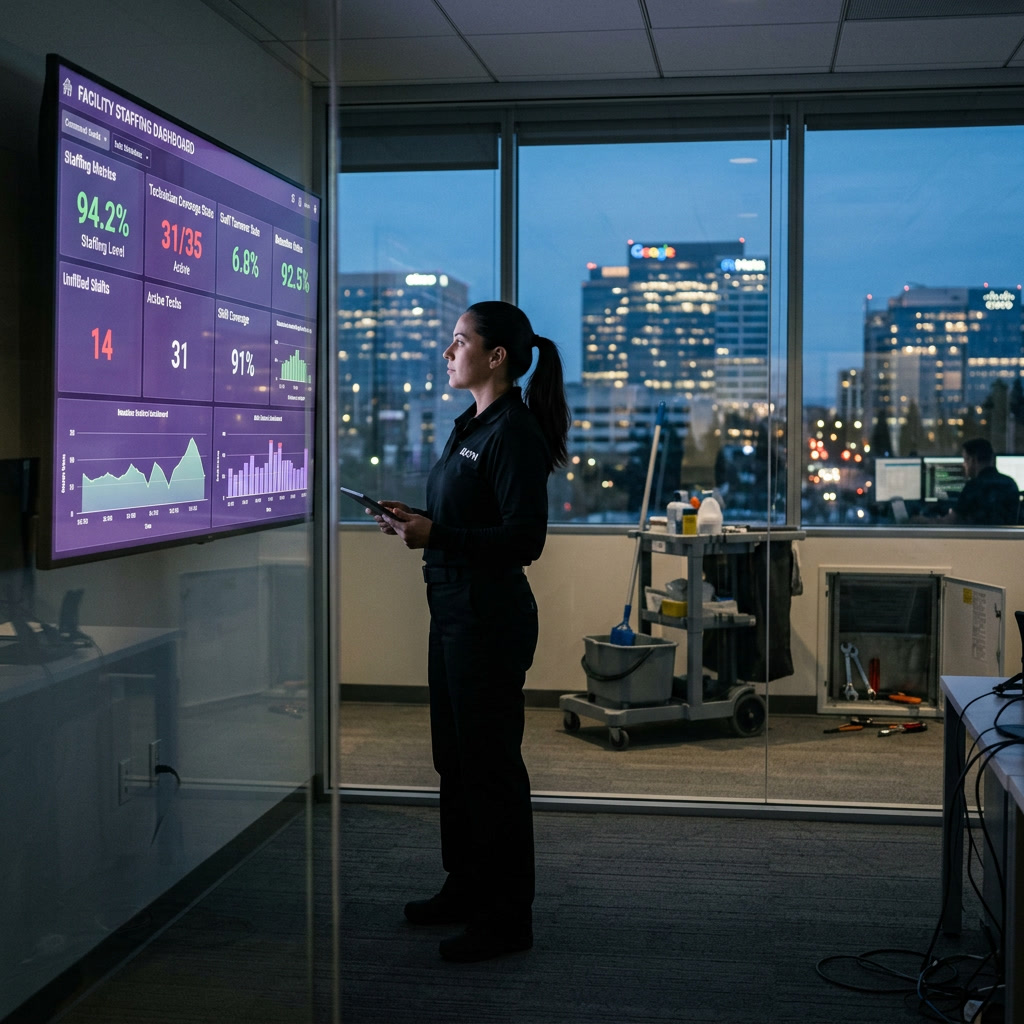
If you manage a commercial property anywhere between San Jose and Redwood City, you've felt it: the janitorial contractor who can't keep a night crew staffed past ninety days, the HVAC technician who leaves for a semiconductor fab's in-house maintenance team, the front-desk security guard who takes a warehouse job for two dollars more an hour. Facilities staffing in Silicon Valley isn't just tight, it's structurally broken in ways that generic "labor shortage" headlines don't capture. Tech campuses, biotech labs, and Class A office towers are all competing for the same narrow pool of skilled tradespeople, custodial staff, and building engineers, and most of them are losing.
This week on the MAFM blog, we're running a five-part series on Workforce Development & Leadership in facilities management. Over the next four posts we'll dig into technical certification pathways for building engineers, supervisor training that actually reduces turnover, cross-training strategies that keep a lean crew covering a full building, and a Friday roadmap tying it all together for owners planning 2027 staffing budgets. But before we get into solutions, we need to be honest about why the current model is failing, and why "just pay more" isn't the whole answer.
At MAFM, we manage staffing pipelines for office parks, mixed-use developments, and lab/R&D space across the Peninsula and South Bay, and the turnover data we track internally tells a consistent story: it's not primarily about wages. It's about career pathing, supervision quality, and whether a custodian or technician can see a future in the trade at all.
National facilities staffing shortages get attributed to an aging tradesperson workforce and fewer young people entering HVAC, electrical, and building engineering apprenticeships. That's real here too, but Silicon Valley has an additional pressure: the region's cost of living forces facilities workers into brutal commute calculus. A janitorial technician working a Sunnyvale office campus at $22/hour is often driving in from Gilroy, Tracy, or Manteca. When gas prices spike or a competing employer offers a route with a shorter commute, you lose that person overnight, and no amount of onsite perks fixes a ninety-minute one-way drive.
We've also watched tech companies themselves become direct competitors for facilities labor. Large campuses increasingly bring janitorial, mailroom, and even basic maintenance in-house, offering benefits packages (subsidized transit, on-campus meals, tuition reimbursement) that a standalone FM contractor or a mid-size property management firm simply cannot match line for line. That means the commercial FM sector isn't just competing against other FM companies for talent; it's competing against Google, Meta, and Apple's internal facilities divisions, who can absorb labor costs differently than a leased Class B office building operating on a tight NNN budget.
The result is a two-tier market: campuses with deep pockets retain staff through non-wage benefits, while everyone else, the mid-size office parks, retail centers, and multi-tenant industrial properties that make up most of MAFM's client base, has to get smarter about development and retention, because they can't win a pure wage war.
Property owners often see facilities turnover as a staffing agency's problem to solve, not a line item that hits their own P&L. That's a mistake. When a night-shift lead custodian leaves a 250,000-square-foot office building, the disruption isn't just a temp filling the shift for two weeks. It's inconsistent floor care that voids warranty terms on recently refinished VCT or polished concrete. It's a new hire who doesn't yet know which suite has the server room with restricted access, or which tenant has a standing complaint about vacuum noise during their 7 a.m. calls with East Coast clients. It's a compliance gap, because the departing employee was the one who actually knew the chemical dilution ratios and OSHA-required PPE protocols for that specific building.
We estimate, based on our own account transitions, that full replacement cost for a skilled facilities technician (recruiting, onboarding, lost productivity during ramp-up, and the tenant-relations cost of service inconsistency) runs between 1.5 and 2.5 times the position's annual wage. For a $50,000/year building engineer, that's $75,000 to $125,000 in real cost, most of it invisible on a monthly invoice but very visible in a building's CAM reconciliation and tenant satisfaction scores over a full year.
Tenant experience takes the hardest hit in Class A office and lab space, where tenants have explicit expectations written into their leases about service levels, HVAC response times, cleaning frequency, common area appearance. A revolving door of facilities staff means those SLAs get missed just often enough to generate tenant complaints, which property managers then have to explain to ownership, which erodes trust in the FM vendor relationship. Turnover, in other words, is a tenant retention issue wearing a staffing costume.
The instinct is to throw money at the wage line and call it solved. Wages matter, and MAFM has adjusted pay bands three times in the past two years to stay competitive in Santa Clara and San Mateo counties. But wage adjustments alone don't fix retention if there's no visible path forward for the person in the role. Facilities work has historically been treated as a dead-end job, you're a custodian, or a security guard, or a groundskeeper, and that's the ceiling. Workers know this, and they leave the moment something with a career ladder opens up, even at similar pay.
What we've found actually works is formal internal progression: documented paths from custodial technician to lead technician to shift supervisor to building engineer, with specific, achievable milestones at each step, a CIMS-GB certification, an EPA Section 608 refrigerant handling credential, a forklift or scissor lift certification, a first-aid/CPR instructor qualification. When a twenty-two-year-old custodian can see that the shift supervisor down the hall started in the same role six years ago and now earns $34/hour with a company vehicle, that visibility changes retention math more than an extra dollar an hour does.
Supervision quality is the other lever, and it's the one most owners underestimate. Employees don't quit buildings, they quit supervisors, and in facilities management, first-line supervisors are frequently promoted based on tenure rather than trained on how to manage people. A crew lead who was the best individual custodian on the team isn't automatically equipped to schedule, coach, and resolve conflict for eight direct reports. We'll go deeper on supervisor training specifically later this week, but the short version is: an investment in a 20-hour supervisor development course pays for itself many times over in reduced attrition on that supervisor's crew.
If you're a facility director or property owner reading this and wondering how exposed your building is, there are direct questions worth asking your current FM provider or staffing vendor this quarter. First: what is our actual turnover rate on this account, by role, for the trailing twelve months? Vague answers or reluctance to share numbers is itself a data point. Second: what certifications does your company fund or subsidize for frontline staff, and what percentage of your workforce has used that pathway in the past year? Third: how many of your current supervisors were promoted internally versus hired externally, and what training did they receive before taking on direct reports?
It's also worth asking how your FM provider handles institutional knowledge transfer, the building-specific details that live in a departing employee's head and nowhere else. Does your vendor maintain building-specific standard operating procedure documents, chemical inventories, equipment maintenance logs, and access protocols independent of any one person's memory? If the answer depends on tribal knowledge, you're one resignation away from a service gap, regardless of how good the individual technician was.
Finally, ask about cross-training coverage, which we'll cover in depth on Wednesday. A building that depends on a single specialist for elevator liaison work, life-safety system testing, or irrigation controller programming has a single point of failure. The strongest FM operations build redundancy into every specialized function precisely because they know the labor market won't let them keep any one person forever.
The facilities staffing shortage in Silicon Valley isn't going to resolve itself through wage inflation alone, the market is too competitive and the cost-of-living pressures too severe for any single lever to work in isolation. What separates FM operations that maintain service consistency from those stuck in a permanent hiring cycle is deliberate investment in career pathing, supervisor training, documented institutional knowledge, and cross-trained redundancy. Over the rest of this week, we'll break down exactly how each of those pieces works in practice.
If turnover on your property's facilities team has become a recurring headache, MAFM's workforce development program can build a retention and staffing plan tailored to your building's specific labor market pressures, contact us for a staffing audit.
Reference upcoming posts this week on technical certification pathways for building engineers (Tuesday), supervisor training and its impact on turnover (Wednesday), cross-training strategies for lean facilities crews (Thursday), and Friday's roadmap synthesizing the week's workforce development series.
U.S. Bureau of Labor Statistics data on building and grounds cleaning/maintenance occupations turnover and wage trends; IFMA (International Facility Management Association) workforce research on facilities labor retention benchmarks.
July 14, 2026
July 15, 2026
July 16, 2026
MAFM offers comprehensive facility management solutions tailored to your business needs.
Get in Touch