Staffing / Workforce
Why Your Facilities Team Keeps Quitting (And What Silicon Valley Building Owners Can Do About It)
July 13, 2026
Walk into most commercial buildings in Santa Clara or San Mateo County and ask the property manager how their chief engineer got that title, and you'll usually hear some version of "he's been here fifteen years." That answer used to be fine. It isn't anymore. The generation of building engineers who learned pneumatic controls in the 1990s and stuck around long enough to run a chiller plant blindfolded is retiring faster than facilities teams can replace them, and the informal apprenticeship model that produced them (tag along with the senior guy, absorb what you can, wait your turn) doesn't survive contact with a labor market where a competent HVAC tech can find three job offers in a week.
This is the fourth post in our week-long series on workforce development and leadership in facilities management. We've covered cross-training programs and leadership pipelines for supervisors; today we're going deeper on one specific, high-stakes pathway: the route from entry-level maintenance technician to certified building or chief engineer. This is the role that keeps a 250,000-square-foot office campus or a semiconductor cleanroom support facility running, and it's the hardest position to backfill when someone leaves without warning.
For Silicon Valley properties specifically, the stakes are higher than in most markets. Tenants running lab space, data halls, or advanced manufacturing floors need engineers who understand precision environmental controls, not just a boiler and a rooftop unit. Building that expertise deliberately, rather than hoping it accumulates, is now a competitive necessity.
The old model worked because tenure was long and turnover was slow. A tech might spend four or five years as a helper before touching a building automation system unsupervised. That timeline assumed the tech would stay that long, and that the senior engineer training them wasn't also eyeing retirement. Neither assumption holds in this market. BOMA's 2024 workforce survey found that over 35% of commercial building engineers nationally are within ten years of retirement, and Bay Area facility managers report even shorter runway because the cost of living pushes younger techs toward higher-paying trades like electrical or into tech-adjacent infrastructure roles at data centers, where starting pay can run $8-10 more per hour than a comparable office building position.
The result is a widening skills gap at the exact moment building systems are getting more complex. A ten-year-old VAV system with basic DDC controls is a different animal than the tenant-facing digital twin and smart-building platforms now standard in new Class A developments across Mountain View and Sunnyvale. Expecting a tech to absorb both the fundamentals and the modern layer through osmosis, on whatever schedule the senior engineer happens to have time for, is how buildings end up with single points of failure, one person who understands the chiller sequencing, and no one else.
We've watched this play out at client properties directly. A 180,000-square-foot life sciences building we support lost its sole building engineer to a semiconductor fab's facilities team, a move that came with a $15,000 signing bonus MAFM couldn't match on short notice. The transition took eleven weeks because no one on the remaining team had been formally trained on the building's specific chilled water reset strategy. That gap is now closed with documentation and cross-training, but it shouldn't have taken a departure to force the fix.
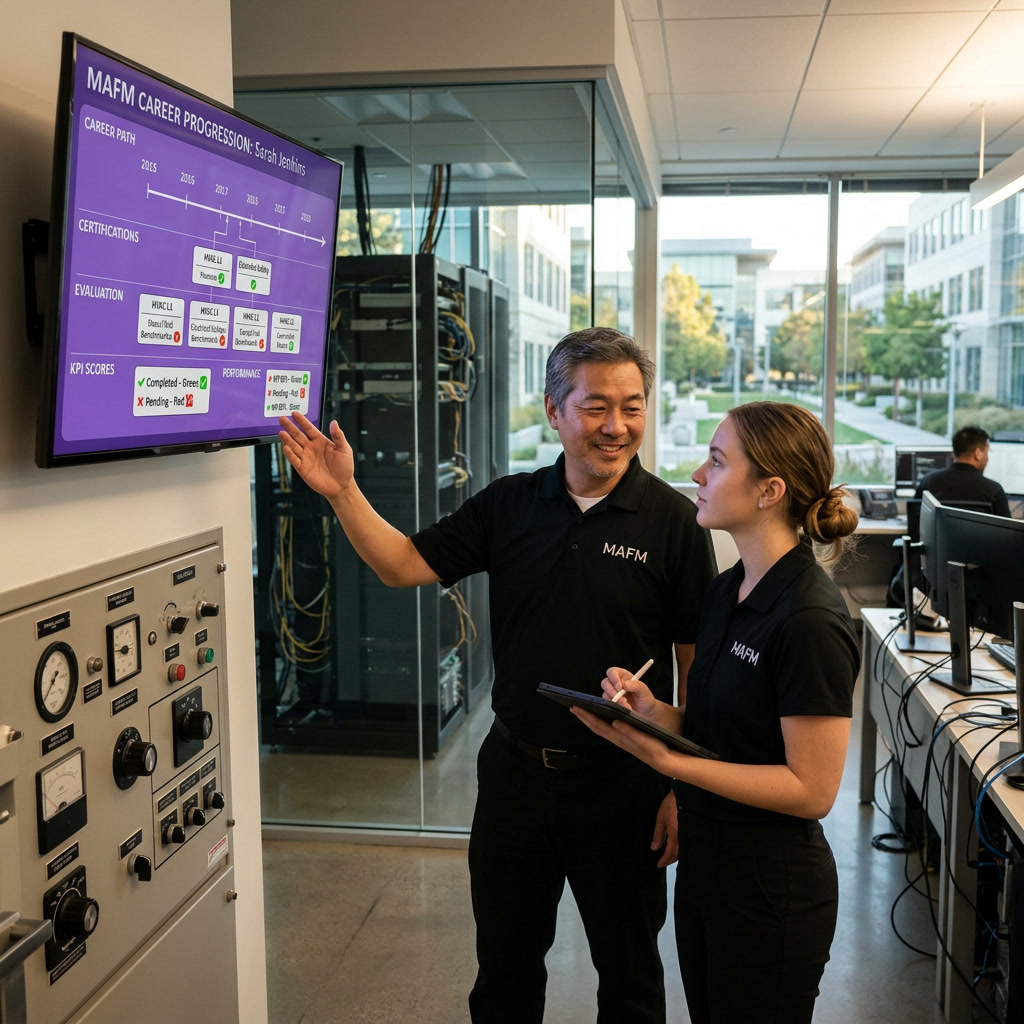
A real career pathway has defined rungs, each with specific competencies, timelines, and pay steps attached, not vague titles that mean different things depending on who you ask. At MAFM, we structure the ladder in four tiers. Tier one is General Maintenance Technician: preventive maintenance rounds, work order completion, basic plumbing and electrical troubleshooting, typically six to twelve months before advancement eligibility. Tier two is HVAC/Systems Technician, which requires an EPA 608 Universal certification at minimum and demonstrated competency on the building's specific RTU and split-system inventory, this is usually a twelve-to-eighteen-month rung.
Tier three, Building Engineer, is where things get specific to the property type. A tech advancing into this tier on a standard office building needs BAS (building automation system) proficiency, typically Tridium Niagara or Honeywell WEBs depending on what the site runs, plus a working knowledge of life safety systems. A tech advancing into this tier on a lab or cleanroom-adjacent property needs additional competency in pressure differential monitoring, HEPA filtration maintenance schedules, and often a CETA or IEST-aligned cleanroom certification. Tier four, Chief Engineer, adds budget management, vendor oversight, capital planning input, and, critically, a training responsibility for tiers one and two. That last piece matters: if your chief engineers aren't formally tasked and compensated for developing the technicians below them, the pipeline stops replenishing itself no matter how good the tiers look on paper.
Each tier transition should have a documented checklist, not a supervisor's gut feeling. We use a 40-point competency checklist for the tech-to-engineer transition alone, covering everything from confined space entry protocols to reading a T&B (test and balance) report. Techs know exactly what they're being measured against, which removes the ambiguity that makes career advancement feel political rather than earned.
Not every certification is worth funding, and facility managers with tight training budgets need to be selective. In our experience running teams across Silicon Valley portfolios, three credentials consistently produce measurable returns. EPA Section 608 certification is non-negotiable and legally required for anyone servicing refrigerant-containing equipment, this isn't optional, and any tech touching an RTU without it is a compliance exposure. Building Operator Certification (BOC) through the Northwest Energy Efficiency Council, offered regularly through PG&E-sponsored programs in the Bay Area, runs about $2,500-3,000 per technician and typically pays for itself within a year through documented energy savings; buildings with BOC-certified operators average 5-15% reductions in energy consumption according to BOC program data.
The third is a Certified Facility Manager (CFM) track through IFMA for anyone moving toward chief engineer or facilities manager roles, heavier investment, in the $1,500-2,000 range plus study time, but it's the credential property owners and REITs increasingly want to see on a chief engineer's resume when evaluating a management contract. Beyond formal certifications, manufacturer-specific training (Trane, Johnson Controls, Siemens BAS platforms) matters enormously for properties running proprietary systems, and it's often free or low-cost directly from the manufacturer, yet frequently skipped because scheduling a tech off-site for two days feels disruptive.
The mistake we see most often is treating training budget as a discretionary line item cut in lean years. A $3,000 BOC certification is cheaper than a single emergency chiller failure caused by a tech misreading a control sequence, and dramatically cheaper than the six-figure cost of an unplanned engineer departure and the vacancy period that follows.
Building the ladder doesn't matter if techs climb it and then leave anyway. Retention in this specific role comes down to three things we've found reliably move the needle: transparent pay bands tied to certification tier rather than tenure alone, a genuine on-call compensation structure that doesn't quietly expect free after-hours availability, and visible investment in the next credential before the current one gets stale. Techs who can see the next rung, know what it pays, and know their employer will fund the training to get there are far less likely to take a lateral move for a marginal raise elsewhere.
Pay transparency specifically defuses a lot of turnover risk. When a tier-two HVAC tech knows that a BOC certification plus a documented competency review moves them to a defined tier-three salary band, not a vague "we'll talk about it", the incentive to stay and climb internally outweighs the uncertainty of starting over at a competitor. We publish these bands internally at every property we staff, and it's consistently the single change clients ask us to replicate after seeing it work.
The other underrated retention lever is simply naming someone as a mentor and compensating them for it. Chief engineers who get a stipend or title recognition for developing tier-one and tier-two staff take the responsibility seriously instead of treating trainees as a burden on their own workload. That mentorship relationship is often what actually keeps a promising tech from leaving in year two, before the credentials alone would justify staying.
The building engineer shortage isn't solving itself, and the Bay Area's competition for skilled trades labor from data centers, semiconductor fabs, and biotech campuses means facilities teams that don't build their own pipeline will keep losing talent to those who can pay more for someone else's trained tech. A structured four-tier career ladder, funded certifications with proven ROI, and retention practices built around transparency rather than tenure won't eliminate turnover, but they turn it from an emergency into a manageable, plannable event.
MAFM builds and manages workforce development programs (including tiered career paths, certification funding, and mentorship structures) for facility teams across Silicon Valley. Contact us to assess your current engineering bench strength and close the gaps before your next departure catches you off guard.
Reference earlier this week's posts on cross-training maintenance staff and building leadership pipelines for facilities supervisors, and link forward to Friday's synthesis post tying the week's workforce development series together.
BOMA International workforce and salary survey data; Building Operator Certification (BOC) program overview via the Northwest Energy Efficiency Council.
July 13, 2026
July 14, 2026
July 15, 2026
MAFM offers comprehensive facility management solutions tailored to your business needs.
Get in Touch