Budgets & Contracts
Reduce Facility Operating Costs in Silicon Valley, 2026
January 12, 2026

Vendor management should be split by layer, not by vendor. The property manager (or whoever signs for the owner) holds the contract and the money, and the facility manager directs the daily work and keeps the performance record. When that split is written down, a vendor knows whose instruction counts. When it is not, the vendor hears two voices and follows the louder one.
The split matters most when something breaks. If a chiller trips on a Tuesday morning and the property manager, the facility manager and the mechanical contractor are each waiting for another to decide, the gap is in the paperwork, not the people.
Both do, but at different layers. Every vendor contract has three layers, and most ownership fights come from treating them as one job:
A workable default is that the property manager owns the commercial layer, because vendor spend lands on the operating statement the owner reviews. The facility manager owns the operational layer, because that person walks the building and hears from tenants. Performance is shared: the facility manager gathers the evidence and the property manager makes the renew or terminate call, since that decision carries budget and risk beyond one building.
This is a default, not a law. Some buildings have a single manager wearing both hats, and some tenants run their own vendors inside leased space. What matters is that your building has an answer, in writing.
IFMA's practical guide to vendor and service contract management (published 2026) says the facility manager "is the owner of the relationship," the person who defines what good looks like, writes it into a scope of work and holds the provider to it. It adds that outsourcing a service does not outsource responsibility for the outcome.
On the property side, the District of Columbia's study guide for property manager licensing (2016) describes the management agreement as the document that "establishes the authority and responsibilities that the manager has on behalf of the owner." It lists, among the usual provisions, who holds the service contracts and the services the manager provides. It is a D.C. exam guide, not California law, but the point carries over: authority over vendors comes from the management agreement, so that is where the split belongs.
The two sources do not conflict. IFMA describes who is accountable for how the work goes. The management agreement says who can sign and spend. Your job is to make those two documents agree.
Vendors learn the gap before either manager does. Common patterns are:
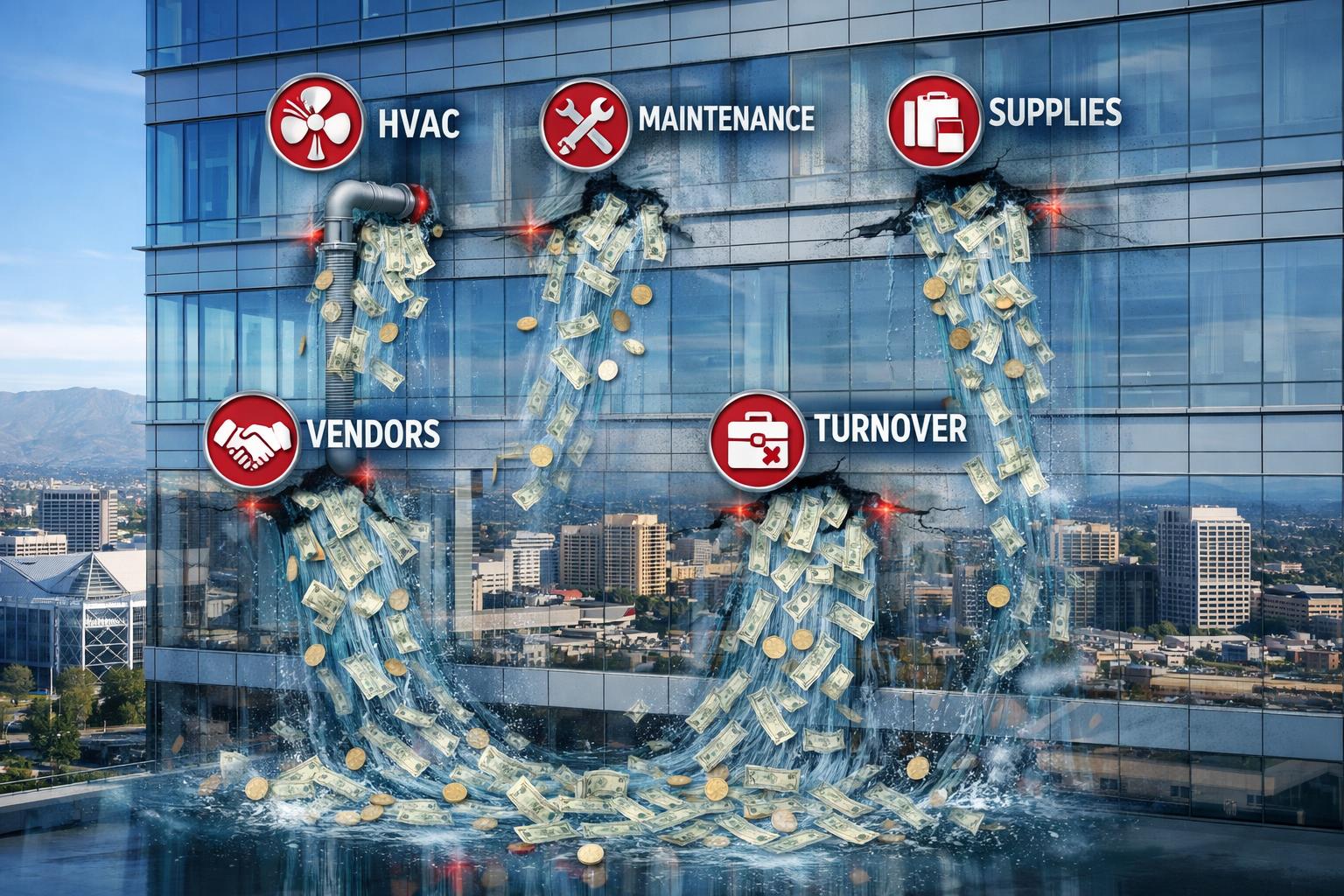
IFMA's guide names the cost: a neglected vendor program "quietly bleeds money through auto-renewals, scope creep, and services nobody is measuring." None of that needs bad intent from anyone. It needs only that nobody is clearly responsible for the follow-through.
Mechanical and HVAC contracts are the easiest case, because equipment either works or it does not. The property manager budgets and signs the service agreement, often with preventive maintenance included. The facility manager schedules visits around tenant hours, dispatches when something fails, and logs recurring faults that should shape the next renewal.
Emergencies need a pre-agreed rule, because nobody should be hunting for an approval at 11pm. Spell out which events the facility manager can dispatch on immediately, up to what dollar amount, and who is told afterward. The amount is a local decision for your building and your owner. This post does not offer a benchmark number because there is no reliable published one.
Critical environments such as labs, server rooms and anything with research or uptime consequences deserve a written exception: standing authority to bring in backup equipment or an emergency contractor first, with the property manager notified at the same time rather than after approval.
Janitorial, landscaping and security are where tenants notice problems fastest, since a dirty lobby or a propped side door is visible and a miscalibrated economizer is not. The fix is to reverse the usual order. The facility manager writes the scope from actual building conditions and tenant feedback, the property manager runs the bid against that scope, and after award the facility manager runs the relationship and reports on it.
Whoever has the power to correct a hazard can share responsibility for it, so the split should not leave safety unowned. Under OSHA's multi-employer citation policy, a "controlling employer" is one with "general supervisory authority over the worksite, including the power to correct safety and health violations itself or require others to correct them." The directive says control "can be established by contract or, in the absence of explicit contractual provisions, by the exercise of control in practice." It also says the controlling employer's duty is reasonable care, which is less than what an employer owes its own employees. This directive is written for multi-employer worksites in general, and how it applies to your building depends on the facts, so ask counsel.
For the contract layer, check the paperwork each vendor class requires. California, for example, requires janitorial employers to register, and the state's janitorial registration FAQ says a person or entity that contracts for janitorial services with an unregistered employer faces a civil fine of $2,000 to $10,000 for a first violation. Someone has to verify that registration before the contract is signed, extended or modified, and that is a contract-layer job.
Security guard companies and other licensed trades carry their own license and insurance requirements. The property manager should see the licensing, training and incident records as an ownership risk matter, while the facility manager reviews staffing and post orders as an operational one.
Put it in writing, then put it where both managers can see it. A verbal understanding between two people who get along will not survive a staffing change. Use this setup:
The DC study guide's contractor process is a reasonable baseline for any bid: write a clear specification, request bids from multiple contractors (it says "frequently three are sought"), inspect the work against the specification, notify the contractor of deficiencies and pay promptly when the work is complete.
Should the property manager or the facility manager sign vendor contracts?
It depends on the management agreement and the owner's procurement rules, but the usual answer is the property manager signs and the facility manager writes the scope and runs the work. The key is that the facility manager has input before signing and can read the contract afterward.
What should an emergency spending limit cover?
It should name the events (such as equipment failure affecting occupancy), the dollar amount the facility manager can approve without sign-off, and who must be told within what time. The amount is your own call, based on your building and owner, since no reliable industry benchmark exists.
How often should vendor performance be reviewed?
On a fixed cycle that both managers attend, with the data already collected. IFMA's guide calls for a regular service review of performance data, and quarterly is a common choice. Pick a rhythm you will actually keep.
What if the owner or tenant runs some vendors directly?
Record them in the same register with the same fields, and note who gives them direction. Hazards created by one vendor can affect another vendor's workers, so shared areas and access need a named contact even when the contracts sit elsewhere.
If nobody can say who approves an emergency call or a staffing change, fix that before the next failure forces the question. MAFM is a facilities management company that plans, schedules and coordinates building services and the vendors behind them, and we perform janitorial service ourselves. Talk to us about facility management for a review of how your vendors are set up today.
MAFM offers comprehensive facility management solutions tailored to your business needs.
Get in Touch