Budgets & Contracts
Reduce Facility Operating Costs in Silicon Valley, 2026
January 12, 2026
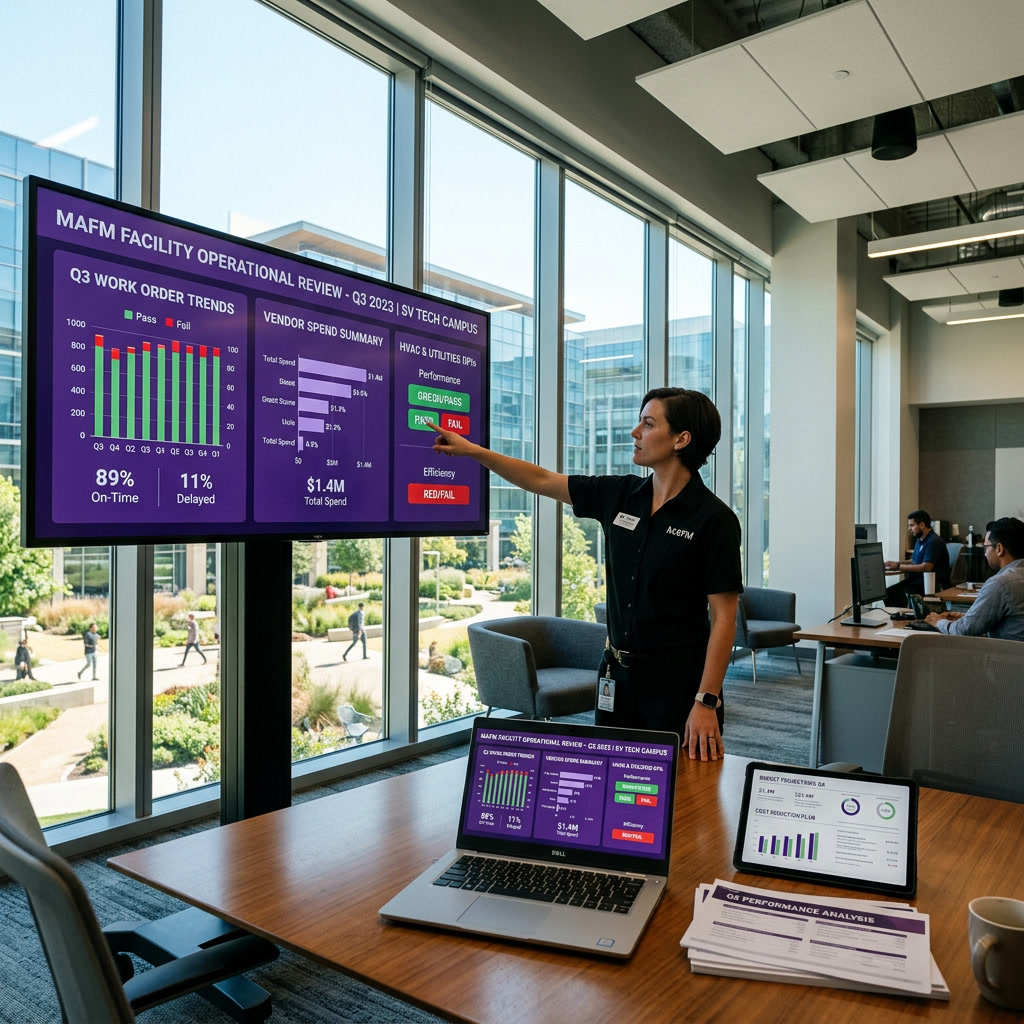
A quarterly facility performance review works when it is built around four buckets, reviewed in a fixed order: asset and maintenance performance, financial performance, compliance and risk, and occupant experience. Pick a handful of metrics per bucket, name a decision for every metric that moved the wrong way, and hold the meeting soon after the quarter closes.
Done that way, ninety days of work orders, invoices and tenant tickets turn into a defensible request for next quarter's budget. Done as a cost report assembled the night before, it only tells leadership what was spent.
Most fail because they are cost reports with a few variance notes attached. A spreadsheet of actual spend against budget shows that chiller repairs ran over in July. It does not show why, whether it was preventable, or whether the same failure is queued up again.
The fix is to pair lagging indicators with leading ones:
The DOE Federal Energy Management Program's O&M Best Practices Guide (Release 3.0, 2010) lists the kinds of indicators a program can track, including work orders generated and closed out, backlog of corrective maintenance, overtime worked and staff turnover. It says these metrics are useful for assessing effectiveness and also for cost justification of equipment purchases, program changes and staff hiring. That second use is the point of a debrief: the numbers are your case for next quarter.
The second failure is volume. A maintenance system can produce hundreds of data points a quarter, and most do not belong in front of ownership. The same guide notes that not every metric fits every situation. Choose a small set tied to cost control, risk and occupant experience, and leave the rest until something looks like an outlier.
Review asset performance first, then finances, then compliance and risk, then occupant experience. Each bucket helps explain the next one. Equipment performance drives budget variance, and a compliance gap or a failing system often shows up as a tenant complaint before it shows up as a citation.
Four numbers carry this bucket: preventive maintenance (PM) completion, the share of unplanned work, mean time to repair on critical equipment, and how old the open backlog is. The DOE guide's metrics table, which it attributes to NASA (2000), gives formulas and benchmarks for several of these. It defines PM completion as preventive actions completed over those scheduled, with a benchmark above 90%. It sets a benchmark of under 10% of hours worked on emergency jobs, and above 90% for schedule compliance.
Treat those as 2000-era reference points from a federal guide, not a rule for your building. What matters is the trend. A PM completion rate that slides because a technician left and was not backfilled predicts a failure spike one or two quarters later, long before it appears as a cost line.
Skip the raw count of work orders created. It reflects how aggressively staff log minor items, not how the building is performing.
When one asset keeps showing up in the unplanned column, the debrief is the place to move it from a repair conversation to a replace conversation, before capital planning closes. For the program behind these numbers, see our guide to preventive maintenance programs.
Budget variance by category and cost per square foot do most of the work. Raw dollars alone mislead: a property that added a tenant improvement or a floor of space will always show higher spend, and that is proportional, not out of control.
Energy deserves a careful comparison. ENERGY STAR Portfolio Manager lets you compare a building's energy use to a yearly baseline, national medians or similar buildings, and its 1 to 100 score is normalized for weather and operating characteristics, with 50 as the median. If you do not have a clean year-over-year baseline, a hotter summer will distort the number and send you chasing an equipment problem that is really weather.
Reconcile vendor invoices against contracted rates every quarter. It is the line item most often skipped, and rate creep and change orders nobody flagged in the moment are easier to catch while the work is fresh. A structured vendor performance scorecard makes that comparison routine rather than a hunt.
As a status list, not a trend line. For every certification and inspection with a hard deadline, the answer is current or not current. An expired elevator certificate or a lapsed fire pump test is not a gradual decline.
A useful compliance page covers:
California employers must keep an Injury and Illness Prevention Program that includes scheduled periodic inspections, with records of who inspected, what was found and what was corrected kept for at least one year (Cal/OSHA Title 8 section 3203). The quarterly debrief is a natural place to confirm those records exist.
Add an energy code line too. The California Energy Commission says the Building Energy Efficiency Standards, including the Title 24, Part 6 Energy Code, are updated every three years, and that the 2025 standards take effect January 1, 2026. Whether a given project or replacement triggers them is a question for your engineer or the local building department, so flag it in the debrief rather than assume.
Average resolution time by ticket category, and performance against any service levels in your leases. Report categories separately: a comfort complaint and a broken door closer resolve differently, and one blended average hides both.
Raw complaint volume with no context on occupancy or season creates anxiety without insight. Read it against what the first three buckets showed. If tickets spiked in August, check whether PM slipped or a system was failing before assuming a service problem. Our post on measuring tenant satisfaction covers surveys that add the tenant's own view.
Keep the document to one page per bucket, and run the meeting around decisions. For every metric that moved the wrong way, propose one of three responses:
A debrief that lists problems without a response reads as a status update and weakens your hand when budget requests arrive. Each page should say what happened, why, and what changes next quarter. Anything longer goes in an appendix.
Timing matters. Hold the review in the first couple of weeks after quarter close, while the data is fresh and before the next quarter's plans are locked, so the debrief shapes decisions instead of documenting them afterward. If your quarter one review is already on a calendar, the same structure applies to Q1 lessons for Q2.
How many metrics should a quarterly facility debrief include?
Two to four per bucket is enough, so roughly eight to sixteen in total. The DOE guide itself says not every metric suits every situation. Add a metric only when it supports a decision you actually make.
When should we hold the Q3 debrief?
Soon after the quarter closes, before the next quarter's budget and vendor plans are locked. That timing is what lets the findings change decisions. A review held months later mostly documents what was already decided.
Should we use industry benchmarks for PM completion and emergency work?
Use them as reference points, not targets to defend. The figures in the DOE guide come from a 2000 NASA source reproduced in a 2010 federal document. Your own trend, quarter over quarter, is the better test of whether the program is improving.
Who should own the debrief?
The facility manager or operations lead, with input from the maintenance team, the cleaning contractor and anyone who manages vendors. A facility management partner can gather the data from several systems and vendors into one document, but the decisions about budget and risk stay with you and ownership.
If your quarterly data sits in separate systems and a pile of vendor invoices, MAFM, a facilities management company, can coordinate the walkthroughs, vendor records and reporting behind a debrief like this one. Talk to us about facility management.
MAFM offers comprehensive facility management solutions tailored to your business needs.
Get in Touch