Facility Maintenance
Commercial HVAC Maintenance for Silicon Valley Offices
February 12, 2026
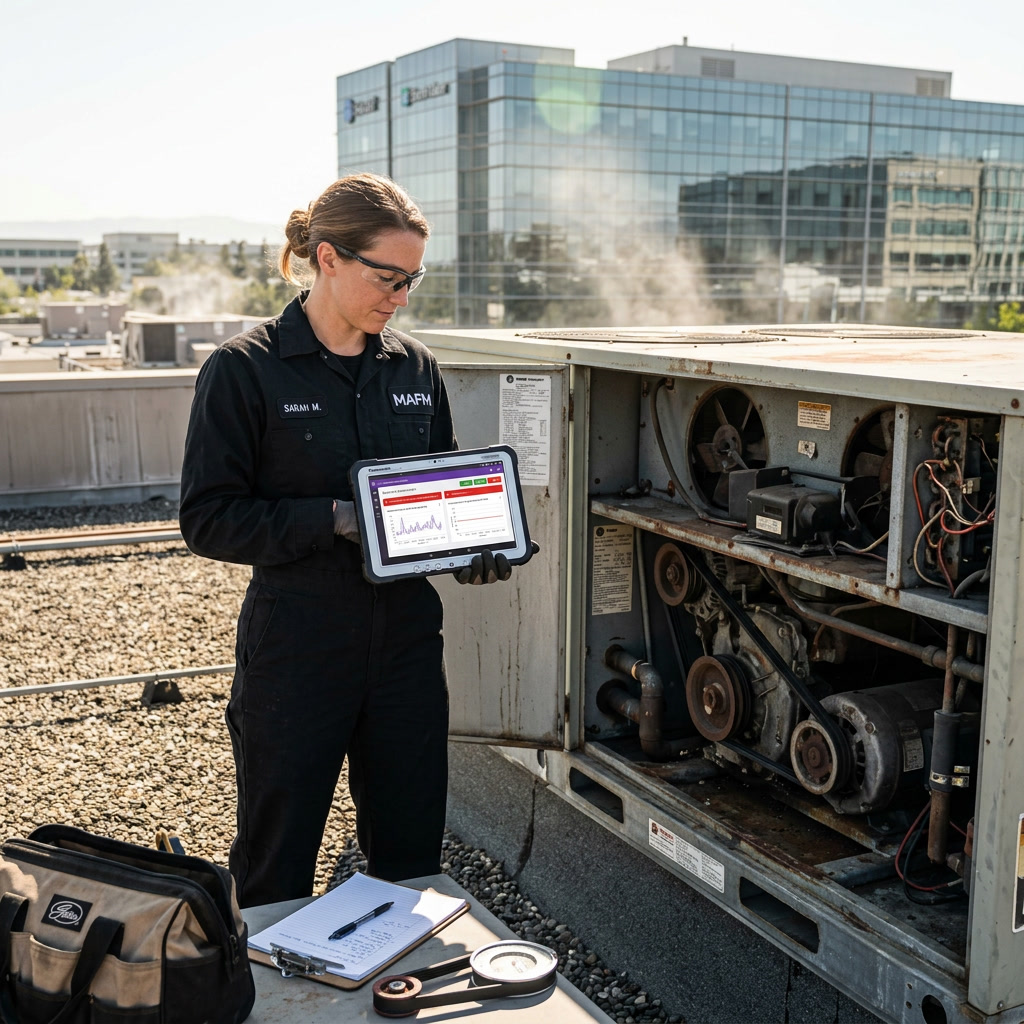
A mid-summer HVAC performance audit is a measured check of what your cooling equipment is doing now, compared with what it did at spring startup and what its design says it should do. Do it after the first sustained stretch of hot weather, while there is still time to fix what you find before the hottest weeks.
A visual walk past the rooftop units will not tell you much. The audit works because it compares numbers: supply air temperature, airflow, motor current, refrigerant readings, economizer behavior and BAS schedules. A trained HVAC technician takes the readings. The facility manager's job is to schedule the work, set the checklist, and make sure every finding turns into a dated action.
Because spring startup only proves the equipment worked in mild weather. Weeks of sustained load expose what a startup check cannot: dirty coils, slipping belts, drifting sensors and schedules that changed without anyone noticing.
PNNL's O&M guidance for unitary HVAC equipment, written for the federal energy program, says effective operations and maintenance is "necessary to maximize efficiency and production, provide occupancy comfort, and reduce failures." It also notes that discomfort, complaints and noise "can be indicators of performance issues." A cluster of warm-zone complaints in July is data, and the audit is how you find the cause.
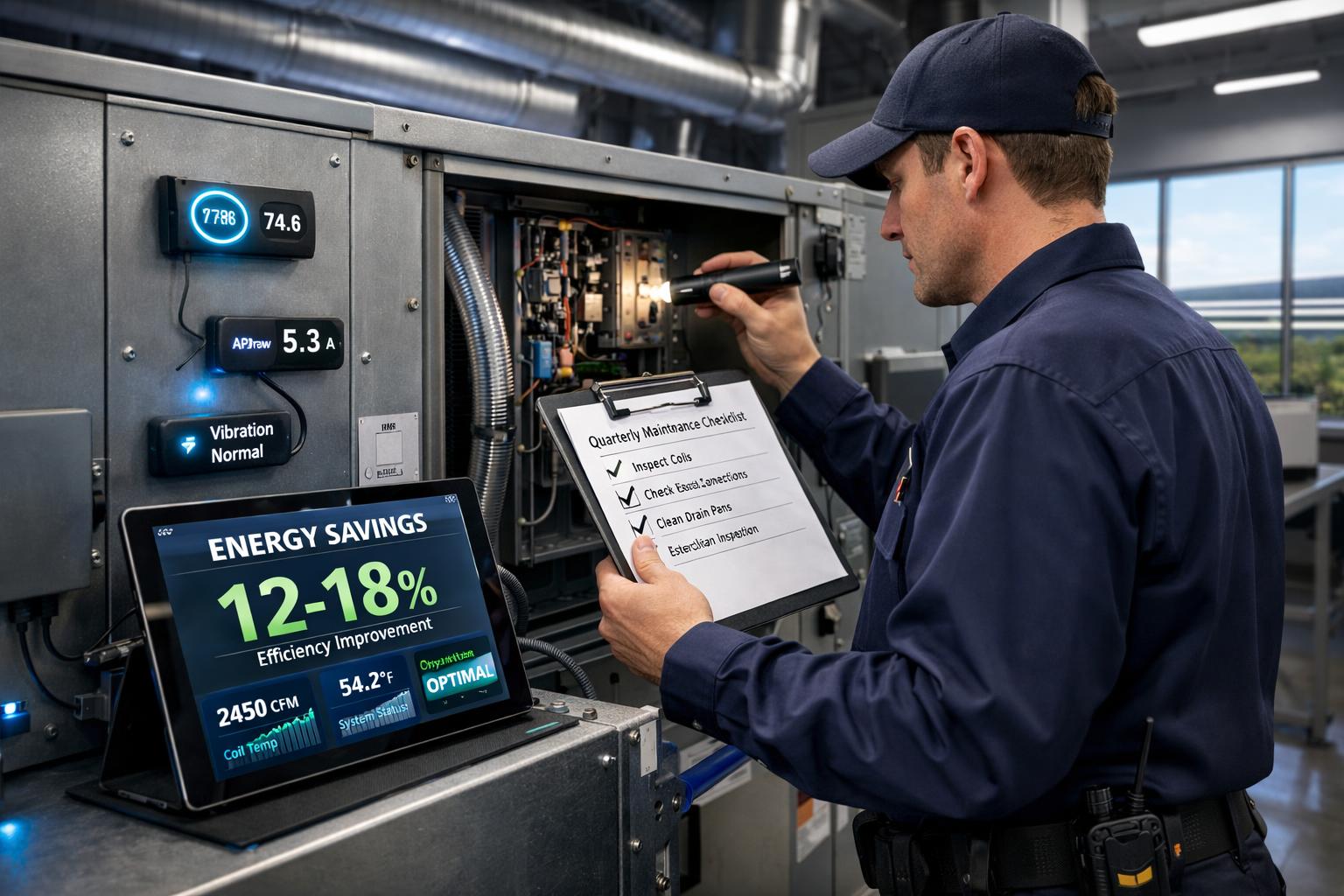
The same guide recommends a preventive program that reduces "costly repairs and unexpected downtime." An older federal estimate, the 2010 DOE Federal Energy Management Program O&M Best Practices Guide, puts the savings of preventive over reactive maintenance at 12% to 18% on average. Treat that as a dated, directional figure, not a promise for your building.
Measure supply air temperature, airflow, motor current and refrigerant condition, and compare each to the equipment's design or nameplate values. PNNL's sample checklist for unitary equipment lists these checks, with its own suggested frequencies.
PNNL is clear that repairs belong with "a trained and authorized HVAC maintenance provider," while facility staff and other approved representatives can perform visual inspections and routine checks and document issues. Follow the manufacturer's instructions where they differ from any sample checklist.
Yes, for larger systems. Under the EPA's Section 608 leak repair rules, owners or operators of covered appliances holding a full charge of 50 or more pounds must take corrective action when a leak exceeds the trigger rate for that appliance type. The EPA's leak repair page says the owner must generally either repair the leak within 30 days of discovery or develop a retrofit or retirement plan within 30 days and finish it within 1 year, with verification tests after repairs.
EPA lists comfort cooling equipment, including chillers, commercial split systems and packaged rooftop units, as a covered category. The page notes that EPA has recently updated these requirements and tells owners to consult the regulation itself, 40 CFR Part 82 Subpart F, so have your HVAC contractor confirm which rules apply to your equipment and refrigerant. Keep leak and charge records in the equipment file either way.
Check it directly, because a broken economizer can run for months without anyone noticing. PNNL's air-side economizer guidance warns that without proper maintenance economizers "may result in poor indoor air quality or significant energy waste and costs," and that those problems can go "unnoticed or undiagnosed for an extended period of time."
That is a particular concern in the Bay Area, where mild mornings make free cooling attractive. PNNL's sample checklist calls for these checks:
PNNL adds that humidity sensors used for enthalpy control "require regular calibration," and that if you cannot maintain them, reverting to a dry-bulb limit "may improve operation." For related background, see our post on using free cooling instead of mechanical cooling.
Water-cooled systems need water treatment and tower condition checked, and the CDC treats them as a health issue as well as an efficiency one. The CDC's cooling tower Legionella guidance says to use a water management program, monitor water parameters on a regular basis, automate anti-corrosion, anti-scale and disinfectant addition, and perform an offline disinfection and cleaning at least annually.
Several items on that list fit a mid-summer audit:
For air-cooled condensers on rooftop and split systems, the audit item is coil cleanliness. PNNL's checklist includes inspecting coils, straightening fins and cleaning as needed. No published figure fits every unit, so measure your own: compare supply air temperature and compressor current before and after cleaning a suspect unit.
Compare what the controls are doing with what you intended. A schedule can change after a controller update or a power interruption, and nobody notices until a zone is warm at 8 a.m. or running all weekend.
PNNL's checklist includes checking thermostats, unit controllers and the building control system, and recalibrating or adjusting setpoints when needed.
Rank every finding by its effect on comfort and capacity, then give each one an owner, a date and a verification step. Items that are already causing complaints or reduced capacity come first, and early-stage degradation gets scheduled before fall rather than deferred.
PNNL recommends logging all of this in a CMMS or electronic logbook, including "findings from functions and diagnostics performed, corrective actions taken, equipment downtime, and other relevant issues." Tell affected tenants early: what you found, when it will be fixed, and what interim steps you are taking. For the rest of the season, see our summer peak operations playbook, and for the full-year view, commercial HVAC maintenance for Silicon Valley offices.
When should a mid-summer HVAC audit happen?
After the first extended run of hot weather, once equipment has operated under real load, and early enough to leave time for parts and repairs. In the Bay Area that usually means late June or July, but there is no code-required date. Choose a window when a technician can complete the readings and you can still schedule follow-up work on mild days.
Who should perform the audit?
A trained, authorized HVAC technician should take the measurements and make any repairs. PNNL says site staff or a contractor can perform checklist tasks, but repairs belong to a qualified provider. Facility staff can handle filter checks, visual inspections and documentation.
Does the audit replace routine preventive maintenance?
No. It adds a performance check on top of it. PNNL's checklists say they do not replace manufacturer recommendations or contracted O&M and warranty services, so keep your normal filter, belt, coil and drain routines running and treat the audit as the measured check in between.
What if the building has no BAS trending?
You can still do the audit with portable instruments and manual readings, then repeat them at the same points next year. A BAS makes economizer and schedule review easier, because trended data shows what the equipment did between visits.
MAFM is a facilities management company. We do not repair HVAC equipment ourselves, but we can plan the audit, coordinate your HVAC and controls vendors, keep the findings on a punch list with owners and dates, and verify the work was done. Talk to us about facility management.
MAFM offers comprehensive facility management solutions tailored to your business needs.
Get in Touch