Facility Maintenance
Commercial HVAC Maintenance for Silicon Valley Offices
February 12, 2026
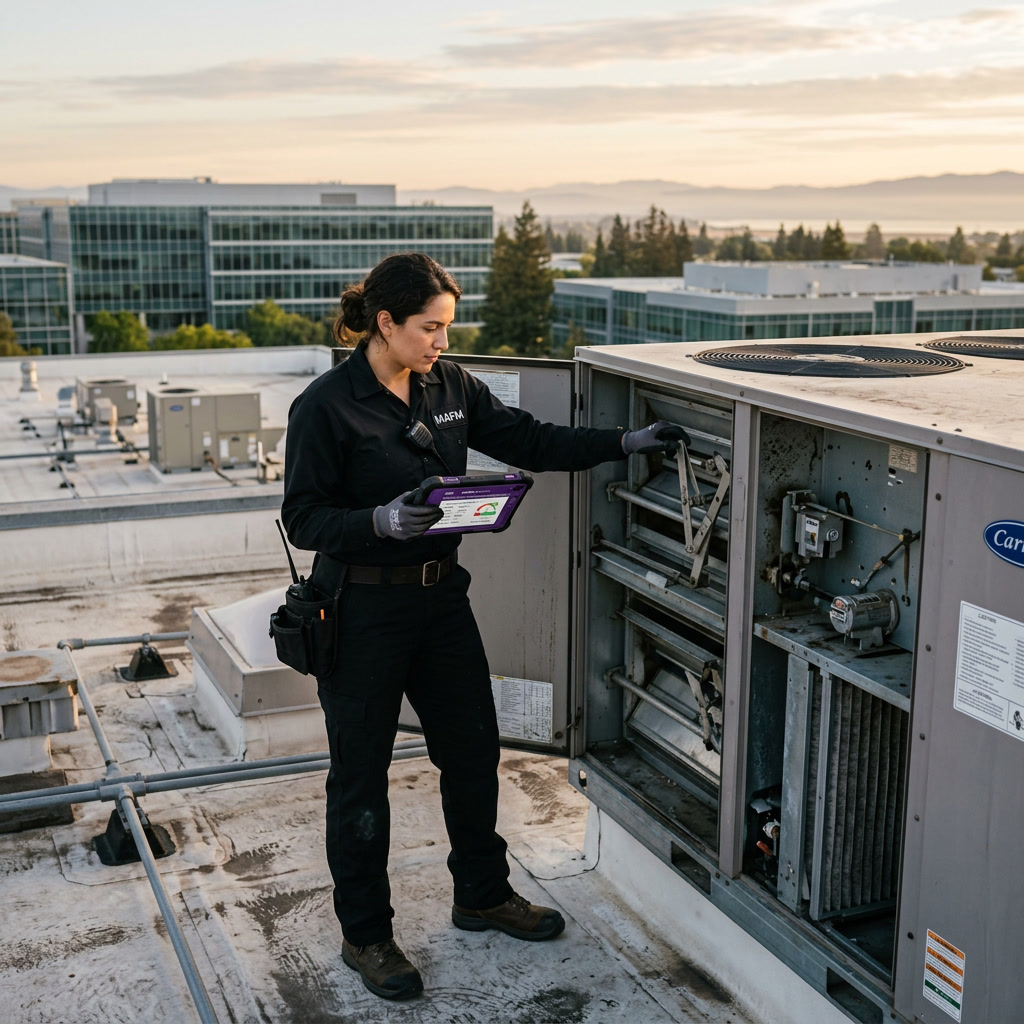
Every September, we walk rooftops across Sunnyvale, Santa Clara, and Fremont and find the same thing: economizer dampers sitting at 20% minimum position on mornings when the outside air is 58 degrees and perfectly capable of cooling the building for free. The compressors are running, the utility meter is spinning, and nobody notices because the space "feels fine." That's the quiet cost of an untuned economizer during shoulder season: and it's one of the highest-leverage fixes in our entire fall HVAC wind-down process.
This is the second post in our week-long series on preparing Silicon Valley cooling systems for the transition out of peak summer load. Yesterday we covered the broader wind-down sequence; today we're going deep on one component that gets overlooked more than any other: the outdoor air economizer. In a climate where morning marine-layer air can sit in the mid-50s while afternoon highs still push past 80, a properly functioning economizer isn't a nice-to-have efficiency feature: it's a load-shifting tool that can cut compressor runtime by 30-40% during the exact weeks (September through early November) when most buildings are still running mechanical cooling out of habit rather than necessity.
For facility teams managing 15, 30, or 60 rooftop package units across a campus, this is also one of the few maintenance items where a half-day tune-up produces a measurable line-item change on next month's PG&E bill.
Silicon Valley's microclimate is unusual, and it's exactly the kind of unusual that rewards economizer investment. Unlike Sacramento or the Central Valley, where fall still delivers 95-degree afternoons, most of our service area (San Jose, Mountain View, Milpitas, Redwood City) sees a widening daily temperature swing starting in late August. Mornings drop into the high 50s and low 60s thanks to the marine layer pushing through the Santa Cruz Mountains gap, while afternoons still climb into the mid-70s to low 80s through October.
That swing is the entire business case for economizer operation. A dry-bulb economizer control sequence set with a reasonable changeover point, typically 65-70°F for Bay Area applications, allows a rooftop unit to satisfy cooling load with 100% outside air for several hours every morning, and often through midday on the cooler days that follow a marine push. Mechanical cooling only needs to pick up the difference in the afternoon, and on many days it doesn't need to run at all.
The problem is that most RTU economizer sequences were commissioned once, years ago, and never revisited. Setpoints drift, sensors degrade, and actuators lose calibration long before anyone notices: because when an economizer fails "closed," the unit just falls back to mechanical cooling and the space stays comfortable. The failure is invisible to tenants and invisible on a walkthrough. It only shows up as a utility bill anomaly that nobody connects back to a $40 damaged linkage.
Across the RTU fleets we service, four issues account for the overwhelming majority of economizer underperformance, and none of them require a unit replacement to fix.
Stuck or seized damper linkages are the most common. Rooftop units in our climate accumulate dust, pollen, and in some cases roofing debris around the damper blades and linkage arms. Over a full cooling season, the actuator motor works harder to achieve the same stroke, and eventually the linkage binds partway open, capping outside air intake regardless of what the control sequence is calling for. We regularly find units logged as "economizing" that are physically incapable of opening past 35%.
Miscalibrated or failed outside air temperature sensors are the second-most common finding. These sensors are mounted in the outside air intake hood, exposed to sun, moisture, and in coastal-influenced zones, salt air. A sensor reading 8-10 degrees warm will cause the control system to lock out free cooling on mornings that are ideal for it: precisely the mornings this time of year delivers most often.
Enthalpy sensor drift affects the smaller number of units controlled on differential enthalpy rather than dry-bulb temperature. These sensors measure humidity as well as temperature and are more failure-prone. When they drift, they tend to falsely indicate high outside humidity, again locking the unit into mechanical cooling even when the air is genuinely usable.
Fourth, and easy to miss during a routine PM: minimum position setpoints left at summer occupancy levels. Some control sequences use a higher minimum outside air damper position during peak occupancy for ventilation, then never step it back down or up appropriately as the changeover logic shifts. The result is dampers stuck at a fixed position that has nothing to do with actual outdoor conditions.
A proper economizer tune-up on a packaged rooftop unit takes a technician 45 minutes to an hour per unit, longer if linkages need disassembly. Here's the sequence we follow, and it's worth having your in-house team or your FM vendor run this on every RTU above 54,000 BTU/h before October: that tonnage threshold matters, and we'll explain why in the next section.
First, actuator stroke test. The technician manually commands the damper from 0% to 100% and back, watching for binding, hesitation, or incomplete travel. Any linkage that doesn't move freely gets cleaned, lubricated with a non-gumming lubricant rated for outdoor exposure, and re-tested. If the actuator itself is weak, common on units eight-plus years old, this is the moment to flag it for replacement rather than waiting for a full failure in the shoulder season when you need it most.
Second, sensor verification against a calibrated reference. We check the outside air sensor reading against a handheld reference thermometer at the intake hood, and correct or replace any sensor reading more than 2 degrees off. For enthalpy-controlled units, we verify the humidity sensor similarly. This is the single highest-value five minutes of the entire visit, because a bad sensor invalidates every other setting downstream.
Third, changeover setpoint review. We check the dry-bulb or enthalpy changeover point against current-season logic. For most of our clients' buildings, we push the changeover setpoint up slightly heading into fall: since afternoon temperatures are still warm enough that a conservative summer setpoint may be leaving usable free-cooling hours on the table in the shoulder months.
Fourth, minimum position audit. We confirm the minimum outside air damper position matches the current ventilation requirement (tied to occupancy and, where applicable, demand-controlled ventilation via CO2 sensors) rather than a static value left over from a prior season or a prior tenant improvement project.
Fifth, and often skipped, is a BAS trend review. Pulling 30 days of trend data on damper position versus outside air temperature tells you immediately whether the unit is actually economizing when conditions allow, or whether it's technically "enabled" but functionally inert. This data point alone has caught more dead economizers for us than physical inspection.
The energy case is straightforward. A rooftop unit that gains four to six additional hours of free cooling per day during September and October, which is realistic for a properly calibrated economizer in our climate, can see compressor runtime drop by roughly a third during that window. On a 10-ton package unit running under a typical Silicon Valley office load profile, that translates to meaningful kWh reduction at exactly the time PG&E's peak time-of-use pricing is still in effect for many commercial rate schedules. Across a 20-unit rooftop fleet, facility teams we work with have documented utility bill reductions in the range of 8-14% for September-October billing cycles after an economizer tune-up, without touching setpoints, controls sequencing changes, or any capital expense.
There's also a compliance dimension that doesn't get enough attention. Title 24, Part 6 requires functioning economizers on most packaged units above 54,000 BTU/h (roughly 4.5 tons) installed or replaced under current code, and California's building energy benchmarking and retro-commissioning requirements increasingly ask for documented economizer functionality, not just presence. If your portfolio is subject to a retro-commissioning cycle or a CalGreen-related audit, a dead economizer discovered by an outside auditor is a deficiency finding with your name on it. Catching it in-house during a scheduled fall tune-up costs a fraction of what it costs to remediate under audit pressure, and it keeps the finding off your compliance record entirely.
Economizers are one of the only pieces of HVAC equipment where "doing nothing" costs you money every single day the fix isn't made, and where the fix itself is cheap, fast, and doesn't require downtime or tenant notification. Given how pronounced our region's fall temperature swing is, this is close to the highest-ROI maintenance action available to a Silicon Valley facility team in August and September. Later this week, we'll look at coil cleaning and staging schedule adjustments: both of which pair directly with a properly functioning economizer to maximize the shoulder-season savings window before winter setpoints take over.
MAFM's HVAC technicians can run a full economizer calibration and BAS trend audit across your rooftop fleet before the fall changeover window closes: contact us to schedule your portfolio assessment this month.
Link back to Monday's series-opener post on the end-of-summer HVAC wind-down sequence, and forward to later-in-the-week posts on condenser coil cleaning and fall staging/setpoint schedules.
California Energy Commission Title 24, Part 6 Building Energy Efficiency Standards (economizer requirements); ASHRAE Guideline 36 on high-performance sequences of operation for economizer control.
MAFM offers comprehensive facility management solutions tailored to your business needs.
Get in Touch