Sustainability & Energy
De-Icing Solutions for California Facilities: What Works
January 28, 2026
Earlier this week we talked about why the fall transition matters for Silicon Valley landscapes and how it sets the tone for spring health. Today we're getting into the mechanics: specifically, what it actually takes to shut down an irrigation system correctly before the first significant rain event hits, which historically lands somewhere between the second and third week of October in the South Bay and Peninsula.
Here's the problem we see every year: properties treat irrigation shutdown as flipping the controller to "off" and calling it done. That approach works fine for a residential backyard. It does not work for a 40-zone drip and spray system feeding a 12-acre corporate campus, and it definitely doesn't work for properties with backflow preventers subject to annual testing requirements from Santa Clara Valley Water District or San Jose Water Company. Skipping steps here doesn't just risk plant loss: it risks cracked backflow assemblies, burst mainlines discovered mid-January when nobody's watching, and compliance headaches that land squarely on the facility manager's desk.
This post walks through the actual sequence our crews follow on commercial properties, the equipment involved, and the mistakes that cost owners real money when November rains arrive and nobody checked the work in September.
A controller set to "off" still leaves water sitting in every lateral line, drip tube, and the backflow preventer assembly itself. In our climate, that's usually not a freeze risk the way it is in Denver or Chicago: but Silicon Valley does get occasional overnight lows in the high 20s to low 30s in December and January, particularly in low-lying areas of Sunnyvale, Santa Clara, and parts of Fremont near the Bay flats. Water sitting in exposed backflow devices, above-ground risers, or drip lines running along east-facing walls that don't see sun until late morning can freeze often enough to crack fittings.
More importantly, water sitting in lines all winter combined with root intrusion, debris buildup, and rodent activity (gophers love chewing into idle poly tubing) means that come March, a system that wasn't properly shut down often has multiple failure points that only show up when you pressurize it again. We've walked properties in April where the irrigation contractor discovers six blown emitters and two cracked valves: all of which could have been caught and prevented with a proper fall shutdown in September or October.
The other piece owners miss: rain sensors and controller programming. If you don't reprogram or disable zones going into the rainy season, and a rain sensor bypass switch gets bumped or fails, you can end up irrigating during a storm: which on a hillside property in Los Altos Hills or Saratoga is not just wasteful, it's a genuine erosion and drainage liability.
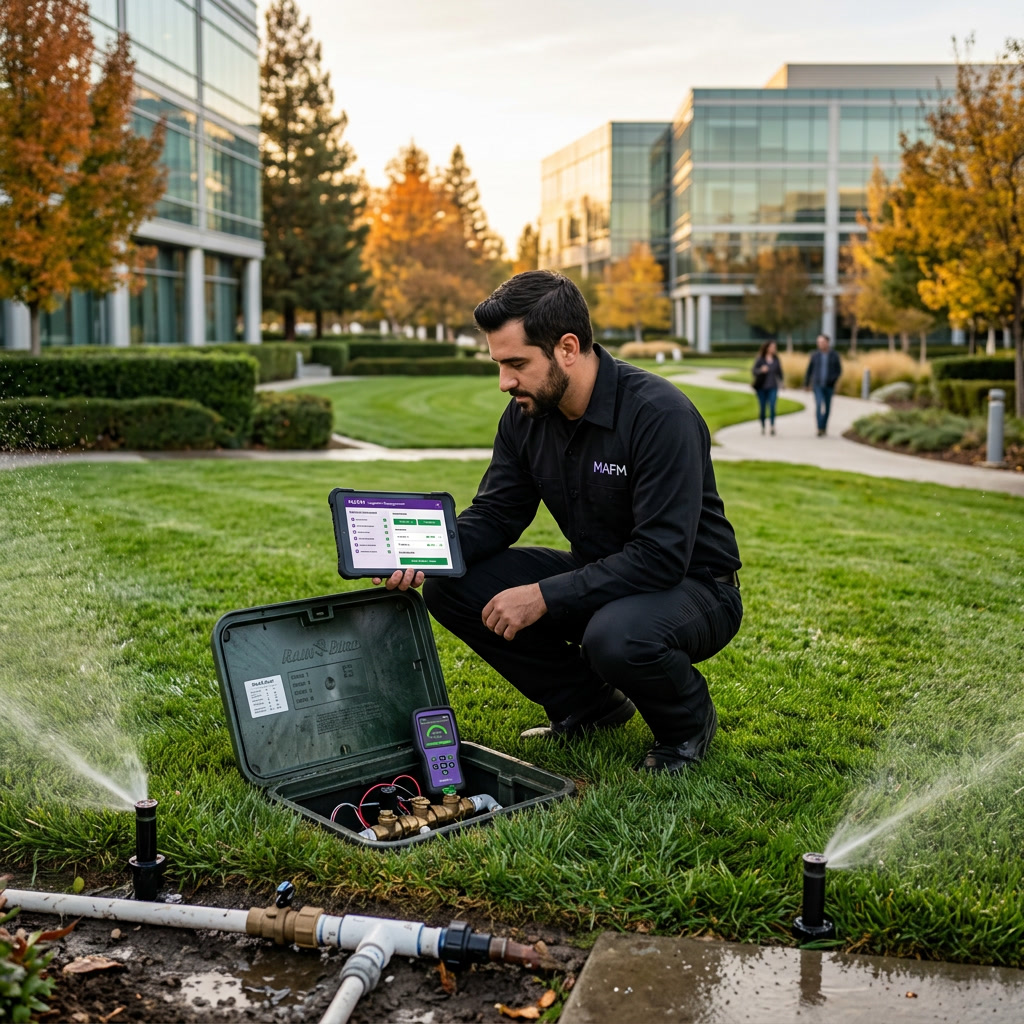
Our field crews follow a five-step sequence on every commercial account, and the order matters.
First, we run a full zone-by-zone inspection while the system is still pressurized. This is the last chance before the off-season to catch a stuck valve, a broken head, or a zone with declining pressure that indicates a slow leak in the mainline. Catching this in late September means a same-week repair. Catching it in February means a soggy, eroded slope and an irate tenant complaint.
Second, we isolate and drain the backflow preventer. For properties on Santa Clara Valley Water District or Cal Water service, most commercial backflow assemblies are double-check valve or reduced-pressure principle devices that require a licensed backflow tester to shut down and drain properly: this isn't optional handyman work, it's a compliance step, since these same assemblies need certified testing again in spring before reactivation. We coordinate this with the certified tester so the shutdown and eventual spring test happen on the same account, avoiding a scheduling gap.
Third, for larger properties (anything above roughly 2 acres of irrigated landscape, which describes a lot of the corporate campuses along Highway 237 and North First Street) we recommend a compressed-air blowout of the mainlines and lateral lines, not just gravity draining. Gravity draining alone leaves low points in the line full of standing water. A blowout using a 50-80 CFM compressor, run zone by zone at controlled PSI (never exceeding manufacturer specs, typically capped around 50 PSI for PVC systems to avoid pipe damage), clears water more completely and is the same practice used in colder climates, applied here as a best practice rather than a strict necessity.
Fourth, we cap or store above-ground components (drip line ends, quick-coupler valves, exposed risers in planter beds) that could be damaged by pressure washing crews, holiday lighting installers, or seasonal decor teams who often show up on these properties in November and December without irrigation on their radar.
The controller is where most properties either save real money or quietly waste it all winter. Rather than shutting the whole system off at the panel, we reprogram controllers to a minimal or dormant watering schedule for any zones with drought-tolerant or established plantings that genuinely need zero supplemental water once rains start: typically this means cutting scheduled run times to zero from November through February for turf and established shrub zones, while leaving a reduced schedule active for anything newly planted in the last 12 months that still needs root establishment support even in the rainy season, since rain alone doesn't always deliver consistent moisture to a young root ball.
Rain sensors and soil moisture sensors get tested manually at this point too: not just visually inspected. We pour water directly onto the sensor or use the test mode most smart controllers offer, verifying the system actually suspends irrigation when moisture is detected. This step gets skipped constantly, and it's the single biggest reason properties end up irrigating during an atmospheric river event in January. If your property runs a weather-based or ET (evapotranspiration) controller, increasingly common on newer Silicon Valley builds and retrofits incentivized through Bay Area Water Supply and Conservation Agency programs, this is also the point to confirm the controller's local weather data feed is still connecting correctly, since a lapsed cellular or Wi-Fi connection on these units silently reverts many models to a default fixed schedule that ignores actual rainfall.
Finally, we document every controller change with dated photos of the program summary screen and log it in the property's maintenance file. When the same property gets reactivated in March or April, whoever handles that work, sometimes not the same crew, needs a clear record of what was changed and why.
Timing matters more than most owners assume. We recommend beginning shutdown work no later than the first week of October for Silicon Valley properties, which gives crews time to work through multi-building campuses before the first meaningful storm, historically arriving mid-to-late October in most years per National Weather Service Bay Area records, though some years push into November. Waiting until after the first rain to start this process means working in wet, muddy conditions and often means the "last chance inspection" in Section 2 happens after damage is already occurring.
On cost: a professional shutdown for a mid-size commercial property (3-8 acres irrigated) typically runs in the range of a few hundred to low thousands of dollars depending on zone count and whether a compressed-air blowout is included, small relative to the cost of a single burst mainline repair, which routinely runs $2,000-$6,000+ once you factor in hardscape or turf replacement around the excavation. Framed against potential water waste from a mis-scheduled controller running all winter, which on a large property can mean thousands of gallons wasted and real dollars on a commercial water bill before anyone notices, the shutdown service pays for itself quickly.
On compliance: if your property is enrolled in any water district rebate or turf replacement program, or subject to a water budget under a district's excessive use ordinance, documentation of proper seasonal shutdown and controller reprogramming can matter if your account gets audited or flagged for unusual winter usage. Keep the maintenance log referenced in Section 3 on file for at least the current billing cycle plus the prior year.
Shutting down irrigation properly is unglamorous work that happens outside, often in the same week facility teams are juggling HVAC seasonal changeovers and holiday event prep: which is exactly why it gets rushed or skipped. But the properties that handle this correctly every September and October are the same ones that don't get surprised by a cracked backflow assembly in March or a water bill anomaly in January. It's a few hours of coordinated work now against months of exposure otherwise.
Later this week we'll look at storm drain and hardscape drainage prep, which pairs directly with everything covered here: because a well-drained system and a well-shut-down irrigation system are the two halves of getting your property truly ready for the rainy season.
Ready to get your property's irrigation shutdown scheduled before the first storm? Contact MAFM to coordinate a full inspection, backflow shutdown, and controller reprogramming with our certified landscape and compliance team.
Link back to Monday's post introducing the fall landscaping transition series, and forward to this week's upcoming post on storm drain and hardscape drainage preparation.
Santa Clara Valley Water District backflow prevention program guidelines; Bay Area Water Supply and Conservation Agency (BAWSCA) seasonal water use resources.
MAFM offers comprehensive facility management solutions tailored to your business needs.
Get in Touch