Staffing / Workforce
Why Your Facilities Team Keeps Quitting (And What Silicon Valley Building Owners Can Do About It)
July 13, 2026
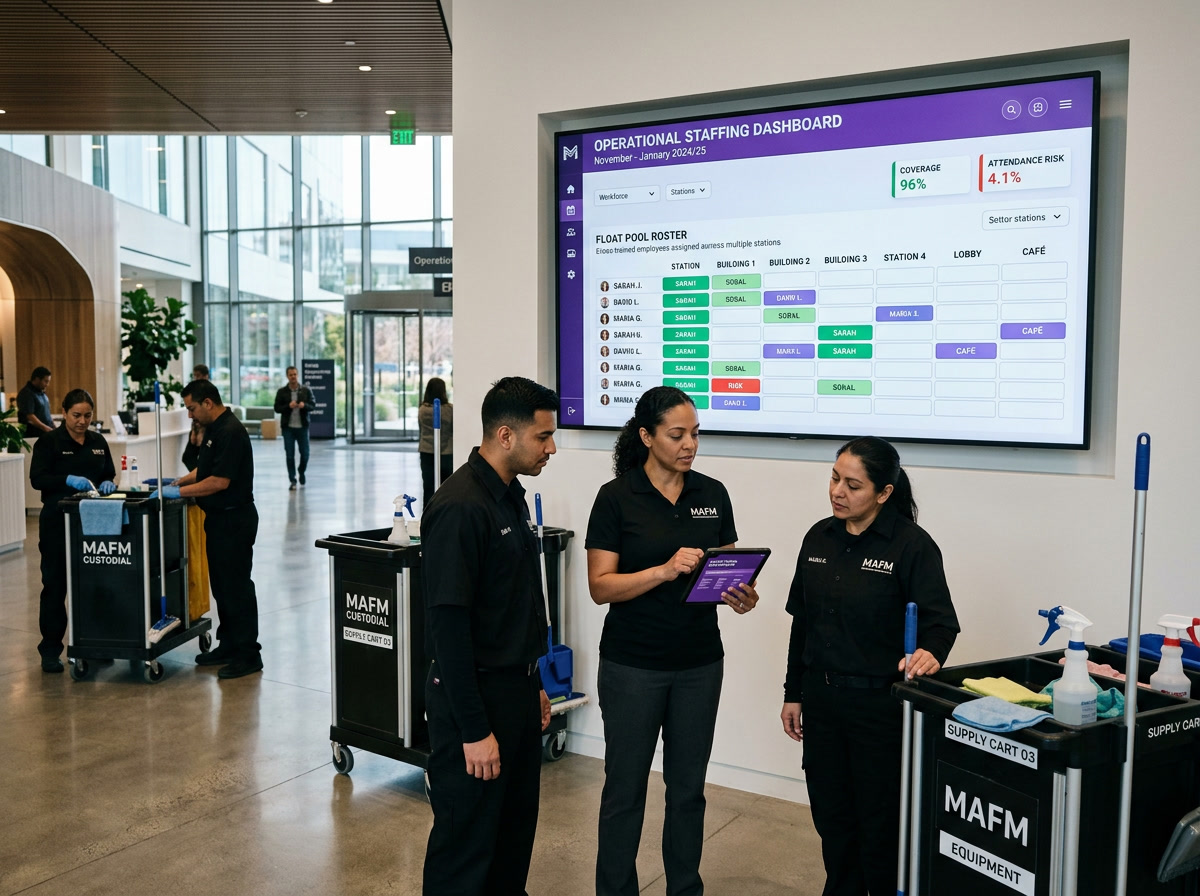
Earlier this week we looked at why November through January is statistically the worst stretch for custodial attendance at Bay Area campuses, and we flagged the scheduling mistakes that turn a few call-outs into visible service failures. Today we're getting tactical about the single best structural fix available to most facility teams: the float pool, a cross-trained bench of workers who can step into any station on short notice.
Most Silicon Valley facility directors default to overtime when a floor tech calls in sick during the holiday crunch. It works for a week. It stops working around week three, when the same four reliable people have covered sixteen extra shifts, burnout sets in, and now you have a fifth call-out — except this time it's someone who was never absent before. A float pool breaks that cycle by distributing coverage capacity across more people before the crunch starts, not during it.
Building one takes about six to eight weeks of lead time, which puts us right at the edge of the window for this season. If your crew isn't cross-trained yet, this is the post to act on before Halloween.
A float pool is not a separate hire category — it's a designation layered onto your existing crew. Typically it's 15-20% of your custodial headcount identified as "cross-stationed," meaning they've been trained and signed off on at least two building zones or task types beyond their primary assignment. At a 120,000-square-foot campus running a six-person day crew plus a four-person night crew, that's roughly two people who can legitimately cover restrooms, break room resets, and lobby/entrance maintenance interchangeably, regardless of which building or floor they normally work.
The mistake most facilities make is assuming cross-training means "can run a vacuum anywhere." That's not enough. Real float coverage requires knowledge of floor-specific protocols: which conference rooms have glass walls requiring streak-free technique before 8am stand-ups, which tenant has a no-fragrance policy for chemical sensitivity accommodations, which freight elevator is the only one rated for the scrub machine. Without that detail, a float worker shows up, does generic cleaning, and you get a tenant complaint anyway — just a quieter one than an empty restroom.
The build-out process: pick your float candidates based on tenure and reliability (not availability — reliable people are usually already loaded up), pair them with the incumbent on each secondary station for two to three shifts of shadow training, and document the station in a one-page cheat sheet covering access codes, chemical restrictions, equipment location, and tenant-specific quirks. That cheat sheet is the part everyone skips and the part that makes the whole system work when the float worker is covering a building they've seen twice.
Facility directors push back on float pools because cross-training costs money up front — typically 8-12 paid hours per float worker per secondary station, which at a loaded rate of $28-32/hour runs $220-380 per person per station. For a two-person, two-station float pool, you're looking at under $1,500 in training cost before the season even starts.
Compare that to the overtime alternative. A single call-out covered by overtime costs time-and-a-half on an $24-26/hour base rate, so roughly $36-39/hour for the shift, plus the hidden cost of the covering employee's own fatigue-driven error rate climbing on hour nine or ten of a double. Run that math across a six-week holiday stretch with an average of three call-outs per week across your portfolio — not unusual for a 40-50 person custodial contract in Silicon Valley between Thanksgiving week and the first week of January — and you're spending $3,000-4,500 in overtime premiums alone, before accounting for the quality degradation that triggers tenant complaints and the service credits that sometimes follow.
The float pool model also reduces your exposure to the worse scenario: the uncovered shift. When overtime-dependent crews hit their third or fourth consecutive call-out week, people start declining the extra shift, and facility managers end up scrambling to pull from a staffing agency at a 25-40% markup, often with workers who've never seen your site. A trained internal float pool means your coverage gap gets filled by someone who already knows where the AED is and which stairwell door sticks.
The float pool only works if it's managed with a clear decision tree, not ad hoc phone calls at 6am. The standard we recommend: when a call-out comes in, the on-site supervisor checks the float roster first, not the overtime-eligible list. This sounds obvious, but in practice schedulers default to whoever answered their last three calls, which is exactly the fatigue spiral the float pool exists to prevent.
Second, floats should be assigned based on priority tier, not proximity. Restrooms and high-traffic lobbies get first call on float coverage; low-visibility areas like storage rooms or mechanical spaces get pushed to the following shift if coverage is thin. We've found that ranking your stations into three priority tiers in advance — and getting sign-off from the property manager on what's acceptable to defer — removes the in-the-moment guesswork that leads to overcorrection (over-covering low-priority areas while a lobby sits unattended).
Third, build in a float-of-the-float: identify one supervisor or lead who can step into a cleaning role directly if the float pool itself is depleted, which does happen during a true flu wave. This is the layer most facility plans miss entirely. At one 280,000-square-foot mixed-use property we support, the operations lead personally covers entrance glass and restroom checks during a crunch — not because it's in the job description, but because the alternative is an unattended lobby entrance during a property tour.
Finally, communicate the float assignment to tenants proactively when it affects a floor they know well. A one-line note — "your regular evening tech is out this week; Maria will be covering and has full access to your floor protocols" — headed off more complaint calls for one of our South Bay clients than any amount of extra cleaning ever did. Tenants tolerate substitutions when they're informed; they escalate when they notice a stranger and assume something's wrong.
A float pool built in October and abandoned in February is a wasted investment. The real return comes from treating it as permanent infrastructure that happens to get stress-tested hardest during the holidays. That means scheduling refresher shadow shifts quarterly — even 90 minutes per float worker per station — so skills don't atrophy and new building protocols (updated access codes, a tenant's new chemical sensitivity policy, a relocated equipment closet) get folded in.
It also means building retention incentives around the float designation itself. Workers who take on cross-training are absorbing more cognitive load and more schedule unpredictability; a flat $1.50-2.00/hour differential for float-certified staff, paid whenever they're actually deployed in that role, costs a facility operation very little relative to what it buys in retention and morale. We've seen float pay differentials reduce float-worker turnover by roughly a third compared to crews where cross-training was expected without additional compensation.
Finally, track float pool utilization the same way you'd track any other operational metric — shifts covered, response time from call-out to float deployment, and tenant complaint volume during float-covered shifts versus standard shifts. If your float pool isn't measurably reducing complaint volume during coverage gaps by spring, the training or the documentation (not the concept) needs revisiting.
The float pool isn't a holiday hack — it's the closest thing custodial operations have to an insurance policy against the predictable attendance dip that hits every Silicon Valley campus between Halloween and the Super Bowl. The lead time to build one properly is closing fast, but a scaled-down version — even just two cross-trained workers covering your highest-priority stations — beats walking into November with a single overtime lever and a prayer.
If you're reading this in mid-October with no float plan in place, the next sixty days are what determine whether your properties sail through the holidays or spend six weeks fielding tenant complaints about unattended restrooms.
MAFM builds and manages float pool programs as part of our custodial staffing contracts across Silicon Valley — talk to us before November about cross-training your bench before the season's first wave of call-outs hits.
Link back to Monday's post introducing the holiday absenteeism staffing crunch series, and forward to Thursday's post on overtime cost controls and Friday's week-in-review roadmap post.
Bureau of Labor Statistics data on seasonal absenteeism trends in building services occupations (bls.gov); International Sanitary Supply Association (ISSA) cross-training and staffing benchmarks for commercial custodial operations (issa.com).
July 13, 2026
July 14, 2026
July 15, 2026
MAFM offers comprehensive facility management solutions tailored to your business needs.
Get in Touch