Technology & Operations
AI Facility Management: What It Can Do for Response Times
January 21, 2026
Earlier this week we looked at forecasting Q4 demand and mapping it against your existing headcount. Once you know the gap (say, an extra 400 labor hours a month between Thanksgiving and New Year's) the next decision is how to fill it. This is where most facility managers default to the same move every year: call the staffing agency, request three bodies, and hope they show up trained. That approach works, sometimes. But it's rarely the cheapest or most reliable option, and it's almost never the right call for every property type in a portfolio.
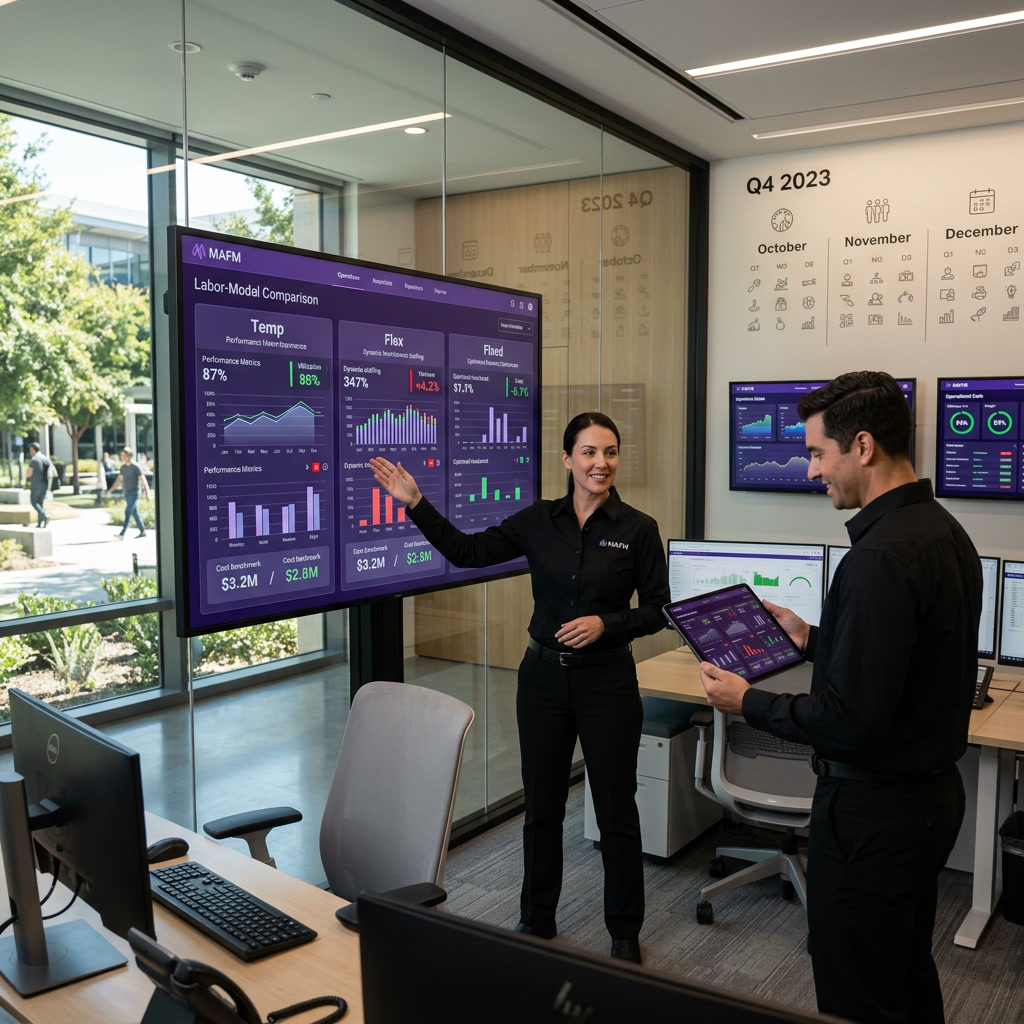
There are really three labor models available for closing a seasonal gap: temporary staffing through an agency, an internal flex pool built from cross-trained existing staff, and fixed seasonal headcount hired directly onto your payroll for a defined term. Each has a different cost structure, a different ramp-up time, and a different failure mode. A 200,000 square foot life sciences campus in Sunnyvale with cleanroom protocols has different constraints than a 40,000 square foot office building in downtown Palo Alto with a lobby, three conference floors, and a rotating cafeteria vendor. Choosing the wrong model doesn't just waste budget: it shows up as missed trash pulls during a board off-site, a spill response that takes 40 minutes instead of 8, or a compliance gap on a chemical log that nobody notices until an audit.
This post walks through the three models, what they actually cost when you account for onboarding and turnover, and how to match each one to the property type and demand pattern you're managing.
Agency temps are the default because they're the fastest lever to pull. Most Bay Area janitorial and maintenance staffing agencies can place a general cleaner within 3-5 business days and a floor tech or day porter within a week if you give them lead time. For a straightforward volume increase (more trash generation, more restroom checks, an extra pass on high-touch surfaces during flu season) this model works fine because the task complexity is low and the training curve is short.
The real cost of agency labor isn't the bill rate, which typically runs $28-$38/hour in Santa Clara and San Mateo counties depending on shift and scope. It's the markup layered on top, usually 35-55% over the worker's actual wage, combined with the productivity tax of a new person learning your building. A temp who doesn't know that the freight elevator on the west side jams if overloaded, or that Suite 220's carpet needs a different extraction chemical because of an old water stain, will cost you in redone work and tenant complaints even if their hourly rate looks reasonable on paper.
The other risk is inconsistency. Agencies reassign their best people to whichever client complains loudest or pays fastest, which means the temp who showed up reliably in week one might be pulled to another account in week three, right when your building's demand peaks for a holiday event. If you go this route, negotiate a dedicated-crew clause in your staffing agreement and require the agency to guarantee the same individuals for the full engagement period, not just "equivalent coverage."
A flex pool is a group of your existing staff (day porters, engineers, night crew leads) who are cross-trained to pick up extra shifts or extra scope during peak weeks, paid at an overtime or shift-differential rate rather than brought in cold. This model has almost no ramp-up cost because these are people who already know your building's quirks, your tenant handbook, and your emergency contacts. The tradeoff is that you have to build the bench before Q4 hits: cross-training in August and September, not November.
The math often favors flex pools for properties with technically complex systems. If your Q4 surge includes managing holiday lighting installations, temporary HVAC load from event spaces, or coordinating loading dock traffic for gift deliveries and catering, you want someone who already understands your BMS and your dock schedule, not a stranger learning it during your busiest week. Paying a senior day porter time-and-a-half to cover an extra shift is frequently cheaper than an agency markup once you factor in the zero training cost and near-zero error rate.
The limiting factor is capacity. You can't flex your way to double coverage if your base staff is already lean: and most Silicon Valley portfolios have been lean since 2023 budget cycles. A realistic flex pool can typically absorb a 15-25% demand increase before you need outside labor anyway. Beyond that threshold, you're combining models, which is normal and often the right answer: flex pool for the technical and tenant-facing work, temp labor for the volume work like extra trash runs and event teardown.
The option most facility managers skip is hiring direct, fixed-term seasonal staff: people on your own payroll or your FM provider's payroll, hired specifically for a 10-14 week window with a clear end date. This sits between the speed of a temp and the loyalty of a flex-pool employee. You get someone who trains for a full week before go-live, learns your building's specific protocols, and is contractually committed to you for the duration rather than reassignable by an agency dispatcher.
This model makes the most sense for demand patterns that are predictable and recurring, the same surge every November through January, at roughly the same intensity, for the same reasons: increased foot traffic from holiday events, package volume in mailrooms and loading docks, and janitorial load from client entertaining. If your property has run the same Q4 pattern for three years running, you have enough data to write a real job description, set a real end date, and skip the agency markup entirely.
The administrative cost is real (payroll setup, workers' comp classification, potentially unemployment insurance exposure at term end) which is why many facility teams route this through their FM partner rather than direct-hiring themselves. A provider that already carries workers' comp coverage, has an applicant pipeline from prior seasons, and can classify the role correctly under California's seasonal employment rules removes most of the administrative friction while still giving you the training and continuity benefits of direct hire.
Class A office towers with heavy tenant-facing lobbies and high visitor traffic during Q4 client events benefit most from flex pools for front-of-house roles (lobby ambassadors, day porters) combined with fixed seasonal hires for after-hours event turnover crews. The visibility of lobby and conference-floor work means untrained temps create reputational risk disproportionate to the labor cost saved.
Life sciences and R&D campuses with cleanroom or lab-adjacent janitorial requirements should lean almost entirely on flex pools and fixed seasonal hires, because agency temps typically can't clear the training and background requirements fast enough to be useful, and the compliance exposure of an untrained person in a controlled environment isn't worth the savings. Budget the training lead time, often 2-3 weeks for cleanroom gowning and chemical handling certification, into your September planning, not your November scramble.
Mixed-use retail and multi-tenant industrial parks with primarily volume-driven demand (more trash, more common-area cleaning, more parking lot maintenance from holiday shoppers or increased dock activity) are the best fit for straight agency temp labor, since the tasks are low-complexity and the demand is often short-duration around specific weeks like Black Friday week or the two weeks before year-end.
Data centers and critical-facility environments should treat this differently altogether: Q4 staffing gaps there are rarely about volume and almost always about ensuring redundant coverage for engineers during holiday PTO, which points toward overtime and flex-pool models exclusively, never temp agency labor for anything touching mechanical or electrical systems.
There's no single right staffing model for Q4: there's a right model for each layer of demand your property generates. The mistake most facility managers make isn't choosing the wrong model, it's choosing only one model for a season that actually has three or four different demand patterns stacked on top of each other. Map your surge by task type and risk level first, then assign the labor model that fits, and you'll spend less on markup while reducing the operational misses that actually damage tenant relationships.
MAFM builds hybrid Q4 staffing plans for Silicon Valley properties: combining our trained flex-pool technicians, direct seasonal hires, and vetted agency partnerships under one coordinated schedule. Contact us before October 1st to lock in seasonal crew availability ahead of the holiday crunch.
Link back to Monday's post on forecasting Q4 facility demand and Tuesday's post on auditing current headcount against holiday workload; reference Friday's upcoming synthesis post that will tie the week's staffing models into a single planning roadmap.
U.S. Bureau of Labor Statistics data on seasonal employment trends in building services (bls.gov); California EDD guidance on seasonal and temporary employment classification requirements.
MAFM offers comprehensive facility management solutions tailored to your business needs.
Get in Touch