Compliance
The Impact of California's 2026 Environmental Regulations on Facility Operations
March 4, 2026
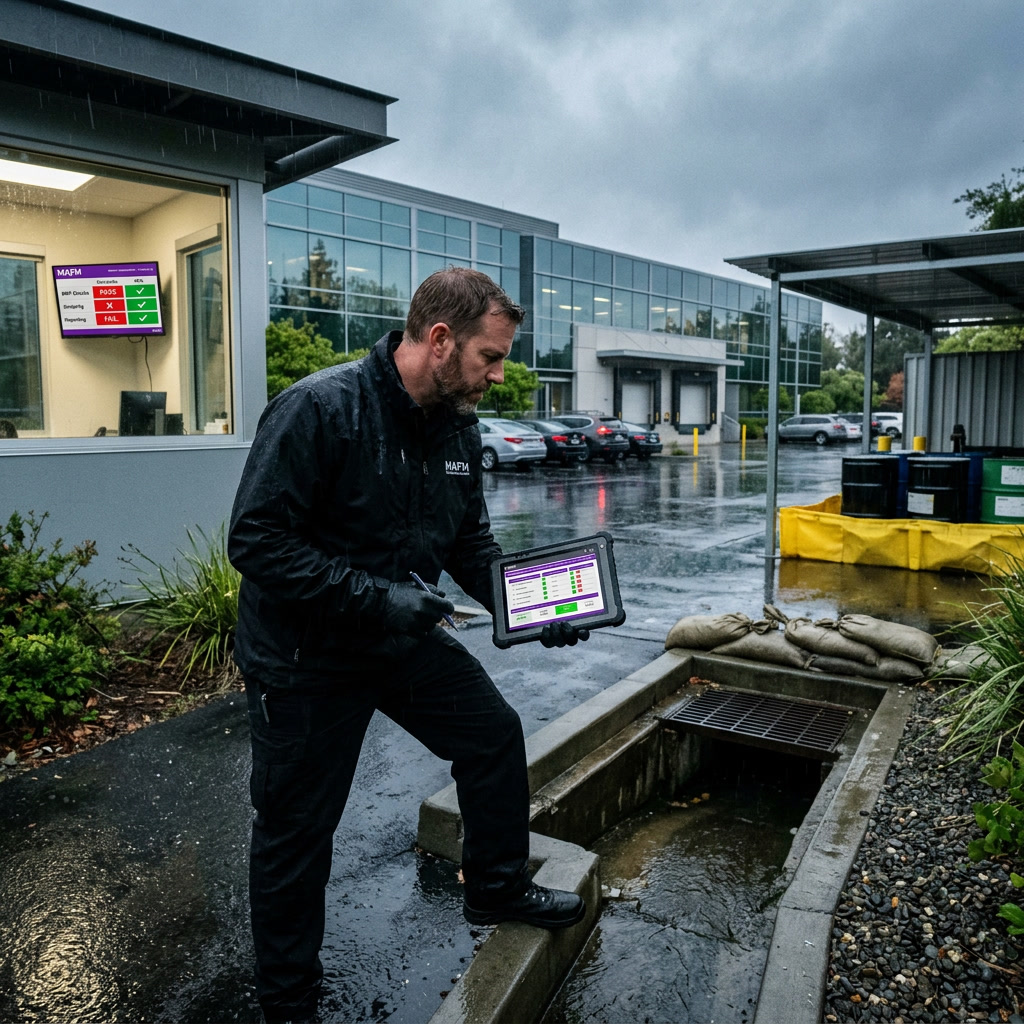
Every wet season, we field the same panicked call from at least one property owner in our portfolio: a Regional Water Quality Control Board notice has arrived, or worse, a neighbor or activist group has filed a citizen complaint under the Clean Water Act, and nobody at the facility can locate the current Stormwater Pollution Prevention Plan. This happens more often than it should in Silicon Valley, where a huge share of commercial and light-industrial sites are subject to California's Industrial General Permit (IGP) but treat the requirement as a filing-cabinet exercise rather than an operational program.
The IGP, administered by the State Water Resources Control Board under Order 2014-0057-DWQ, covers a wider swath of facilities than most owners realize. If your site conducts outdoor material handling, vehicle maintenance, outdoor storage, manufacturing, warehousing and distribution with truck loading docks, or metal fabrication, you may already be subject to permit coverage whether or not anyone has confirmed it in years. Santa Clara County's creeks all drain to South San Francisco Bay, a water body already impaired for several pollutants, which means regional water boards have real incentive to enforce here.
This post walks through what the permit actually requires on the ground: the plan itself, the sampling calendar, the inspection cadence, and the exceedance response process that trips up even experienced facility teams.
Coverage under the IGP is triggered by Standard Industrial Classification (SIC) code, not by how a building is marketed or leased. We've walked into buildings leased as "flex R&D space" that, based on the tenant's actual activity, qualified as covered facilities under codes for electronic component manufacturing or wholesale distribution. Landlords who assumed office-park zoning meant no exposure were wrong, and in two cases in Milpitas over the past three years, that assumption cost them retroactive enrollment plus penalties for the unpermitted discharge period.
The practical step we push every client toward is a formal applicability determination, not a guess. This means pulling the tenant's actual SIC code (or the closest match to actual operations, since self-reported codes on leases are notoriously unreliable), checking it against the list in Attachment A of the General Permit Order, and documenting the determination in writing even if the answer is "not covered." No Exposure Certification (NEC) is available for facilities where industrial materials and activities are fully sheltered from rain contact, but the NEC has strict conditions, including a mandatory annual site visit and photo documentation, and boards have been actively auditing NEC filers in the Bay Area since 2022.
Multi-tenant industrial parks are the trickiest case. A single park with six units might have three tenants covered, two exempt, and one borderline, and the property owner is typically the entity that holds permit responsibility even though tenants control day-to-day operations. This is where facility management needs to own the tracking, because tenant turnover means the applicability picture changes every time a lease rolls.
A Stormwater Pollution Prevention Plan that was written at initial permit enrollment and never touched again is one of the most common findings in board inspections. The SWPPP has to reflect current site conditions: current outdoor storage locations, current best management practices (BMPs) installed, current drainage map, and current responsible staff contacts. We've taken over accounts where the SWPPP listed a facility manager who left the company four years earlier and depicted a loading dock configuration that had been reconfigured twice since.
The permit requires an annual comprehensive facility evaluation, and that evaluation is supposed to drive SWPPP updates, not the other way around. Practically, this means walking the entire site footprint, checking every outdoor drainage path, confirming BMP condition (are the catch basin inserts saturated, are secondary containment berms cracked, is the good housekeeping around dumpster corrals actually happening), and updating the site map if anything has physically changed. Skipping this evaluation, or doing it as a desk exercise instead of a walk, is one of the most frequently cited deficiencies in Water Board inspection reports we've reviewed for prospective clients.
BMP selection also has to match what the site actually does, not a generic template. A facility with an outdoor loading dock handling electronic components needs different controls than one with outdoor vehicle fueling or metal shavings from machining operations. We've seen SWPPPs recycled from a boilerplate consultant template with BMPs that don't correspond to anything physically present on site, which is an easy target in an inspection and does nothing to actually prevent discharge.
Facilities under the IGP are required to collect stormwater samples during qualifying storm events, generally the first two events of the wet season with sampling windows spaced correctly apart, and analyze them for parameters tied to their industry sector, commonly pH, total suspended solids (TSS), and oil and grease, with additional parameters depending on SIC code. Missing the sampling window because nobody was on call during a storm is a permit violation in its own right, independent of what the results would have shown.
The permit sets Numeric Action Levels (NALs) for these parameters. Exceeding an NAL doesn't trigger an automatic fine, but it does trigger an Exceedance Response Action (ERA) process with real deadlines. A Level 1 ERA requires a qualified individual to evaluate the source of the exceedance and document corrective BMP additions within specific timeframes. A Level 2 ERA, triggered by exceeding the same parameter across multiple monitoring years, requires a more formal technical report, often prepared by a QSD (Qualified SWPPP Developer), evaluating whether additional structural controls or even a numeric effluent limit applies going forward.
The facilities that manage this well have a standing relationship with a QSD or environmental consultant before the wet season starts, not one they scramble to find after a Level 1 exceedance letter arrives. We coordinate this on behalf of several clients specifically because sampling has to happen within a tight window of a qualifying storm, sometimes with less than a day's notice depending on forecast timing, and facility staff without prior training and pre-staged sampling kits reliably miss the window.
When a Regional Water Quality Control Board inspector shows up, whether triggered by a complaint, a random audit, or a pattern of NAL exceedances reported through the Storm Water Multiple Application and Report Tracking System (SMARTS), they are not primarily looking at whether your SWPPP reads well. They are looking at whether the documented BMPs match physical reality, whether your annual comprehensive site evaluation actually happened (evidenced by dated photos and a completed checklist, not just a signature), and whether your sampling records show consistent, timely collection over multiple wet seasons.
SMARTS itself is a compliance point that gets overlooked. Annual reports, exceedance response reports, and permit registration documents (PRDs) all get filed through this system, and missed or late SMARTS filings are themselves a violation separate from any water quality issue. We keep a standing calendar for every enrolled client with SMARTS deadlines built in alongside sampling windows, because these dates don't move for anyone's fiscal year or ownership transition.
Recordkeeping retention matters too. The permit requires retaining SWPPP versions, monitoring data, and inspection records for a minimum period, and during a property sale or refinance, buyers' environmental counsel increasingly ask for this file directly. A clean, continuous compliance record has become a genuine due diligence asset in Silicon Valley industrial transactions, and a messy one has killed or delayed deals we've watched from the sidelines.
Stormwater compliance under the Industrial General Permit isn't a once-a-year filing exercise, it's a program that touches SIC code determinations, physical site conditions, wet-weather sampling logistics, and a state database that tracks deadlines with no grace period for busy facility teams. The cost of getting it wrong isn't hypothetical: NAL exceedances that escalate to Level 2 ERAs bring consultant fees and structural retrofit costs that dwarf what a properly staffed compliance program would have cost from the start, and enforcement actions attach to the property, following it through ownership changes.
If your facility hasn't had its SWPPP and applicability status reviewed in the last twelve months, or if you're not certain your site has a pre-arranged QSD relationship and sampling kit ready before the first qualifying storm, that's the gap worth closing before the wet season, not during it.
MAFM's compliance team manages SWPPP updates, annual site evaluations, wet-weather sampling coordination, and SMARTS filings for facilities across Santa Clara and San Mateo counties. Contact us to schedule a stormwater compliance audit before the 2026-2027 wet season begins.
Reference earlier posts this week on regulatory updates and compliance program structure (Monday's introduction to the week's compliance theme, and Tuesday/Wednesday's deep dives into related regulatory areas) as related reading for facility managers building out a comprehensive compliance calendar.
California State Water Resources Control Board Industrial General Permit (Order 2014-0057-DWQ) program page; U.S. EPA NPDES Stormwater Program overview for industrial facilities.
March 4, 2026
July 27, 2026
July 28, 2026
MAFM offers comprehensive facility management solutions tailored to your business needs.
Get in Touch